Schwappacher Raphaela, Dieterich Walburga, Reljic Dejan, Pilarsky Christian, Mukhopadhyay Debabrata, Chang David K, Biankin Andrew V, Siebler Jürgen, Herrmann Hans J, Neurath Markus F, Zopf Yurdagül
Medical Department 1, Friedrich-Alexander University Erlangen-Nürnberg, Ulmenweg 18, 91054 Erlangen, Germany.
Hector-Center for Nutrition, Exercise and Sports, Medical Department 1, Friedrich-Alexander University Erlangen-Nürnberg, Ulmenweg 18, 91054 Erlangen, Germany.
Cancers (Basel). 2021 Jul 29;13(15):3820. doi: 10.3390/cancers13153820.
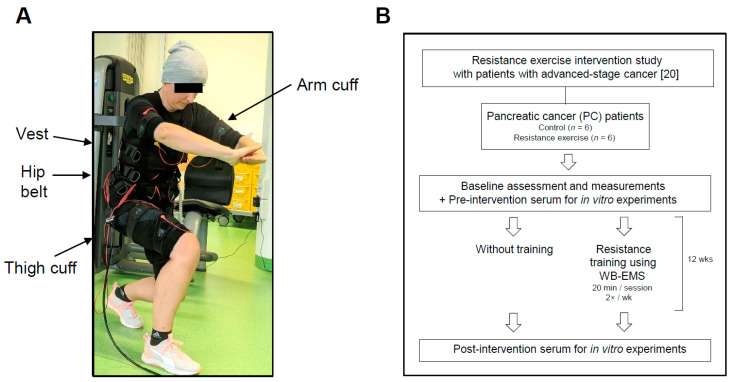
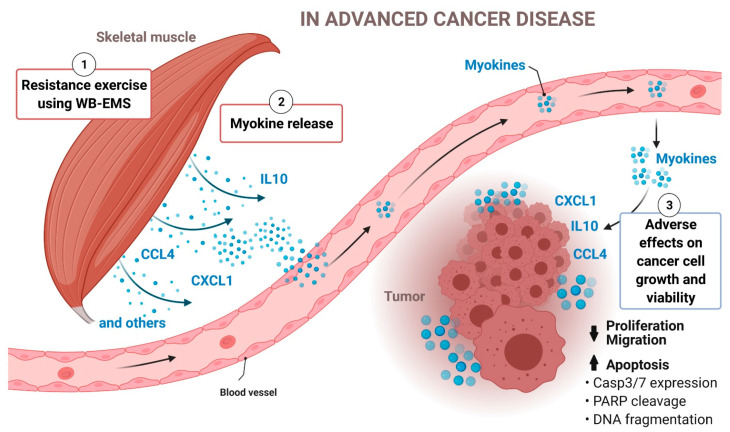
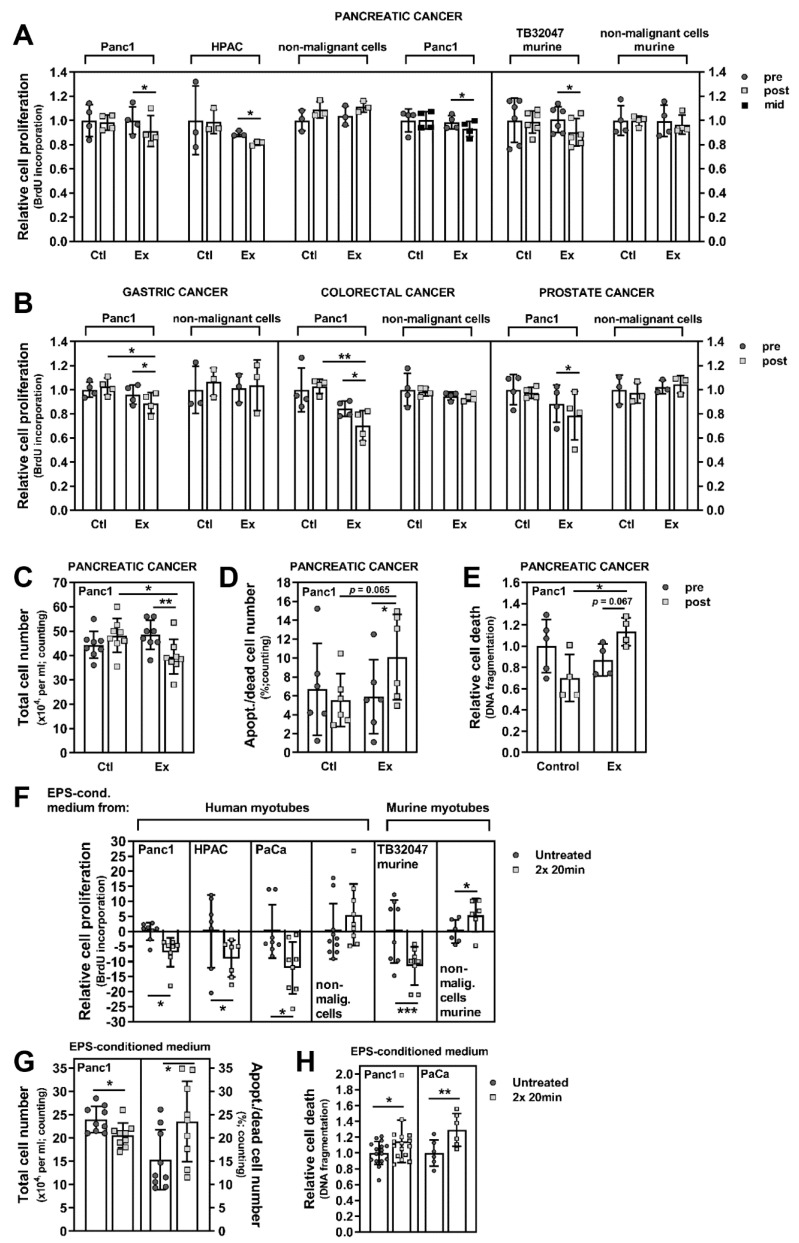
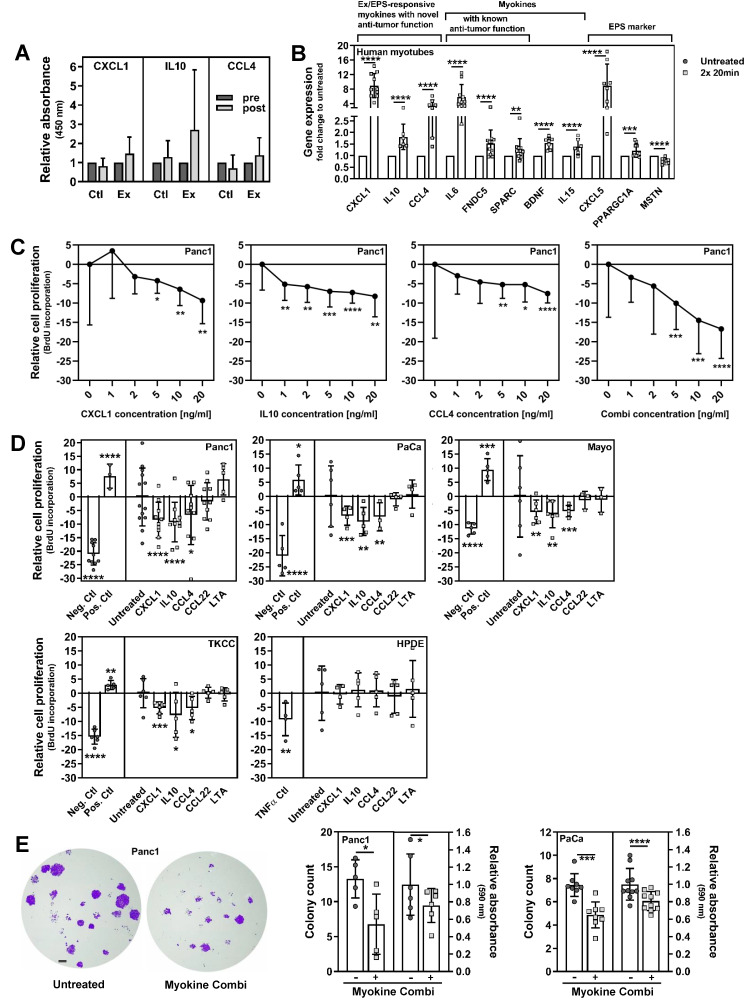
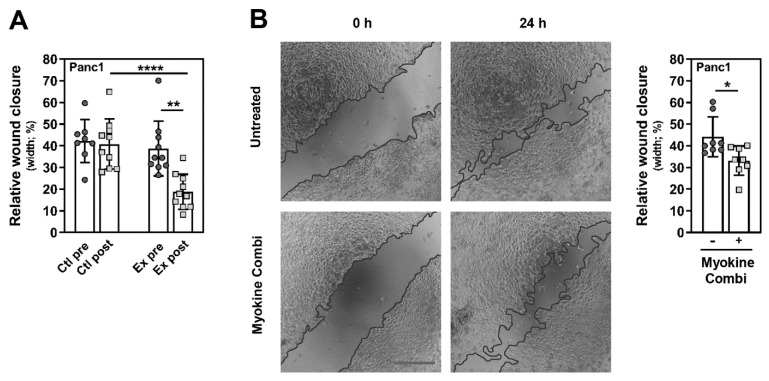
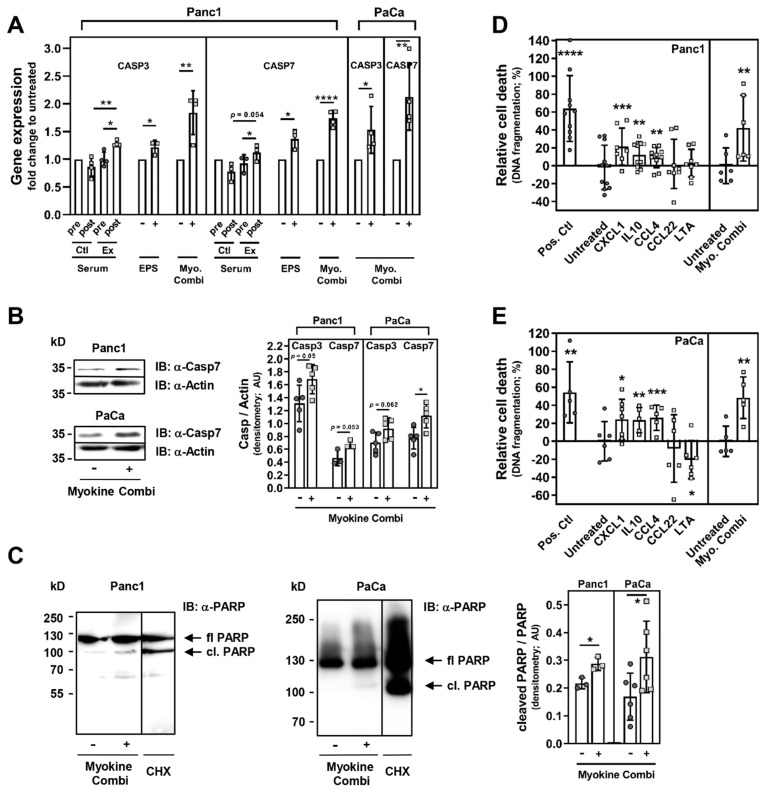
The evidence that regular physical exercise reduces the risk of developing cancer is well described. However, the interaction between physical exercise and cancer is not fully clarified yet. Several myokines released by skeletal muscle appear to have a direct anti-tumour function. There are few data on myokine secretion after exercise in patients with advanced tumours. Pancreatic cancer (PC) is a very aggressive and usually fatal cancer. To investigate the effects of exercise in PC, the blood of advanced-stage PC patients was analysed after 12 weeks of resistance training using whole-body electromyostimulation. After the 12-week training period, the patient serum inhibited the proliferation and the motility of PC cells and enhanced PC cell apoptosis. The impact of exercise training was also investigated in an exercise-mimicking in vitro model using electric pulse stimulation of human myotubes and revealed similar anti-tumour effects on PC cells, clearly indicating direct cancer-protective properties of activated skeletal muscle. Protein and gene expression analyses in plasma from exercise-trained patients and in myotube cultures after in vitro exercise showed that interleukin 10 (IL10), C-X-C motif ligand 1 (CXCL1) and C-C motif chemokine ligand 4 (CCL4) are myokines released from activated skeletal muscle. In accordance with the effects of serum from exercise-trained patients, the supplementation with recombinant IL10, CXCL1 and CCL4 impaired growth and migration of PC cells. Treatment of PC cells with these myokines upregulated caspase 3/7 expression and the cleavage of poly(ADP-ribose) polymerase, leading to enhanced PC cell death. The identification of myokines with anti-tumour properties in advanced-stage PC patients after exercise opens a new perspective in supportive therapy with sports and exercise for cancer patients.
经常进行体育锻炼可降低患癌风险,这方面的证据已有详尽描述。然而,体育锻炼与癌症之间的相互作用尚未完全阐明。骨骼肌释放的几种肌动蛋白似乎具有直接的抗肿瘤功能。关于晚期肿瘤患者运动后肌动蛋白分泌的数据较少。胰腺癌(PC)是一种极具侵袭性且通常致命的癌症。为了研究运动对胰腺癌的影响,使用全身肌电刺激对晚期胰腺癌患者进行了12周的抗阻训练后,分析了他们的血液。在为期12周的训练期后,患者血清抑制了胰腺癌细胞的增殖和运动能力,并增强了胰腺癌细胞的凋亡。还在一个模拟运动的体外模型中,通过对人肌管进行电脉冲刺激来研究运动训练的影响,结果显示对胰腺癌细胞具有类似的抗肿瘤作用,这清楚地表明了活化骨骼肌具有直接的抗癌特性。对运动训练患者血浆以及体外运动后肌管培养物进行的蛋白质和基因表达分析表明,白细胞介素10(IL10)、C-X-C基序配体1(CXCL1)和C-C基序趋化因子配体4(CCL4)是活化骨骼肌释放的肌动蛋白。与运动训练患者血清的作用一致,补充重组IL10、CXCL1和CCL4会损害胰腺癌细胞的生长和迁移。用这些肌动蛋白处理胰腺癌细胞会上调半胱天冬酶3/7的表达以及聚(ADP-核糖)聚合酶的裂解,导致胰腺癌细胞死亡增加。在晚期胰腺癌患者运动后鉴定出具有抗肿瘤特性的肌动蛋白,为癌症患者的运动支持治疗开辟了新的前景。