Wozny Anne-Sophie, Gauthier Arnaud, Alphonse Gersende, Malésys Céline, Varoclier Virginie, Beuve Michael, Brichart-Vernos Delphine, Magné Nicolas, Vial Nicolas, Ardail Dominique, Nakajima Tetsuo, Rodriguez-Lafrasse Claire
Cellular and Molecular Radiobiology Laboratory, Lyon-Sud Medical School, UMR CNRS5822/IP2I, Univ Lyon, Lyon 1 University, 69921 Oullins, France.
Department of Biochemistry and Molecular Biology, Lyon-Sud Hospital, Hospices Civils de Lyon, 69310 Pierre-Bénite, France.
Cancers (Basel). 2021 Jul 30;13(15):3833. doi: 10.3390/cancers13153833.
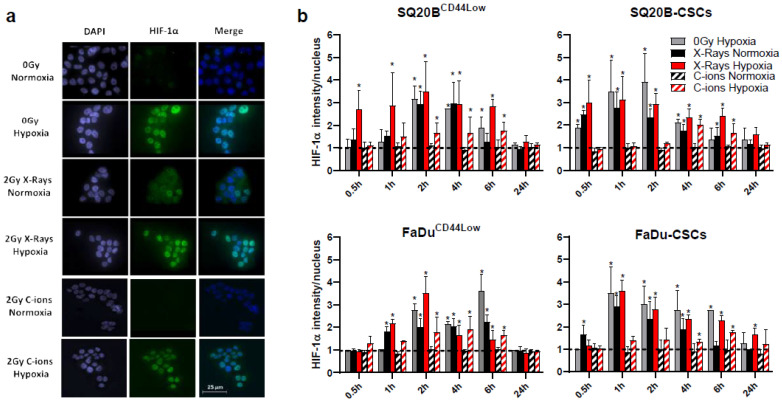
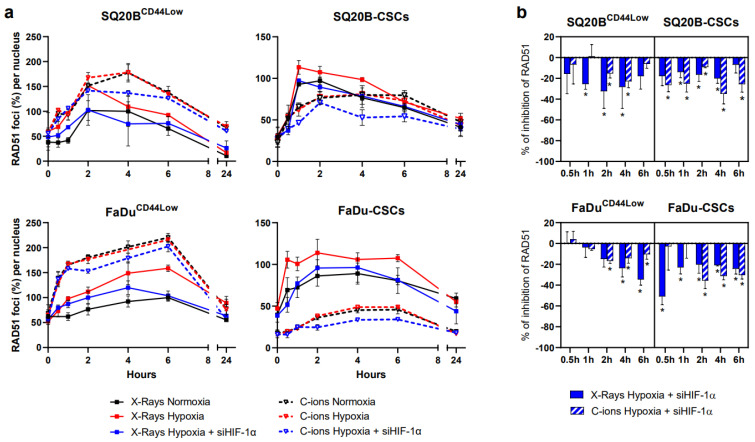
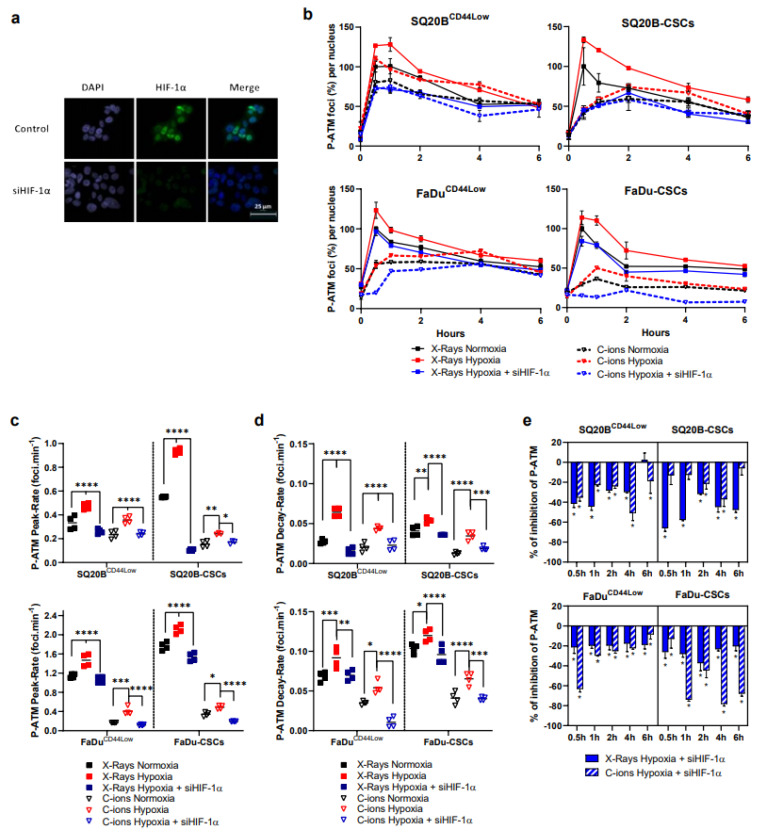
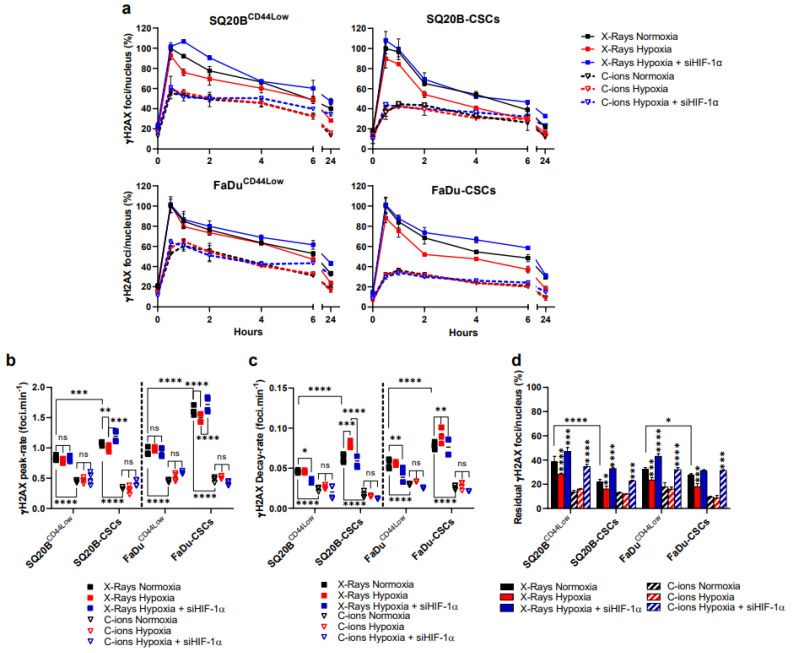
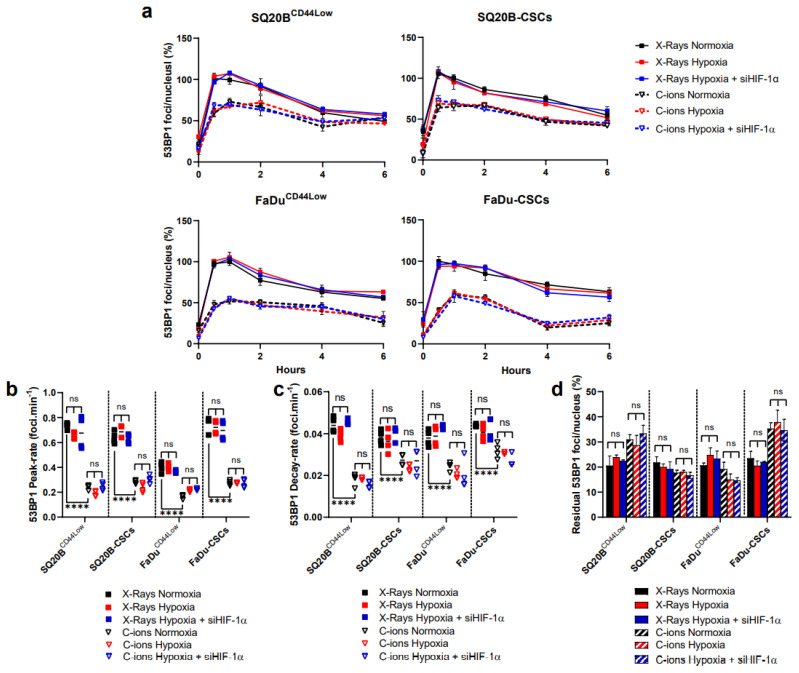
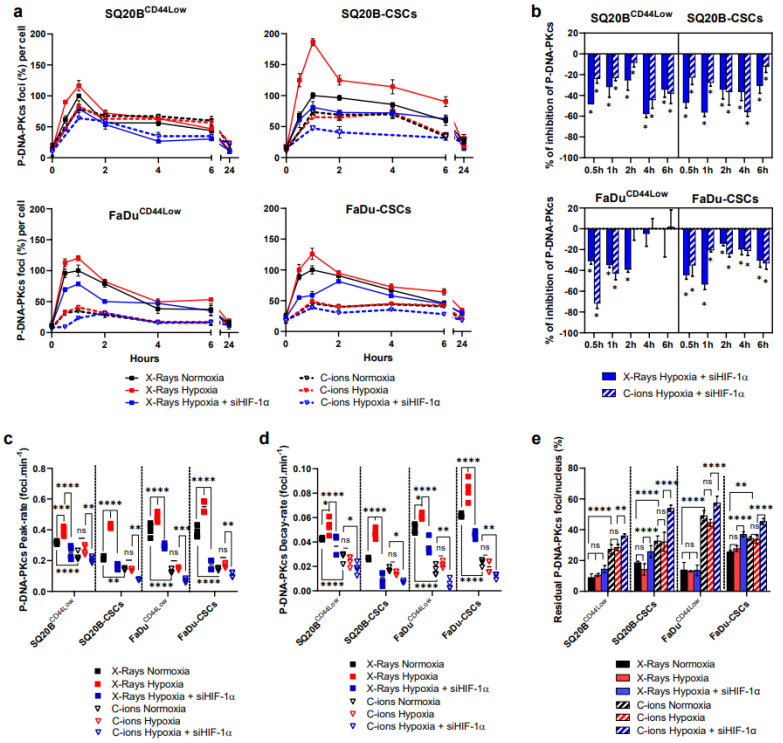
Hypoxia-Inducible Factor 1α (HIF-1α), which promotes cancer cell survival, is the main regulator of oxygen homeostasis. Hypoxia combined with photon and carbon ion irradiation (C-ions) stabilizes HIF-1α. Silencing HIF-1α under hypoxia leads to substantial radiosensitization of Head-and-Neck Squamous Cell Carcinoma (HNSCC) cells after both photons and C-ions. Thus, this study aimed to clarify a potential involvement of HIF-1α in the detection, signaling, and repair of DNA Double-Strand-Breaks (DSBs) in response to both irradiations, in two HNSCC cell lines and their subpopulations of Cancer-Stem Cells (CSCs). After confirming the nucleoshuttling of HIF-1α in response to both exposure under hypoxia, we showed that silencing HIF-1α in non-CSCs and CSCs decreased the initiation of the DSB detection (P-ATM), and increased the residual phosphorylated H2AX (γH2AX) foci. While HIF-1α silencing did not modulate 53BP1 expression, P-DNA-PKcs (NHEJ-c) and RAD51 (HR) signals decreased. Altogether, our experiments demonstrate the involvement of HIF-1α in the detection and signaling of DSBs, but also in the main repair pathways (NHEJ-c and HR), without favoring one of them. Combining HIF-1α silencing with both types of radiation could therefore present a potential therapeutic benefit of targeting CSCs mostly present in tumor hypoxic niches.
缺氧诱导因子1α(HIF-1α)可促进癌细胞存活,是氧稳态的主要调节因子。缺氧与光子和碳离子辐射(碳离子)相结合可使HIF-1α稳定。在缺氧条件下沉默HIF-1α会导致头颈部鳞状细胞癌(HNSCC)细胞在接受光子和碳离子辐射后产生显著的放射增敏作用。因此,本研究旨在阐明HIF-1α在两种HNSCC细胞系及其癌症干细胞(CSC)亚群中对两种辐射的DNA双链断裂(DSB)检测、信号传导和修复过程中的潜在作用。在确认缺氧条件下HIF-1α在两种辐射暴露后的核穿梭现象后,我们发现,在非CSC和CSC中沉默HIF-1α会减少DSB检测的起始(P-ATM),并增加残留的磷酸化H2AX(γH2AX)病灶。虽然HIF-1α沉默并未调节53BP1表达,但P-DNA-PKcs(NHEJ-c)和RAD51(HR)信号减少。总之,我们的实验证明HIF-1α参与了DSB的检测和信号传导,也参与了主要的修复途径(NHEJ-c和HR),但并未偏向其中之一。因此,将HIF-1α沉默与两种类型的辐射相结合可能对靶向肿瘤低氧微环境中主要存在的CSC具有潜在的治疗益处。