Vitelli-Storelli Facundo, Rubín-García María, Pelucchi Claudio, Benavente Yolanda, Bonzi Rossella, Rota Matteo, Palli Domenico, Ferraroni Monica, Lunet Nuno, Morais Samantha, Ye Weimin, Plymoth Amelie, Malekzadeh Reza, Tsugane Shoichiro, Hidaka Akihisa, Aragonés Nuria, Castaño-Vinyals Gemma, Zaridze David Georgievich, Maximovich Dmitry, Vioque Jesus, García-de-la-Hera Manuela, Zhang Zuo-Feng, Shigueaki Hamada Gerson, Pakseresht Mohammadreza, Pourfarzi Farhad, Mu Lina, Boccia Stefania, Pastorino Roberta, Yu Guo-Pei, Lagiou Areti, Lagiou Pagona, Negri Eva, La Vecchia Carlo, Martín Vicente
Grupo de Investigación en Interacciones Gen-Ambiente y Salud (GIIGAS), Institute of Biomedicine (IBIOMED), University of León, 24071 León, Spain.
Department of Clinical Sciences and Community Health, University of Milan, 20133 Milan, Italy.
Cancers (Basel). 2021 Jul 30;13(15):3844. doi: 10.3390/cancers13153844.
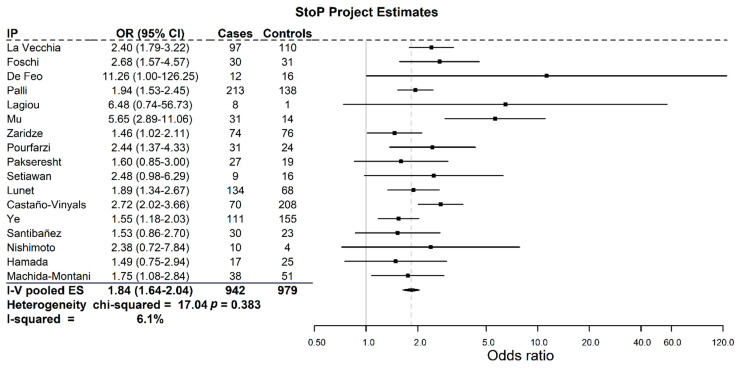
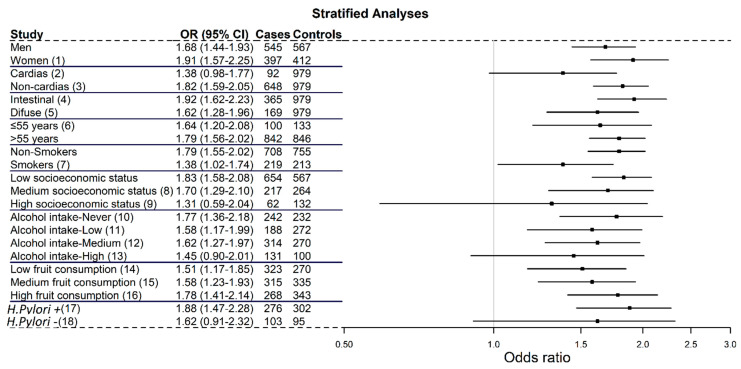
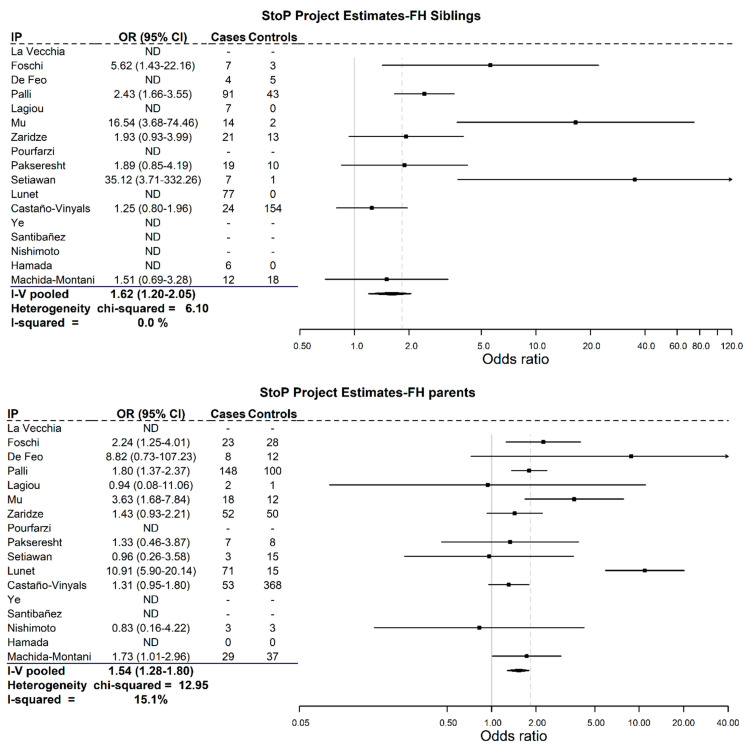
Although there is a clear relationship between family history (FH) and the risk of gastric cancer (GC), quantification is still needed in relation to different histological types and anatomical sites, and in strata of covariates. The objective was to analyze the risk of GC according to first-degree FH in a uniquely large epidemiological consortium of GC. This investigation includes 5946 cases and 12,776 controls from 17 studies of the Stomach Cancer Pooling (StoP) Project consortium. Summary odds ratios (OR) and the corresponding 95% confidence intervals (CIs) were calculated by pooling study-specific ORs using fixed-effect model meta-analysis techniques. Stratified analyses were carried out by sex, age, tumor location and histological type, smoking habit, socioeconomic status, alcohol intake and fruit consumption. The pooled OR for GC was 1.84 (95% CI: 1.64-2.04; I2 = 6.1%, P heterogeneity = 0.383) in subjects with vs. those without first-degree relatives with GC. No significant differences were observed among subgroups of sex, age, geographic area or study period. Associations tended to be stronger for non-cardia (OR = 1.82; 95% CI: 1.59-2.05 for subjects with FH) than for cardia GC (OR = 1.38; 95% CI: 0.98-1.77), and for the intestinal (OR = 1.92; 95% CI: 1.62-2.23) than for the diffuse histotype (OR = 1.62; 95% CI: 1.28-1.96). This analysis confirms the effect of FH on the risk of GC, reporting an approximately doubled risk, and provides further quantification of the risk of GC according to the subsite and histotype. Considering these findings, accounting for the presence of FH to carry out correct prevention and diagnosis measures is of the utmost importance.
尽管家族史(FH)与胃癌(GC)风险之间存在明确关联,但仍需要针对不同组织学类型、解剖部位以及协变量分层进行量化分析。目的是在一个规模独特的大型胃癌流行病学联盟中,根据一级家族史分析胃癌风险。本调查纳入了来自胃癌合并(StoP)项目联盟17项研究的5946例病例和12776例对照。采用固定效应模型荟萃分析技术合并各研究的比值比(OR),计算汇总OR及相应的95%置信区间(CI)。按性别、年龄、肿瘤位置、组织学类型、吸烟习惯、社会经济地位、饮酒量和水果摄入量进行分层分析。有胃癌一级亲属的受试者与无胃癌一级亲属的受试者相比,胃癌汇总OR为1.84(95%CI:1.64 - 2.04;I² = 6.1%,P异质性 = 0.383)。在性别、年龄、地理区域或研究时期的亚组中未观察到显著差异。非贲门癌的关联(有家族史受试者的OR = 1.82;95%CI:1.59 - 2.05)往往比贲门癌更强(OR = 1.38;95%CI:0.98 - 1.77),肠型(OR = 1.92;95%CI:1.62 - 2.23)比弥漫型组织学类型(OR = 1.62;95%CI:1.28 - 1.96)更强。该分析证实了家族史对胃癌风险的影响,报告风险增加约一倍,并根据亚部位和组织学类型进一步量化了胃癌风险。考虑到这些发现,考虑家族史的存在以实施正确的预防和诊断措施至关重要。