Vitale Candida, Boccellato Elia, Comba Lorenzo, Jones Rebecca, Perutelli Francesca, Griggio Valentina, Coscia Marta
University Division of Hematology, A. O. U. Città della Salute e della Scienza di Torino, Via Genova 3, 10126 Torino, Italy.
Department of Molecular Biotechnology and Health Sciences, University of Torino, Via Nizza 52, 10126 Torino, Italy.
Cancers (Basel). 2021 Jul 30;13(15):3856. doi: 10.3390/cancers13153856.
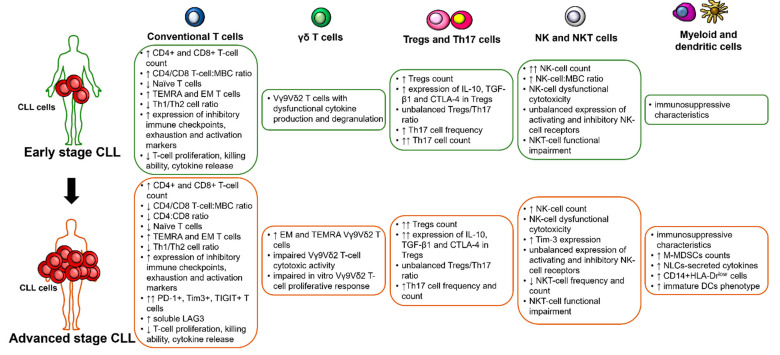
Chronic lymphocytic leukemia (CLL) is characterized by a wide spectrum of immune alterations, affecting both the innate and adaptive immunity. These immune dysfunctions strongly impact the immune surveillance, facilitate tumor progression and eventually affect the disease course. Quantitative and functional alterations involving conventional T cells, γδ T cells, regulatory T cells, NK and NKT cells, and myeloid cells, together with hypogammaglobulinemia, aberrations in the complement pathways and altered cytokine signature have been reported in patients with CLL. Some of these immune parameters have been shown to associate with other CLL-related characteristics with a known prognostic relevance or to correlate with disease prognosis. Also, in CLL, the complex immune response dysfunctions eventually translate in clinical manifestations, including autoimmune phenomena, increased risk of infections and second malignancies. These clinical issues are overall the most common complications that affect the course and management of CLL, and they also may impact overall disease prognosis.
慢性淋巴细胞白血病(CLL)的特征是存在广泛的免疫改变,影响固有免疫和适应性免疫。这些免疫功能障碍强烈影响免疫监视,促进肿瘤进展并最终影响疾病进程。据报道,CLL患者存在涉及传统T细胞、γδT细胞、调节性T细胞、NK和NKT细胞以及髓样细胞的数量和功能改变,同时伴有低丙种球蛋白血症、补体途径异常和细胞因子特征改变。其中一些免疫参数已被证明与其他具有已知预后相关性的CLL相关特征相关,或与疾病预后相关。此外,在CLL中,复杂的免疫反应功能障碍最终会转化为临床表现,包括自身免疫现象、感染风险增加和第二恶性肿瘤。这些临床问题总体上是影响CLL病程和管理的最常见并发症,它们也可能影响整体疾病预后。