Department of Molecular Pharmacology and Physiology, Morsani College of Medicine, University of South Florida, Tampa, FL 33612, USA.
Cells. 2021 Jul 2;10(7):1676. doi: 10.3390/cells10071676.
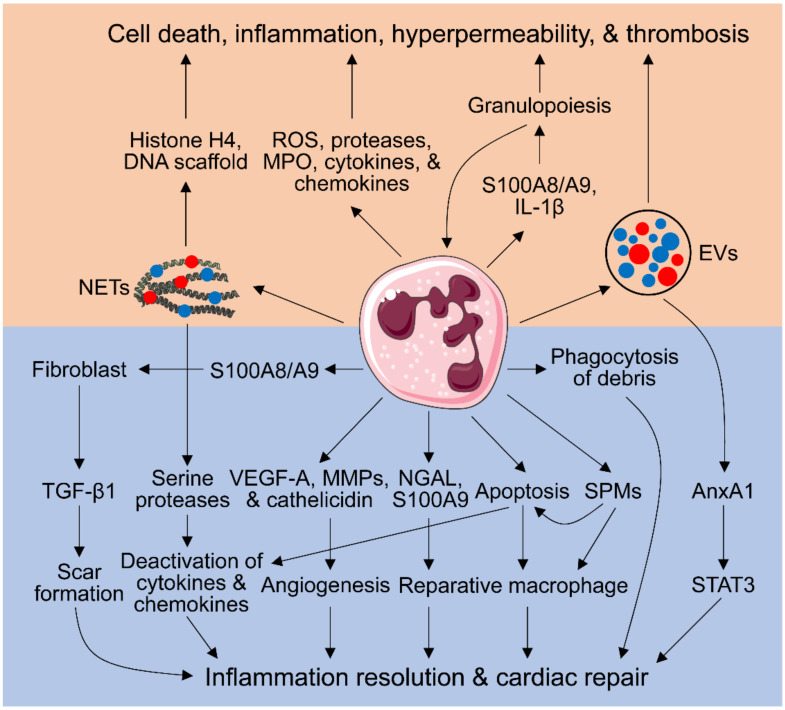
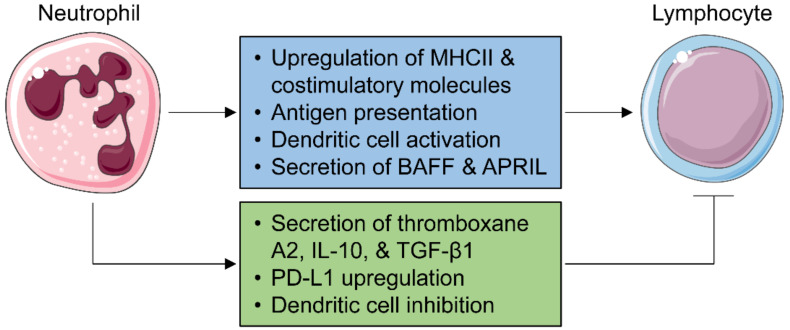
Neutrophils are first-line responders of the innate immune system. Following myocardial infarction (MI), neutrophils are quickly recruited to the ischemic region, where they initiate the inflammatory response, aiming at cleaning up dead cell debris. However, excessive accumulation and/or delayed removal of neutrophils are deleterious. Neutrophils can promote myocardial injury by releasing reactive oxygen species, granular components, and pro-inflammatory mediators. More recent studies have revealed that neutrophils are able to form extracellular traps (NETs) and produce extracellular vesicles (EVs) to aggravate inflammation and cardiac injury. On the contrary, there is growing evidence showing that neutrophils also exert anti-inflammatory, pro-angiogenic, and pro-reparative effects, thus facilitating inflammation resolution and cardiac repair. In this review, we summarize the current knowledge on neutrophils' detrimental roles, highlighting the role of recently recognized NETs and EVs, followed by a discussion of their beneficial effects and molecular mechanisms in post-MI cardiac remodeling. In addition, emerging concepts about neutrophil diversity and their modulation of adaptive immunity are discussed.
中性粒细胞是先天免疫系统的一线反应者。心肌梗死后(MI),中性粒细胞迅速募集到缺血区域,启动炎症反应,旨在清除死亡细胞碎片。然而,中性粒细胞的过度积聚和/或清除延迟是有害的。中性粒细胞通过释放活性氧物质、颗粒成分和促炎介质来促进心肌损伤。最近的研究表明,中性粒细胞能够形成细胞外陷阱(NETs)并产生细胞外囊泡(EVs),从而加重炎症和心脏损伤。相反,越来越多的证据表明,中性粒细胞也发挥抗炎、促血管生成和促进修复的作用,从而促进炎症的消退和心脏的修复。在这篇综述中,我们总结了中性粒细胞的有害作用的最新知识,重点介绍了最近发现的 NETs 和 EVs 的作用,然后讨论了它们在 MI 后心脏重构中的有益作用和分子机制。此外,还讨论了中性粒细胞多样性及其对适应性免疫的调节的新观点。