Department of Clinical and Experimental Medicine, University Hospital of Messina, 98122 Messina, Italy.
Department of Cognitive Sciences, Psychology, Education and Cultural Studies, University of Messina, 98121 Messina, Italy.
Int J Environ Res Public Health. 2021 Jul 31;18(15):8144. doi: 10.3390/ijerph18158144.
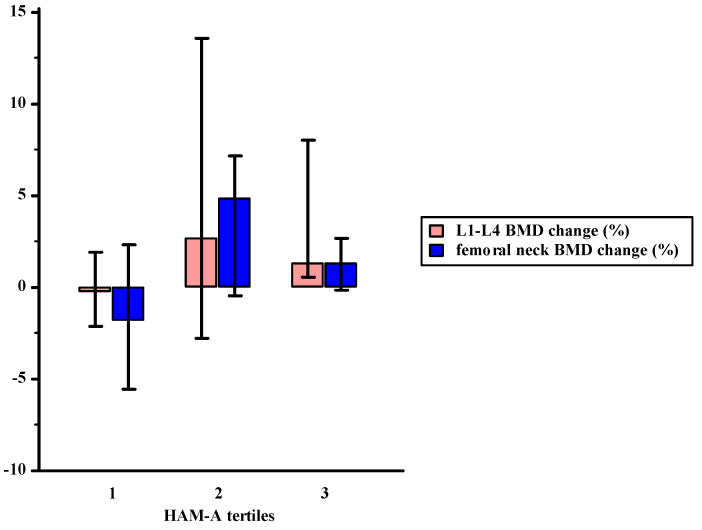
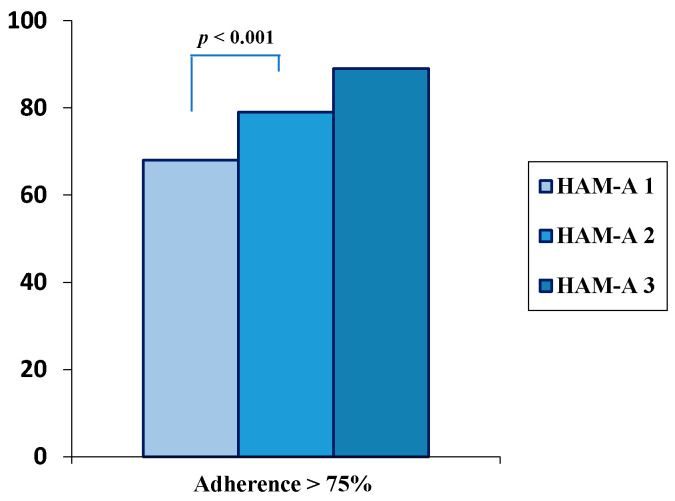
Clinical psychological factors may predict medical diseases. Anxiety level has been associated with osteoporosis, but its role on bone mineral density (BMD) change is still unknown. This study aimed to investigate the association between anxiety levels and both adherence and treatment response to oral bisphosphonates (BPs) in postmenopausal osteoporosis. BMD and anxiety levels were evaluated trough dual-energy X-ray absorptiometry and the Hamilton Anxiety Rating Scale (HAM-A), respectively. Participants received weekly medication with alendronate or risedronate and were grouped according to the HAM-A scores into tertiles (HAM-A 3 > HAM-A 2 > HAM-A 1). After 24 months, BMD changes were different among the HAM-A tertiles. The median lumbar BMD change was significantly greater in both the HAM-A 2 and HAM-A 3 in comparison with the HAM-A 1. The same trend was observed for femoral BMD change. Adherence to BPs was >75% in 68% of patients in the HAM-A 1, 79% of patients in the HAM-A 2, and 89% of patients in the HAM-A 3 ( = 0.0014). After correcting for age, body mass index, depressive symptoms, and the 10-yr. probability of osteoporotic fractures, anxiety levels independently predicted lumbar BMD change (β = 0.3417, SE 0.145, = 0.02). In conclusion, women with higher anxiety levels reported greater BMD improvement, highlighting that anxiety was associated with adherence and response to osteoporosis medical treatment, although further research on this topic is needed.
临床心理因素可能预测医学疾病。焦虑水平与骨质疏松症有关,但它对骨密度(BMD)变化的作用尚不清楚。本研究旨在探讨焦虑水平与绝经后骨质疏松症患者口服双膦酸盐(BPs)的依从性和治疗反应之间的关系。BMD 和焦虑水平分别通过双能 X 射线吸收法和汉密尔顿焦虑量表(HAM-A)进行评估。参与者每周接受阿伦膦酸盐或利塞膦酸盐治疗,并根据 HAM-A 评分分为三分位(HAM-A3>HAM-A2>HAM-A1)。24 个月后,HAM-A 三分位之间的 BMD 变化不同。与 HAM-A1 相比,HAM-A2 和 HAM-A3 的腰椎 BMD 变化中位数显著更大。股骨 BMD 变化也呈现出相同的趋势。在 HAM-A1 中,有 68%的患者 BPs 依从性>75%,在 HAM-A2 中,有 79%的患者 BPs 依从性>75%,在 HAM-A3 中,有 89%的患者 BPs 依从性>75%(=0.0014)。在校正年龄、体重指数、抑郁症状和 10 年骨质疏松性骨折概率后,焦虑水平独立预测腰椎 BMD 变化(β=0.3417,SE 0.145,=0.02)。总之,焦虑水平较高的女性报告 BMD 改善更大,这表明焦虑与骨质疏松症治疗的依从性和反应有关,但需要进一步研究这一课题。