Department of Physiology, Faculty of Medicine, University of Debrecen, Egyetem tér 1, 4032 Debrecen, Hungary.
Doctoral School of Molecular Medicine, University of Debrecen, Egyetem tér 1, 4032 Debrecen, Hungary.
Int J Mol Sci. 2021 Jul 21;22(15):7776. doi: 10.3390/ijms22157776.
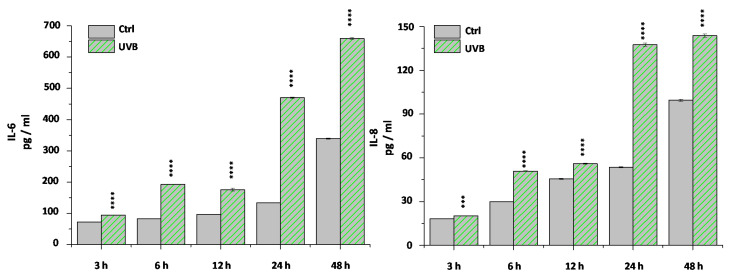
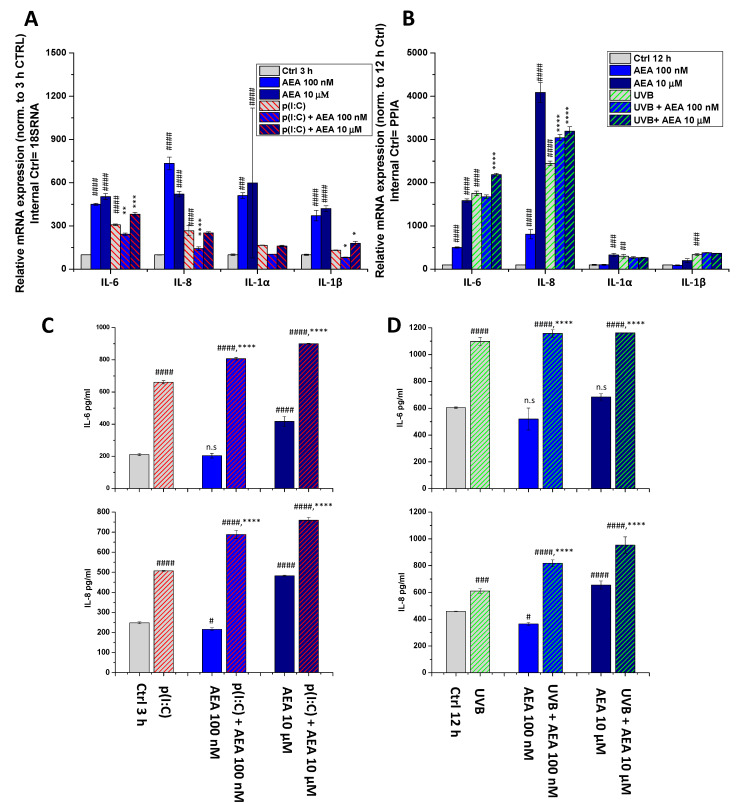
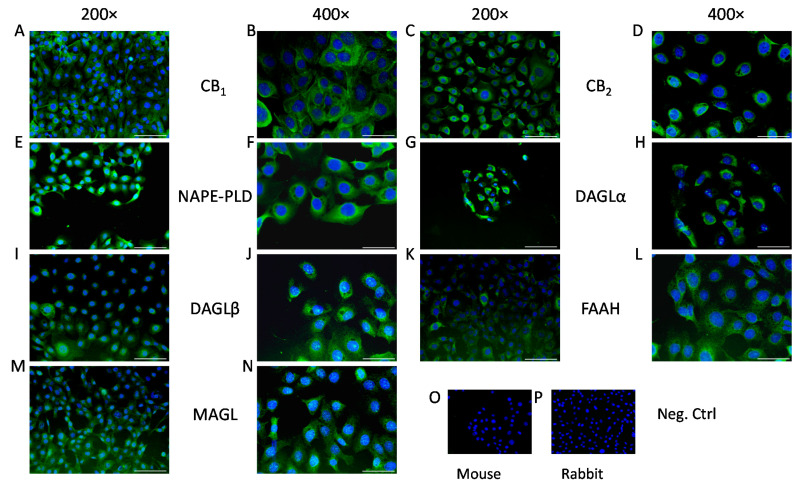
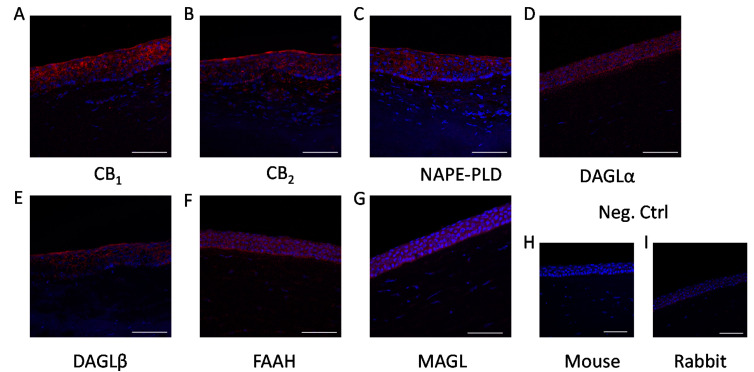
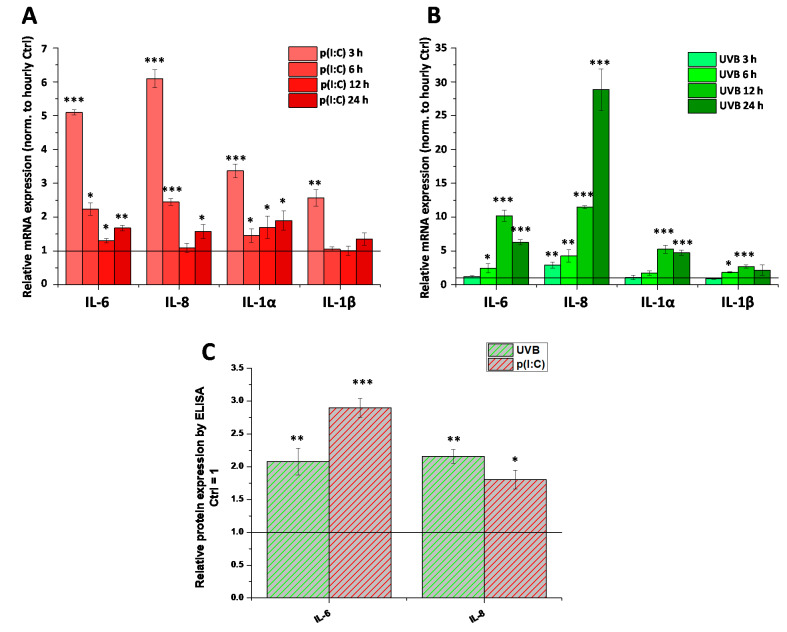
Photodamage-induced and viral keratitis could benefit from treatment with novel nonsteroid anti-inflammatory agents. Therefore, we determined whether human corneal epithelial cells (HCECs) express members of the endocannabinoid system (ECS), and examined how the endocannabinoid anandamide (AEA, N-arachidonoyl ethanolamine) influences the Toll-like receptor 3 (TLR3) agonism- or UVB irradiation-induced inflammatory response of these cells. Other than confirming the presence of cannabinoid receptors, we show that endocannabinoid synthesizing and catabolizing enzymes are also expressed in HCECs in vitro, as well as in the epithelial layer of the human cornea in situ, proving that they are one possible source of endocannabinoids. p(I:C) and UVB irradiation was effective in promoting the transcription and secretion of inflammatory cytokines. Surprisingly, when applied alone in 100 nM and 10 μM, AEA also resulted in increased pro-inflammatory cytokine production. Importantly, AEA further increased levels of these cytokines in the UVB model, whereas its lower concentration partially prevented the transcriptional effect of p(I:C), while not decreasing the p(I:C)-induced cytokine release. HCECs express the enzymatic machinery required to produce endocannabinoids both in vitro and in situ. Moreover, our data show that, despite earlier reports about the anti-inflammatory potential of AEA in murine cornea, its effects on the immune phenotype of human corneal epithelium may be more complex and context dependent.
光损伤和病毒角膜炎可以受益于新型非甾体抗炎药的治疗。因此,我们确定人角膜上皮细胞(HCEC)是否表达内源性大麻素系统(ECS)的成员,并研究内源性大麻素花生四烯酸乙醇胺(AEA,N-花生四烯酰乙醇胺)如何影响这些细胞的 Toll 样受体 3(TLR3)激动剂或 UVB 照射诱导的炎症反应。除了证实大麻素受体的存在外,我们还表明,内源性大麻素合成和代谢酶也在体外的 HCEC 中表达,以及在原位的人角膜上皮层中表达,证明它们是内源性大麻素的一个可能来源。p(I:C)和 UVB 照射有效地促进了炎症细胞因子的转录和分泌。令人惊讶的是,当单独以 100 nM 和 10 μM 的浓度应用时,AEA 也导致促炎细胞因子的产生增加。重要的是,AEA 在 UVB 模型中进一步增加了这些细胞因子的水平,而其较低的浓度部分阻止了 p(I:C)的转录效应,而不减少 p(I:C)诱导的细胞因子释放。HCEC 在体外和原位表达产生内源性大麻素所需的酶机制。此外,我们的数据表明,尽管早期有报道称 AEA 在小鼠角膜中具有抗炎潜力,但它对人角膜上皮细胞免疫表型的影响可能更复杂,且依赖于上下文。