Laboratory of Endocrinology, Research Institute of Clinical and Experimental Lymphology-Branch of the Institute of Cytology and Genetics, Siberian Branch of Russian Academy of Sciences (RICEL-Branch of IC&G SB RAS), 630060 Novosibirsk, Russia.
Laboratory of Computer Proteomics, Federal Research Center Institute of Cytology and Genetics, Siberian Branch of the Russian Academy of Sciences (IC&G SB RAS), 630090 Novosibirsk, Russia.
Int J Mol Sci. 2021 Jul 21;22(15):7783. doi: 10.3390/ijms22157783.
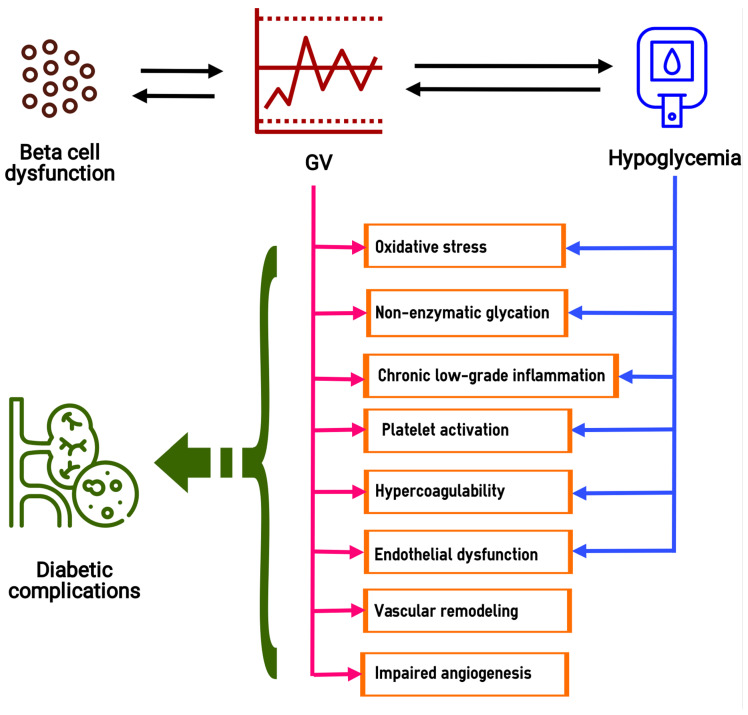
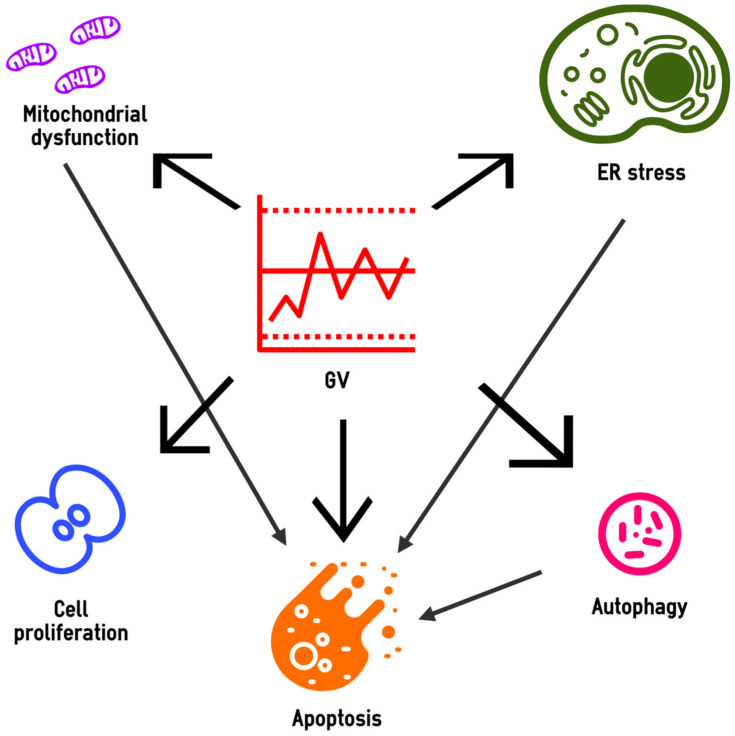
A growing body of evidence points to the role of glucose variability (GV) in the development of the microvascular and macrovascular complications of diabetes. In this review, we summarize data on GV-induced biochemical, cellular and molecular events involved in the pathogenesis of diabetic complications. Current data indicate that the deteriorating effect of GV on target organs can be realized through oxidative stress, glycation, chronic low-grade inflammation, endothelial dysfunction, platelet activation, impaired angiogenesis and renal fibrosis. The effects of GV on oxidative stress, inflammation, endothelial dysfunction and hypercoagulability could be aggravated by hypoglycemia, associated with high GV. Oscillating hyperglycemia contributes to beta cell dysfunction, which leads to a further increase in GV and completes the vicious circle. In cells, the GV-induced cytotoxic effect includes mitochondrial dysfunction, endoplasmic reticulum stress and disturbances in autophagic flux, which are accompanied by reduced viability, activation of apoptosis and abnormalities in cell proliferation. These effects are realized through the up- and down-regulation of a large number of genes and the activity of signaling pathways such as PI3K/Akt, NF-κB, MAPK (ERK), JNK and TGF-β/Smad. Epigenetic modifications mediate the postponed effects of glucose fluctuations. The multiple deteriorative effects of GV provide further support for considering it as a therapeutic target in diabetes.
越来越多的证据表明葡萄糖变异性(GV)在糖尿病微血管和大血管并发症的发展中起作用。在这篇综述中,我们总结了 GV 诱导的与糖尿病并发症发病机制相关的生化、细胞和分子事件的数据。目前的数据表明,GV 对靶器官的恶化作用可以通过氧化应激、糖基化、慢性低度炎症、内皮功能障碍、血小板激活、血管生成受损和肾纤维化来实现。与高 GV 相关的低血糖会加剧 GV 对氧化应激、炎症、内皮功能障碍和高凝状态的影响。波动的高血糖有助于β细胞功能障碍,从而进一步增加 GV,并完成恶性循环。在细胞中,GV 诱导的细胞毒性作用包括线粒体功能障碍、内质网应激和自噬流紊乱,同时伴有活力降低、细胞凋亡激活和细胞增殖异常。这些作用是通过大量基因的上调和下调以及 PI3K/Akt、NF-κB、MAPK(ERK)、JNK 和 TGF-β/Smad 等信号通路的活性来实现的。表观遗传修饰介导了葡萄糖波动的迟发效应。GV 的多种恶化作用为将其视为糖尿病的治疗靶点提供了进一步的支持。