Department of Ophthalmology and Visual Sciences, University of Illinois at Chicago, Chicago, IL 60612, USA.
Department of Microbiology and Immunology, University of Illinois at Chicago, Chicago, IL 60612, USA.
Int J Mol Sci. 2021 Jul 23;22(15):7856. doi: 10.3390/ijms22157856.
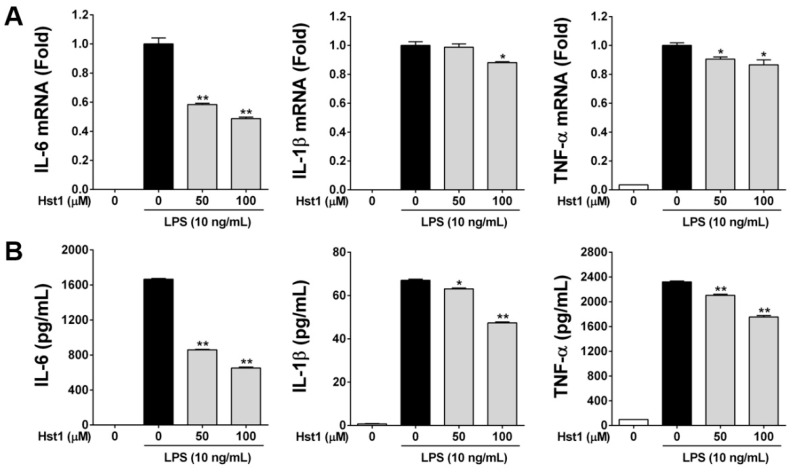
Macrophages play a critical role in the inflammatory response to environmental triggers, such as lipopolysaccharide (LPS). Inflammatory signaling through macrophages and the innate immune system are increasingly recognized as important contributors to multiple acute and chronic disease processes. Nitric oxide (NO) is a free radical that plays an important role in immune and inflammatory responses as an important intercellular messenger. In addition, NO has an important role in inflammatory responses in mucosal environments such as the ocular surface. Histatin peptides are well-established antimicrobial and wound healing agents. These peptides are important in multiple biological systems, playing roles in responses to the environment and immunomodulation. Given the importance of macrophages in responses to environmental triggers and pathogens, we investigated the effect of histatin-1 (Hst1) on LPS-induced inflammatory responses and the underlying molecular mechanisms in RAW264.7 (RAW) macrophages. LPS-induced inflammatory signaling, NO production and cytokine production in macrophages were tested in response to treatment with Hst1. Hst1 application significantly reduced LPS-induced NO production, inflammatory cytokine production, and inflammatory signaling through the JNK and NF-kB pathways in RAW cells. These results demonstrate that Hst1 can inhibit LPS-induced inflammatory mediator production and MAPK signaling pathways in macrophages.
巨噬细胞在对外界环境刺激物(如脂多糖(LPS))的炎症反应中起着关键作用。巨噬细胞和先天免疫系统的炎症信号转导越来越被认为是多种急性和慢性疾病过程的重要贡献者。一氧化氮(NO)是一种自由基,作为一种重要的细胞间信使,在免疫和炎症反应中起着重要作用。此外,NO 在眼表面等黏膜环境的炎症反应中也起着重要作用。组蛋白肽是成熟的抗菌和伤口愈合剂。这些肽在多个生物系统中发挥作用,在应对环境和免疫调节方面发挥作用。鉴于巨噬细胞在对外界环境刺激物和病原体的反应中的重要性,我们研究了组蛋白-1(Hst1)对 RAW264.7(RAW)巨噬细胞中 LPS 诱导的炎症反应及其潜在分子机制的影响。检测了 Hst1 处理后巨噬细胞中 LPS 诱导的炎症信号转导、NO 产生和细胞因子产生。Hst1 的应用显著降低了 RAW 细胞中 LPS 诱导的 NO 产生、炎症细胞因子产生以及 JNK 和 NF-kB 途径的炎症信号转导。这些结果表明,Hst1 可以抑制巨噬细胞中 LPS 诱导的炎症介质产生和 MAPK 信号通路。