Guangdong Provincial Key Laboratory of Protein Function and Regulation in Agricultural Organisms, College of Life Sciences, South China Agricultural University, Tianhe District, Guangzhou 510642, China.
Key Laboratory of Zoonosis of Ministry of Agriculture and Rural Affairs, South China Agricultural University, Guangzhou 510642, China.
Int J Mol Sci. 2021 Jul 25;22(15):7936. doi: 10.3390/ijms22157936.
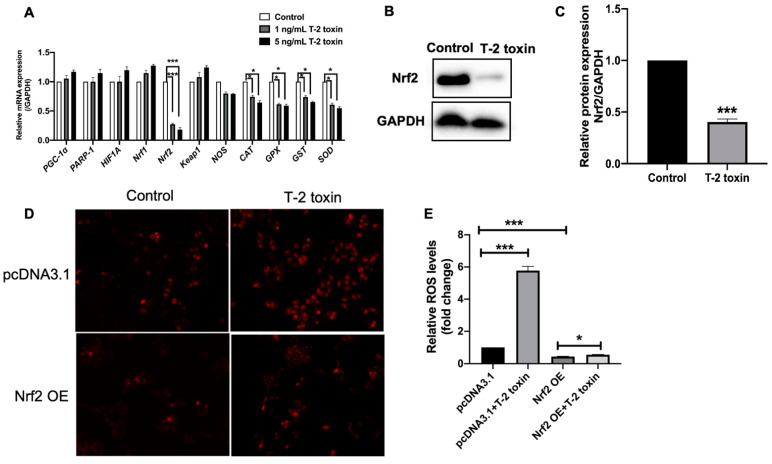
T-2 toxin is mainly produced by species, which is an extremely toxic mycotoxin to humans and animals. It is well known that T-2 toxin induces oxidative stress, but the molecular mechanism is still unknown. In this study, we found that T-2 toxin significantly promoted reactive oxygen species (ROS) accumulation in MCF-7 cells at low doses which maintains cell viability at least 80%. Further analysis showed that T-2 toxin downregulated the expression of the master regulator of antioxidant defense gene, nuclear factor erythroid 2-related factor (), and its targeted antioxidant genes. Overexpression of Nrf2 or its target gene heme oxygenase 1 (HO1) significantly blocked the ROS accumulation in MCF-7 cells under T-2 toxin treatment. Moreover, we found that T-2 toxin downregulated the antioxidant genes via inducing the expression of ATF3ΔZip2a/2b. Importantly, overexpression of ATF3ΔZip2a/2b promoted the ubiquitination and degradation of Nrf2. Altogether, our results demonstrated that T-2 toxin-induced ROS accumulation via ATF3ΔZip2a/2b mediated ubiquitination and degradation of Nrf2, which provided a new insight into the mechanism of T-2 toxin-induced oxidative stress.
T-2 毒素主要由 产生,对人类和动物具有极强的毒性。众所周知,T-2 毒素会引起氧化应激,但分子机制尚不清楚。在本研究中,我们发现 T-2 毒素在低剂量下可显著促进 MCF-7 细胞中活性氧(ROS)的积累,同时保持细胞活力至少 80%。进一步分析表明,T-2 毒素下调了抗氧化防御基因的主要调控因子核因子红细胞 2 相关因子(Nrf2)及其靶向抗氧化基因的表达。在 T-2 毒素处理下,Nrf2 或其靶基因血红素加氧酶 1(HO1)的过表达可显著阻止 ROS 的积累。此外,我们发现 T-2 毒素通过诱导 ATF3ΔZip2a/2b 的表达下调抗氧化基因。重要的是,ATF3ΔZip2a/2b 的过表达促进了 Nrf2 的泛素化和降解。总之,我们的结果表明,T-2 毒素通过 ATF3ΔZip2a/2b 介导的 Nrf2 泛素化和降解诱导 ROS 积累,为 T-2 毒素诱导的氧化应激机制提供了新的见解。