V. Zelman Center for Neurobiology and Brain Restoration, Skolkovo Institute of Science and Technology, 121205 Moscow, Russia.
Faculty of Bioengineering and Bioinformatics, Moscow State University, 119234 Moscow, Russia.
Int J Mol Sci. 2021 Jul 28;22(15):8089. doi: 10.3390/ijms22158089.
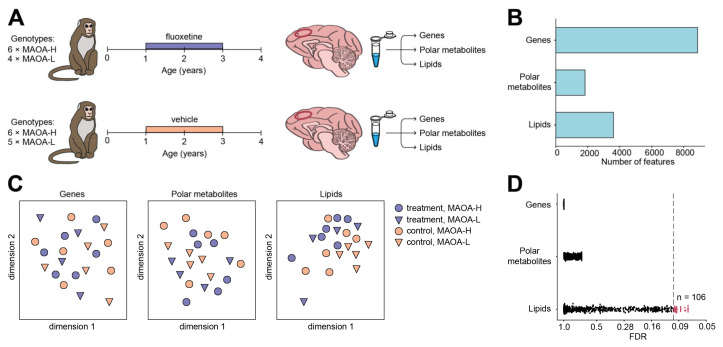
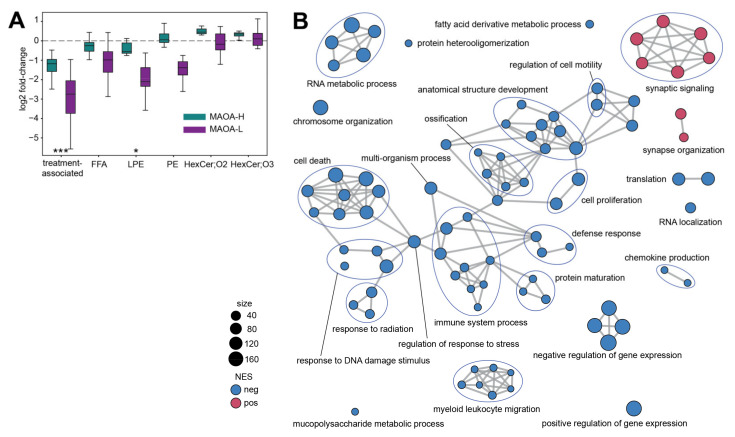
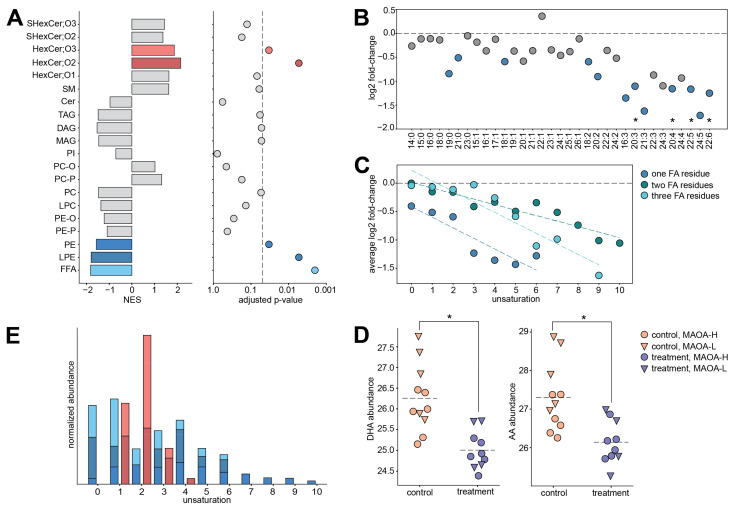
Fluoxetine is an antidepressant commonly prescribed not only to adults but also to children for the treatment of depression, obsessive-compulsive disorder, and neurodevelopmental disorders. The adverse effects of the long-term treatment reported in some patients, especially in younger individuals, call for a detailed investigation of molecular alterations induced by fluoxetine treatment. Two-year fluoxetine administration to juvenile macaques revealed effects on impulsivity, sleep, social interaction, and peripheral metabolites. Here, we built upon this work by assessing residual effects of fluoxetine administration on the expression of genes and abundance of lipids and polar metabolites in the prelimbic cortex of 10 treated and 11 control macaques representing two monoamine oxidase A () genotypes. Analysis of 8871 mRNA transcripts, 3608 lipids, and 1829 polar metabolites revealed substantial alterations of the brain lipid content, including significant abundance changes of 106 lipid features, accompanied by subtle changes in gene expression. Lipid alterations in the drug-treated animals were most evident for polyunsaturated fatty acids (PUFAs). A decrease in PUFAs levels was observed in all quantified lipid classes excluding sphingolipids, which do not usually contain PUFAs, suggesting systemic changes in fatty acid metabolism. Furthermore, the residual effect of the drug on lipid abundances was more pronounced in macaques carrying the MAOA-L genotype, mirroring reported behavioral effects of the treatment. We speculate that a decrease in PUFAs may be associated with adverse effects in depressive patients and could potentially account for the variation in individual response to fluoxetine in young people.
氟西汀是一种抗抑郁药,不仅常用于治疗成人抑郁症,也常用于治疗儿童强迫症和神经发育障碍。一些患者,尤其是年轻人,长期服用该药后出现不良反应,因此需要详细研究氟西汀治疗引起的分子变化。对两年龄猕猴进行氟西汀治疗后,发现其对冲动、睡眠、社交互动和外周代谢物有影响。本研究在此基础上,评估了氟西汀给药对 10 只治疗组和 11 只对照组猕猴(代表两种单胺氧化酶 A () 基因型)的额前皮质基因表达和脂质及极性代谢物丰度的残留效应。对 8871 个 mRNA 转录本、3608 种脂质和 1829 种极性代谢物进行分析,发现大脑脂质含量发生了实质性变化,包括 106 种脂质特征的丰度发生了显著变化,同时基因表达也发生了细微变化。药物处理动物的脂质变化最明显的是多不饱和脂肪酸(PUFA)。在所有定量脂质类别中,除通常不含 PUFAs 的鞘脂外,PUFA 水平均下降,提示脂肪酸代谢的系统性变化。此外,药物对脂质丰度的残留效应在携带 MAOA-L 基因型的猕猴中更为明显,反映了治疗的行为效应。我们推测 PUFAs 的减少可能与抑郁患者的不良反应有关,并且可能是年轻人对氟西汀反应个体差异的原因。