Honma Masaru, Nozaki Hiroyoshi
Department of Dermatology, Asahikawa Medical University Hospital, 2-1-1-1 Midorigaoka-Higashi, Asahikawa 0788510, Japan.
International Medical Support Center, Asahikawa Medical University Hospital, 2-1-1-1 Midorigaoka-Higashi, Asahikawa 0788510, Japan.
J Clin Med. 2021 Jul 21;10(15):3199. doi: 10.3390/jcm10153199.
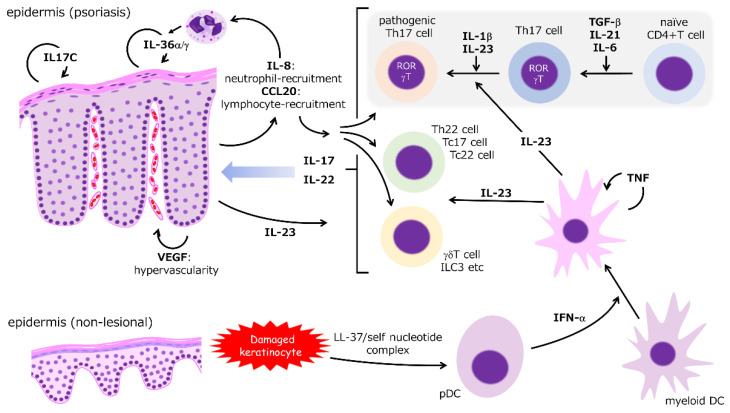
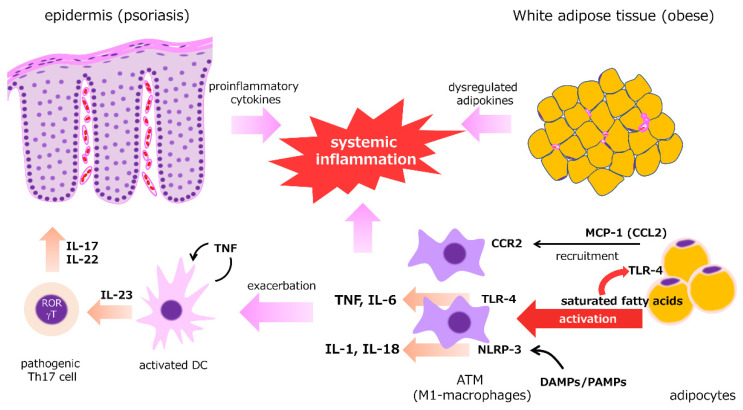
Psoriasis is a chronic inflammatory skin disease induced by multifactorial causes and is characterized by bothersome, scaly reddish plaques, especially on frequently chafed body parts, such as extensor sites of the extremities. The latest advances in molecular-targeted therapies using biologics or small-molecule inhibitors help to sufficiently treat even the most severe psoriatic symptoms and the extra cutaneous comorbidities of psoriatic arthritis. The excellent clinical effects of these therapies provide a deeper understanding of the impaired quality of life caused by this disease and the detailed molecular mechanism in which the interleukin (IL)-23/IL-17 axis plays an essential role. To establish standardized therapeutic strategies, biomarkers that define deep remission are indispensable. Several molecules, such as cytokines, chemokines, antimicrobial peptides, and proteinase inhibitors, have been recognized as potent biomarker candidates. In particular, blood protein markers that are repeatedly measurable can be extremely useful in daily clinical practice. Herein, we summarize the molecular mechanism of psoriasis, and we describe the functions and induction mechanisms of these biomarker candidates.
银屑病是一种由多因素引起的慢性炎症性皮肤病,其特征是出现令人烦恼的、有鳞屑的红色斑块,尤其是在经常摩擦的身体部位,如四肢的伸侧部位。使用生物制剂或小分子抑制剂的分子靶向治疗的最新进展有助于充分治疗甚至最严重的银屑病症状以及银屑病关节炎的皮肤外合并症。这些疗法出色的临床效果使人们对这种疾病导致的生活质量受损以及白细胞介素(IL)-23/IL-17轴发挥重要作用的详细分子机制有了更深入的了解。为了建立标准化的治疗策略,定义深度缓解的生物标志物是必不可少的。几种分子,如细胞因子、趋化因子、抗菌肽和蛋白酶抑制剂,已被认为是有效的生物标志物候选物。特别是可重复测量的血液蛋白质标志物在日常临床实践中可能极其有用。在此,我们总结了银屑病的分子机制,并描述了这些生物标志物候选物的功能和诱导机制。