Cadime Irene, Santos Ana Lúcia, Ribeiro Iolanda, Viana Fernanda Leopoldina
Psychology Research Center, School of Psychology, University of Minho, Braga, Portugal.
Centro de Linguística da Universidade de Lisboa, Departamento de Linguística Geral e Românica, School of Arts and Humanities, University of Lisbon, Lisbon, Portugal.
Front Psychol. 2021 Jul 22;12:677575. doi: 10.3389/fpsyg.2021.677575. eCollection 2021.
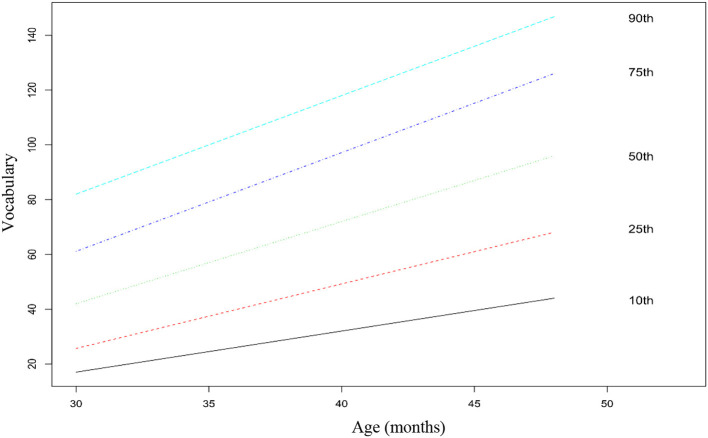
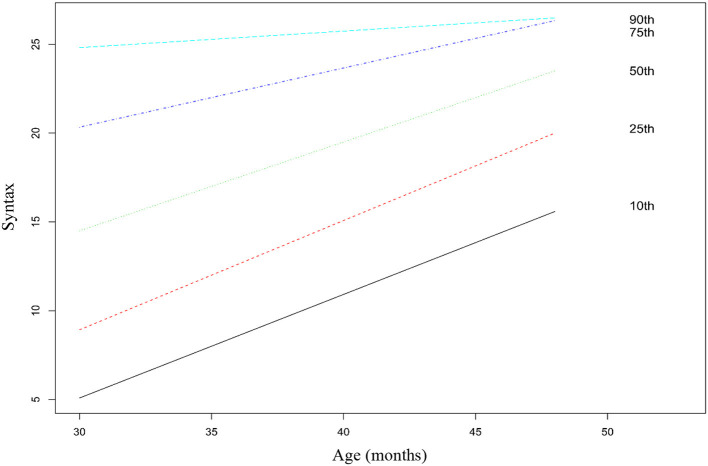
This study presents the validation analysis of the European Portuguese version of the MacArthur-Bates Communicative Development Inventory III (CDI-III-PT). The CDI-III-PT is a parental report measure allowing researchers to assess expressive vocabulary and the syntactic abilities of children aged 2;6-4;0. In this study, we present a version comprising a lexical subscale which follows the Swedish adaptation and an original syntactic subscale allowing us to include language-specific structures. The reports of 739 children were collected; in addition, a standardized measure of language was also administered to a sub-sample of these children and the reports of preschool teachers were collected for another sub-sample. The results indicate a high internal consistency of the lexical and syntactic subscales. As for sociodemographic variables often found to be predictors of language development, as measured by this type of instrument, the results indicate that age and maternal education are significant predictors of the scores, and that first-born children attain higher scores in vocabulary than later born children, but no significant gender differences were found. The scores of the CDI-III-PT are positively correlated with the ones obtained in the standardized language measure, thus supporting their validity. A high agreement between the reports of parents and teachers was also found. These findings indicate that the CDI-III-PT has adequate psychometric properties and that it can be a useful tool for research and clinical practice. The age-based norms that are now provided can be used to evaluate whether a child is performing poorly compared to their peers.
本研究呈现了欧洲葡萄牙语版麦克阿瑟-贝茨沟通发展量表第三版(CDI-III-PT)的效度分析。CDI-III-PT是一种家长报告式测评工具,可让研究人员评估2岁6个月至4岁儿童的表达性词汇和句法能力。在本研究中,我们呈现的版本包括一个遵循瑞典语改编版的词汇子量表和一个原创的句法子量表,使我们能够纳入特定语言的结构。收集了739名儿童的报告;此外,还对这些儿童的一个子样本进行了标准化语言测评,并为另一个子样本收集了学前教师的报告。结果表明词汇和句法子量表具有较高的内部一致性。至于这类测评工具常发现的、可作为语言发展预测指标的社会人口统计学变量,结果表明年龄和母亲受教育程度是得分的显著预测指标,头胎儿童在词汇方面的得分高于后出生的儿童,但未发现显著的性别差异。CDI-III-PT的得分与标准化语言测评所得分数呈正相关,从而支持了其效度。还发现家长和教师的报告之间具有高度一致性。这些发现表明CDI-III-PT具有足够的心理测量学特性,并且它可以成为研究和临床实践的有用工具。现在提供的基于年龄的常模可用于评估一个孩子与同龄人相比表现是否不佳。