The International Peace Maternity and Child Health Hospital, School of Medicine, Shanghai Jiao Tong University, Shanghai, China.
Shanghai Key Laboratory of Embryo Original Disease, Shanghai, China.
Front Endocrinol (Lausanne). 2021 Jul 22;12:706369. doi: 10.3389/fendo.2021.706369. eCollection 2021.
While it is well documented that maternal adverse exposures contribute to a series defects on offspring health according to the Developmental Origins of Health and Disease (DOHaD) theory, paternal evidence is still insufficient. Advanced paternal age is associated with multiple metabolism and psychiatric disorders. Birth weight is the most direct marker to evaluate fetal growth. Therefore, we designed this study to explore the association between paternal age and birth weight among infants born at term and preterm (<37 weeks gestation).
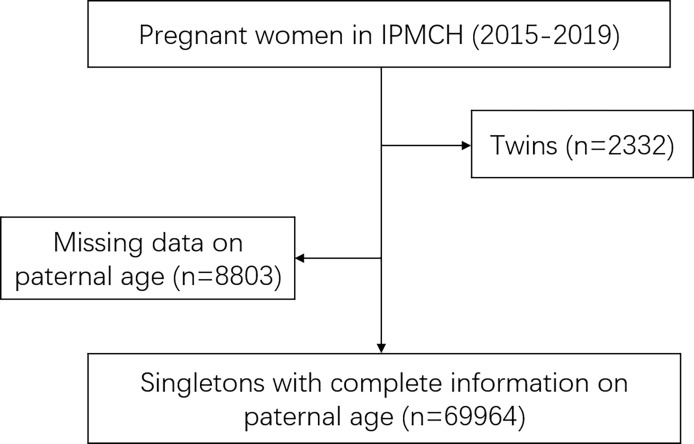
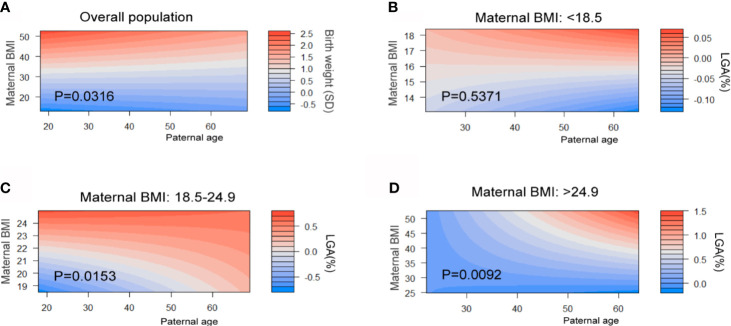
A large retrospective study was conducted using population-based hospital data from January 2015 to December 2019 that included 69,964 cases of singleton infant births with complete paternal age data. The primary outcome was infant birth weight stratified by sex and gestational age including small for gestational age (SGA, 10th percentile) and large for gestational age (LGA, 90th percentile). Birth weight percentiles by gestational age were based on those published in the INTERGROWTH-21st neonatal weight-for gestational-age standard. Logistic regression analysis and linear regression model were used to estimate the association between paternal age and infant birth weight.
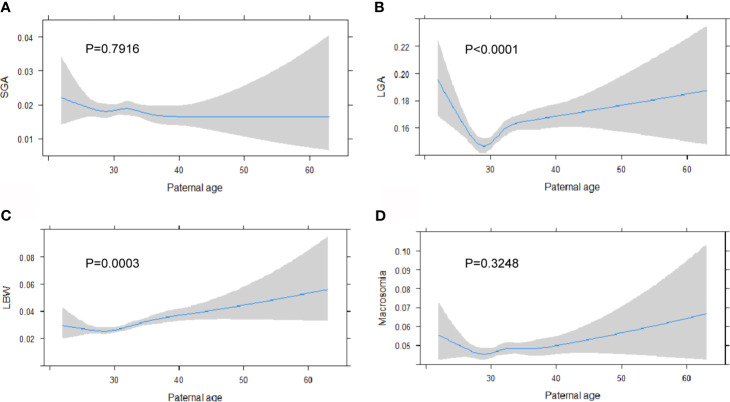
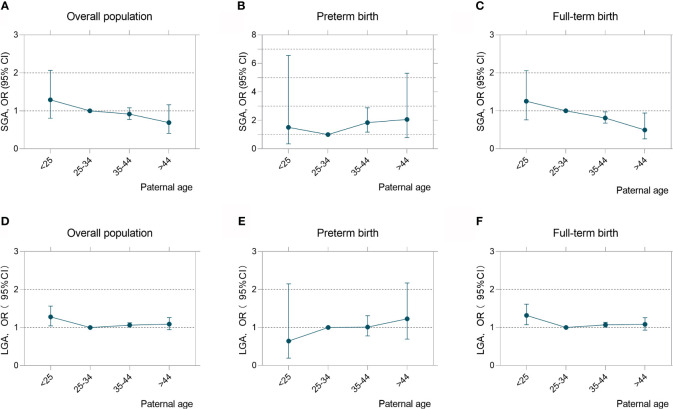
Advanced paternal age was associated with a higher risk for a preterm birth [35-44 years: adjusted odds ratio (OR) = 1.13, 95%CI (1.03 to 1.24); >44 years: OR = 1.36, 95%CI (1.09 to 1.70)]. Paternal age exerted an opposite effect on birth weight with an increased risk of SGA among preterm infants (35-44years: OR = 1.85, 95%CI (1.18 to 2.89) and a decreased risk among term infant (35-44years: OR = 0.81, 95%CI (0.68 to 0.98); >44 years: OR = 0.50, 95%CI (0.26 to 0.94). U-shaped associations were found in that LGA risk among term infants was higher in both younger (<25 years) (OR = 1.32; 95%CI, 1.07 to 1.62) and older (35-44 years) (OR = 1.07; 95% CI, 1.01 to 1.14) fathers in comparison to those who were 25 to 34 years old at the time of delivery.
Our study found advanced paternal age increased the risk of SGA among preterm infants and for LGA among term infants. These findings likely reflect a pathophysiology etiology and have important preconception care implications and suggest the need for antenatal monitoring.
根据健康与疾病的发育起源(DOHaD)理论,已有充分的文献证明母体不良暴露会导致一系列后代健康缺陷,但父体方面的证据仍然不足。高龄父亲与多种代谢和精神疾病有关。出生体重是评估胎儿生长的最直接指标。因此,我们设计了这项研究,以探讨足月和早产(<37 周妊娠)婴儿中父亲年龄与出生体重之间的关系。
本研究采用基于人群的回顾性队列研究,使用 2015 年 1 月至 2019 年 12 月期间的医院数据,纳入了 69964 例有完整父亲年龄数据的单胎婴儿出生病例。主要结局指标是根据性别和胎龄分层的婴儿出生体重,包括小于胎龄儿(SGA,第 10 百分位)和大于胎龄儿(LGA,第 90 百分位)。胎龄别出生体重百分位数基于 INTERGROWTH-21 新生儿体重-胎龄标准。采用 logistic 回归分析和线性回归模型来估计父亲年龄与婴儿出生体重之间的关系。
高龄父亲与早产风险增加相关[35-44 岁:调整后的比值比(OR)=1.13,95%可信区间(CI)(1.03 至 1.24);>44 岁:OR=1.36,95%CI(1.09 至 1.70)]。父亲年龄对出生体重的影响呈相反趋势,早产儿中 SGA 的风险增加(35-44 岁:OR=1.85,95%CI(1.18 至 2.89),而足月儿中 SGA 的风险降低(35-44 岁:OR=0.81,95%CI(0.68 至 0.98);>44 岁:OR=0.50,95%CI(0.26 至 0.94))。我们发现足月儿中 LGA 的风险存在 U 型关联,即年轻(<25 岁)(OR=1.32;95%CI,1.07 至 1.62)和年长(35-44 岁)(OR=1.07;95%CI,1.01 至 1.14)父亲的 LGA 风险均高于 25 至 34 岁的父亲。
我们的研究发现,高龄父亲会增加早产儿 SGA 和足月儿 LGA 的风险。这些发现可能反映了一种病理生理学病因,具有重要的孕前保健意义,并提示需要进行产前监测。