Zhao Yaqi, Liu Zheming, Li Lan, Wu Jie, Zhang Huibo, Zhang Haohan, Lei Tianyu, Xu Bin
Cancer Center, Renmin Hospital of Wuhan University, Wuhan, China.
Front Microbiol. 2021 Jul 21;12:707290. doi: 10.3389/fmicb.2021.707290. eCollection 2021.
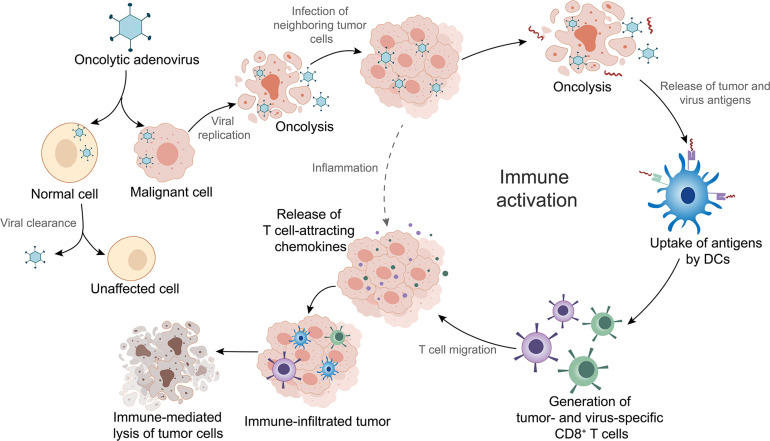
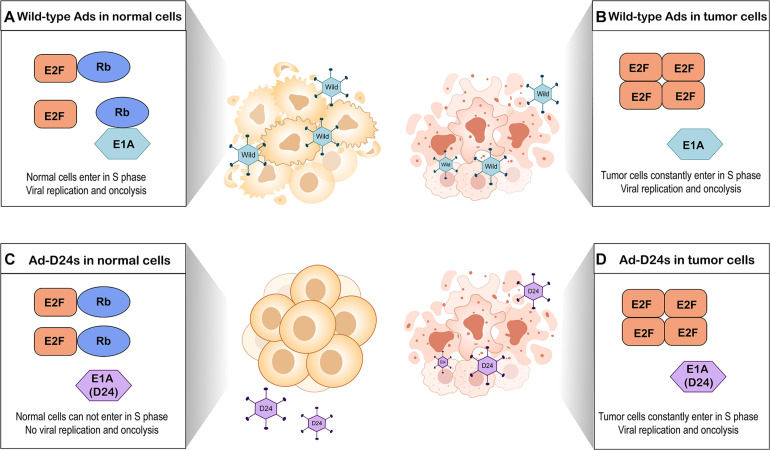
Immunotherapy has moved to the forefront of modern oncologic treatment in the past few decades. Various forms of immunotherapy currently are emerging, including oncolytic viruses. In this therapy, viruses are engineered to selectively propagate in tumor cells and reduce toxicity for non-neoplastic tissues. Adenovirus is one of the most frequently employed oncolytic viruses because of its capacity in tumor cell lysis and immune response stimulation. Upregulation of immunostimulatory signals induced by oncolytic adenoviruses (OAds) might significantly remove local immune suppression and amplify antitumor immune responses. Existing genetic engineering technology allows us to design OAds with increasingly better tumor tropism, selectivity, and antitumor efficacy. Several promising strategies to modify the genome of OAds have been applied: capsid modifications, small deletions in the pivotal viral genes, insertion of tumor-specific promoters, and addition of immunostimulatory transgenes. OAds armed with tumor-associated antigen (TAA) transgenes as cancer vaccines provide additional therapeutic strategies to trigger tumor-specific immunity. Furthermore, the combination of OAds and immune checkpoint inhibitors (ICIs) increases clinical benefit as evidence shown in completed and ongoing clinical trials, especially in the combination of OAds with antiprogrammed death 1/programed death ligand 1 (PD-1/PD-L1) therapy. Despite remarkable antitumor potency, oncolytic adenovirus immunotherapy is confronted with tough challenges such as antiviral immune response and obstruction of tumor microenvironment (TME). In this review, we focus on genomic modification strategies of oncolytic adenoviruses and applications of OAds in cancer immunotherapy.
在过去几十年中,免疫疗法已成为现代肿瘤治疗的前沿领域。目前,各种形式的免疫疗法不断涌现,包括溶瘤病毒。在这种疗法中,病毒经过改造后能够在肿瘤细胞中选择性繁殖,并降低对非肿瘤组织的毒性。腺病毒因其具有肿瘤细胞裂解和免疫反应刺激能力,是最常用的溶瘤病毒之一。溶瘤腺病毒(OAds)诱导的免疫刺激信号上调可能会显著消除局部免疫抑制并增强抗肿瘤免疫反应。现有的基因工程技术使我们能够设计出肿瘤嗜性、选择性和抗肿瘤疗效越来越好的OAds。几种有前景的OAds基因组修饰策略已得到应用:衣壳修饰、关键病毒基因的小缺失、肿瘤特异性启动子的插入以及免疫刺激转基因的添加。携带肿瘤相关抗原(TAA)转基因的OAds作为癌症疫苗提供了额外的治疗策略来触发肿瘤特异性免疫。此外,正如已完成和正在进行 的临床试验所显示的证据那样,OAds与免疫检查点抑制剂(ICIs)的联合使用增加了临床获益,尤其是在OAds与抗程序性死亡蛋白1/程序性死亡配体1(PD-1/PD-L1)疗法的联合应用中。尽管溶瘤腺病毒免疫疗法具有显著的抗肿瘤效力,但仍面临抗病毒免疫反应和肿瘤微环境(TME)阻碍等严峻挑战。在本综述中,我们重点关注溶瘤腺病毒的基因组修饰策略以及OAds在癌症免疫治疗中的应用。