Inserm U1082, Poitiers, France.
Université de Poitiers, Poitiers, France.
Front Immunol. 2021 Jul 21;12:674016. doi: 10.3389/fimmu.2021.674016. eCollection 2021.
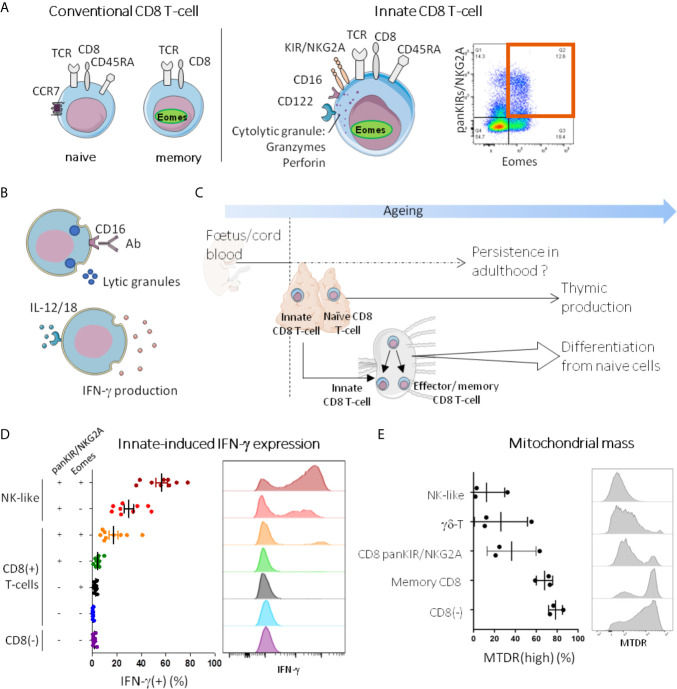
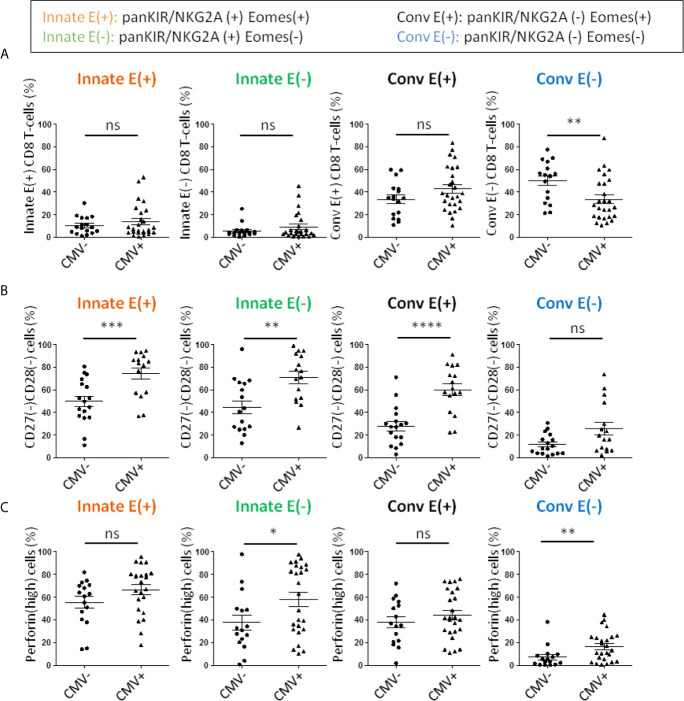
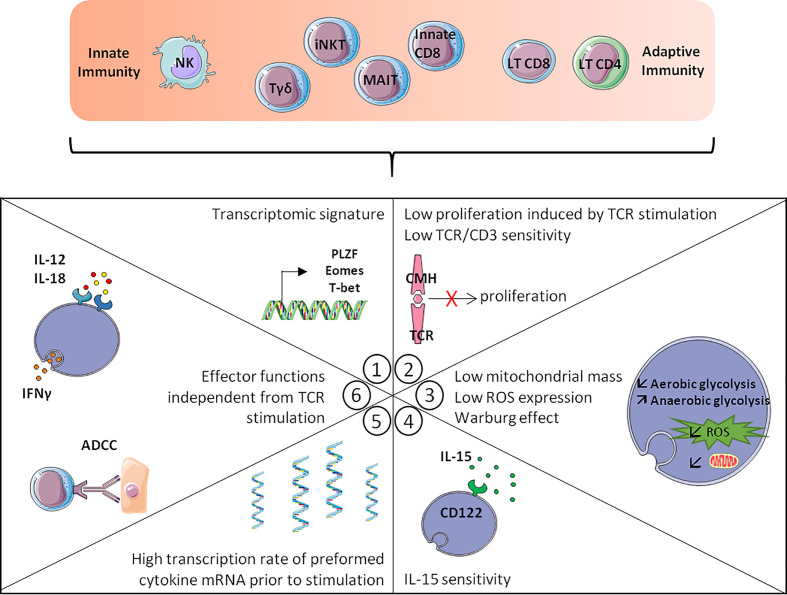
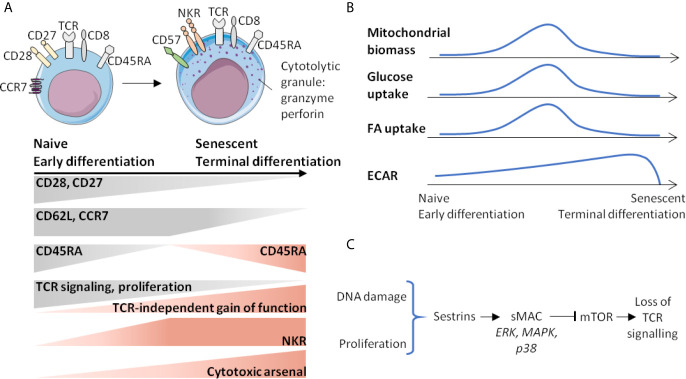
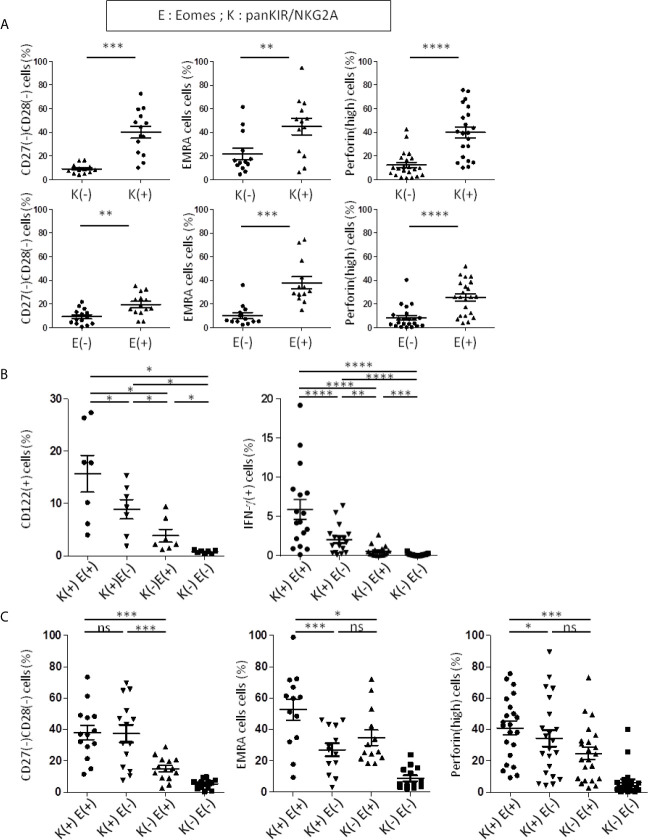
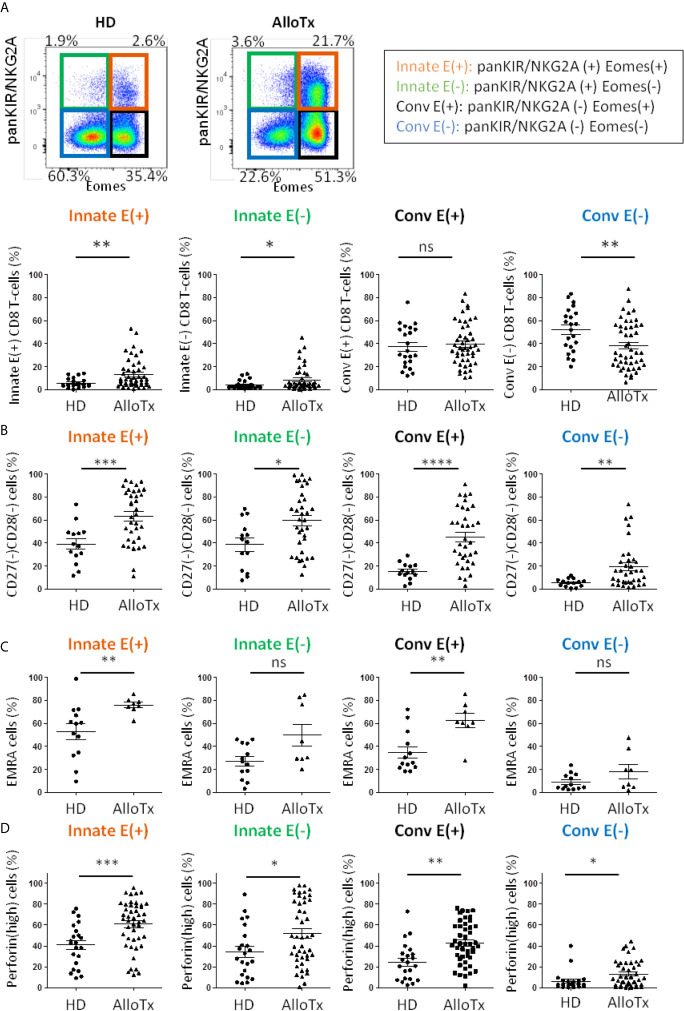
Immunosenescence is a physiological process that is associated with changes in the immune system, particularly among CD8 T-cells. Recent studies have hypothesized that senescent CD8 T-cells are produced with chronologic age by chronic stimulation, leading to the acquisition of hallmarks of innate-like T-cells. While conventional CD8 T-cells are quite well characterized, CD8 T-cells sharing features of NK cells and memory CD8 T-cells, are a newly described immune cell population. They can be distinguished from conventional CD8 T-cells by their combined expression of panKIR/NKG2A and Eomesodermin (E), a unique phenotype closely associated with IFN-γ production in response to innate stimulation. Here, we first provided new evidence in favor of the innate character of panKIR/NKG2A(+) E(+) CD8 T-cells in normal subjects, documenting their position at an intermediate level in the innateness gradient in terms of both innate IFN-γ production and diminished mitochondrial mass. We also revealed that CD8 E(+) panKIR/NKG2A(+) T-cells, hereafter referred to as Innate E(+) CD8 T-cells, exhibit increased senescent (CD27(-) CD28(-)) phenotype, compared to their conventional memory counterparts. Surprisingly, this phenomenon was not dependent on age. Given that inflammation related to chronic viral infection is known to induce NK-like marker expression and a senescence phenotype among CD8 T-cells, we hypothesized that innate E(+) CD8 T-cells will be preferentially associated with exacerbated cellular senescence in response to chronic alloantigen exposure or CMV infection. Accordingly, in a pilot cohort of stable kidney allotransplant recipients, we observed an increased frequency of the Innate E(+) CD8 T-cell subset, together with an exacerbated senescent phenotype. Importantly, this phenotype cannot be explained by age alone, in clear contrast to their conventional memory counterparts. The senescent phenotype in CD8 T-cells was further increased in cytomegalovirus (CMV) positive serology transplant recipients, suggesting that transplantation and CMV, rather than aging by itself, may promote an exacerbated senescent phenotype of innate CD8 T-cells. In conclusion, we proposed that kidney transplantation, the setting of inflammatory of alloantigen exposure and CMV infection, may exogenously age the CD8 T-cell compartment, especially its innate component. The physiopathological consequences of this change in the immune system remain to be elucidated.
免疫衰老(Immunosenescence)是一种与免疫系统变化相关的生理过程,尤其是在 CD8 T 细胞中。最近的研究假设,衰老的 CD8 T 细胞是由慢性刺激随着年龄的增长而产生的,导致获得先天样 T 细胞的特征。虽然传统的 CD8 T 细胞已经得到了很好的描述,但具有 NK 细胞和记忆 CD8 T 细胞特征的 CD8 T 细胞是一种新描述的免疫细胞群体。它们可以通过其 panKIR/NKG2A 和 Eomesodermin(E)的共同表达来与传统的 CD8 T 细胞区分开来,这种独特的表型与先天刺激下 IFN-γ 的产生密切相关。在这里,我们首先提供了支持正常受试者中 panKIR/NKG2A(+) E(+) CD8 T 细胞先天特征的新证据,证明它们在先天 IFN-γ产生和减少线粒体质量方面处于先天梯度的中间水平。我们还揭示了 CD8 E(+) panKIR/NKG2A(+) T 细胞,以下简称先天 E(+) CD8 T 细胞,与传统的记忆细胞相比,表现出更高的衰老(CD27(-) CD28(-))表型。令人惊讶的是,这种现象并不依赖于年龄。鉴于已知慢性病毒感染相关的炎症会诱导 CD8 T 细胞中 NK 样标志物的表达和衰老表型,我们假设先天 E(+) CD8 T 细胞将优先与慢性同种异体抗原暴露或 CMV 感染引起的细胞衰老加剧相关。因此,在稳定的肾移植受者的试点队列中,我们观察到先天 E(+) CD8 T 细胞亚群的频率增加,同时伴有衰老表型的加剧。重要的是,这种表型不能仅用年龄来解释,与传统的记忆细胞形成鲜明对比。在 CMV 阳性血清学移植受者中,CD8 T 细胞的衰老表型进一步增加,这表明移植和 CMV,而不是单纯的衰老,可能会促进先天 CD8 T 细胞的衰老表型加剧。总之,我们提出,肾移植、同种异体抗原暴露和 CMV 感染的炎症环境可能会使 CD8 T 细胞区室,特别是其先天成分,发生外源性衰老。免疫系统这种变化的生理病理学后果仍有待阐明。