Gastroenterology, Department of Translational and Precision Medicine, "Sapienza" University, 00185 Rome, Italy.
Internal Medicine, Department of Translational and Precision Medicine, "Sapienza" University, 00185 Rome, Italy.
Nutrients. 2021 Jul 2;13(7):2296. doi: 10.3390/nu13072296.
Sarcopenia is considered an important risk factor for morbidity and mortality in liver cirrhosis. Beta-hydroxy-beta-methylbutyrate (HMB) has the potential to increase muscle mass and performance by stimulating protein synthesis and reducing muscle catabolism. The present study aimed at evaluating the effect of HMB supplementation on muscle mass and function in patients with liver cirrhosis. Changes in frailty during the study were also estimated, and the safety of HMB supplementation was verified.
This is a randomized, single-blind, placebo-controlled pilot trial. Twenty-four patients (14 HMB and 10 placebo) affected by liver cirrhosis were enrolled in the study. Each patient received dedicated counseling, which included nutrition and physical activity recommendations for chronic liver disease patients. Patients were randomized to receive 3 g/day of HMB or placebo (sorbitol powder) for 12 consecutive weeks. A diet interview, anthropometry, electrical bioimpedance analysis (BIA), quadriceps ultrasound, physical performance battery, Liver Frailty Index (LFI), and cognitive tests were completed at enrolment (T0), at 12 weeks (T1), and 24 weeks after enrolment (T2).
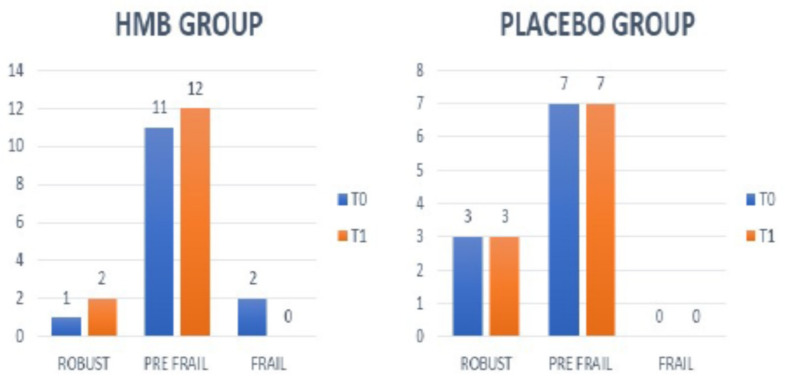
At baseline, the two groups were similar in demography, severity of liver disease, muscle mass, muscle function, and cognitive tests. LFI at baseline was higher in patients in the HMB group vs. those in the placebo group (4.1 ± 0.4 vs. 3.4 ± 0.6, < 0.01). After treatment, a statistically significant increase in muscle function was seen in the HMB group (chair stand test: 14.2 ± 5 s vs. 11.7 ± 2.6 s, < 0.05; six-minute walk test: 361.8 ± 68 m vs. 409.4 ± 58 m, < 0.05). Quadriceps muscle mass measured by ultrasound also increased (4.9 ± 1.8 vs. 5.4 ± 1.8 mm, < 0.05) after HMB, while LFI decreased (4.1 ± 0.4 vs. 3.7 ± 0.4, < 0.05). HMB was well tolerated by patients, and no adverse events were documented.
Our study suggests the efficacy of 12-week beta-hydroxy-beta-methylbutyrate supplementation in promoting improvements in muscle performance in compensated cirrhotic patients. LFI was also ameliorated. Further studies with a greater number of patients are required to reinforce this hypothesis.
肌少症被认为是肝硬化患者发病率和死亡率的重要危险因素。β-羟基-β-甲基丁酸(HMB)通过刺激蛋白质合成和减少肌肉分解代谢,具有增加肌肉质量和性能的潜力。本研究旨在评估 HMB 补充剂对肝硬化患者肌肉质量和功能的影响。研究期间还估计了虚弱程度的变化,并验证了 HMB 补充剂的安全性。
这是一项随机、单盲、安慰剂对照的初步试验。24 名患者(14 名 HMB 和 10 名安慰剂)患有肝硬化,被纳入研究。每位患者都接受了专门的咨询,其中包括针对慢性肝病患者的营养和身体活动建议。患者被随机分配接受 3 克/天的 HMB 或安慰剂(山梨糖醇粉)连续 12 周。在入组时(T0)、12 周时(T1)和入组后 24 周时(T2)完成饮食访谈、人体测量、生物电阻抗分析(BIA)、股四头肌超声、身体机能测试套件、肝脏虚弱指数(LFI)和认知测试。
在基线时,两组在人口统计学、肝病严重程度、肌肉质量、肌肉功能和认知测试方面相似。HMB 组的 LFI 高于安慰剂组(4.1 ± 0.4 与 3.4 ± 0.6,<0.01)。治疗后,HMB 组的肌肉功能有显著的统计学改善(坐立起身测试:14.2 ± 5 秒与 11.7 ± 2.6 秒,<0.05;6 分钟步行测试:361.8 ± 68 米与 409.4 ± 58 米,<0.05)。HMB 后股四头肌超声测量的肌肉质量也增加(4.9 ± 1.8 与 5.4 ± 1.8 毫米,<0.05),而 LFI 降低(4.1 ± 0.4 与 3.7 ± 0.4,<0.05)。HMB 被患者很好地耐受,没有记录到不良反应。
我们的研究表明,12 周β-羟基-β-甲基丁酸补充剂可有效改善代偿性肝硬化患者的肌肉运动表现。LFI 也得到了改善。需要更多患者的进一步研究来加强这一假设。