Kopitzky Rodion
Department of Circular and Bio-Based Plastics, Fraunhofer UMSICHT, Fraunhofer Institute for Environmental, Safety and Energy Technology, Osterfelder Str. 3, 46047 Oberhausen, Germany.
Polymers (Basel). 2021 Jul 30;13(15):2531. doi: 10.3390/polym13152531.
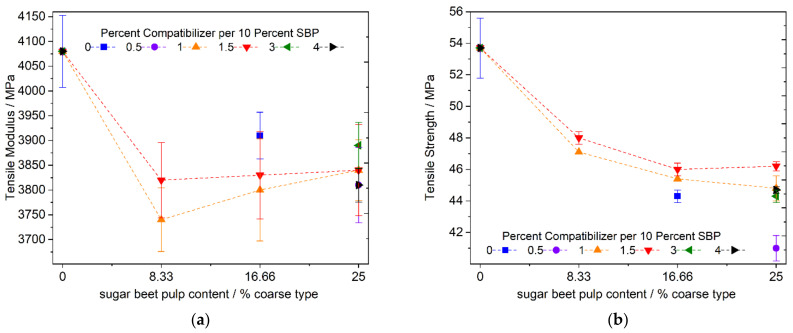
Sugar beet pulp (SBP) is a residue available in large quantities from the sugar industry, and can serve as a cost-effective bio-based and biodegradable filler for fully bio-based compounds based on bio-based polyesters. The heterogeneous cell structure of sugar beet suggests that the processing of SBP can affect the properties of the composite. An "Ultra-Rotor" type air turbulence mill was used to produce SBP particles of different sizes. These particles were processed in a twin-screw extruder with poly(lactic acid) (PLA) and poly(butylene succinate) (PBS) and fillers to granules for possible marketable formulations. Different screw designs, compatibilizers and the use of glycerol as a thermoplasticization agent for SBP were also tested. The spherical, cubic, or ellipsoidal-like shaped particles of SBP are not suitable for usage as a fiber-like reinforcement. In addition, the fineness of ground SBP affects the mechanical properties because (i) a high proportion of polar surfaces leads to poor compatibility, and (ii) due to the inner structure of the particulate matter, the strength of the composite is limited to the cohesive strength of compressed sugar-cell compartments of the SBP. The compatibilization of the polymer-matrix-particle interface can be achieved by using compatibilizers of different types. Scanning electron microscopy (SEM) fracture patterns show that the compatibilization can lead to both well-bonded particles and cohesive fracture patterns in the matrix. Nevertheless, the mechanical properties are limited by the impact and elongation behavior. Therefore, the applications of SBP-based composites must be well considered.
甜菜粕(SBP)是制糖工业大量产生的一种残渣,可作为一种具有成本效益的生物基且可生物降解的填料,用于基于生物基聚酯的全生物基化合物。甜菜的异质细胞结构表明,SBP的加工过程会影响复合材料的性能。使用“超转子”型气流粉碎机生产不同尺寸的SBP颗粒。这些颗粒在双螺杆挤出机中与聚乳酸(PLA)、聚丁二酸丁二醇酯(PBS)和填料一起加工成颗粒,以制成可能具有市场价值的配方产品。还测试了不同的螺杆设计、增容剂以及使用甘油作为SBP的热塑性化剂。SBP的球形、立方体形或椭球形颗粒不适合用作纤维状增强材料。此外,磨碎的SBP的细度会影响机械性能,原因如下:(i)高比例的极性表面导致相容性差;(ii)由于颗粒物的内部结构,复合材料的强度仅限于SBP压缩糖细胞隔室的内聚强度。聚合物-基体-颗粒界面的增容可以通过使用不同类型的增容剂来实现。扫描电子显微镜(SEM)断裂模式表明,增容可导致颗粒良好结合以及基体中的内聚断裂模式。然而,机械性能受冲击和伸长行为的限制。因此,必须充分考虑基于SBP的复合材料的应用。