Department of Medicine, University of Miami Miller School of Medicine, Miami, FL, USA.
Department of Public Health Sciences, University of Miami Miller School of Medicine, Miami, FL, USA.
Sci Total Environ. 2021 Dec 1;798:149177. doi: 10.1016/j.scitotenv.2021.149177. Epub 2021 Jul 21.
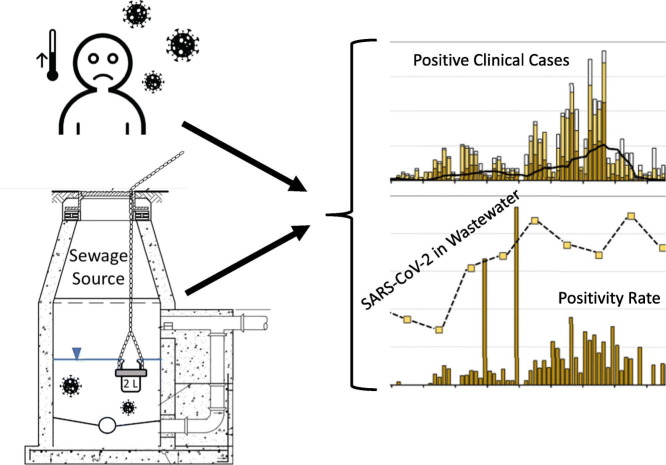
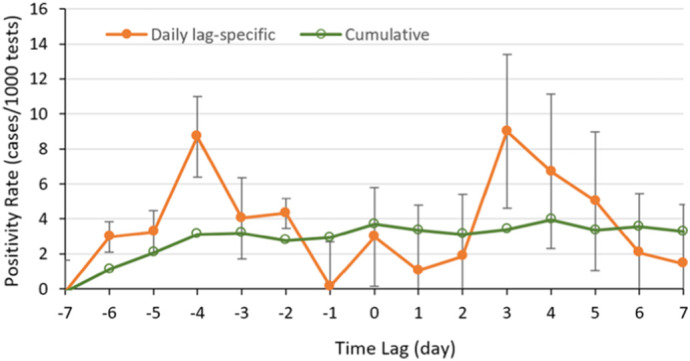
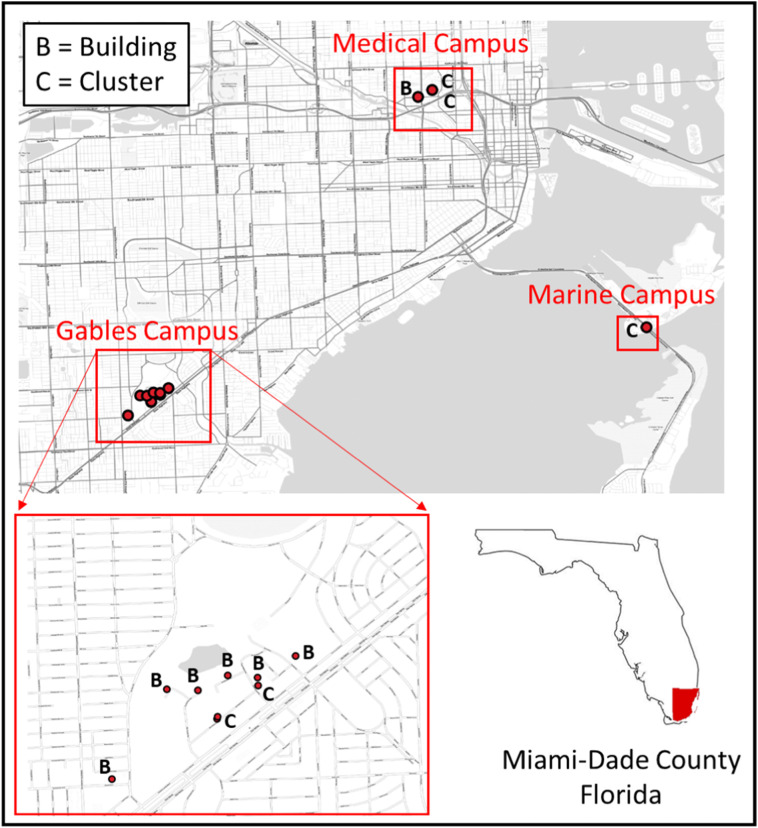
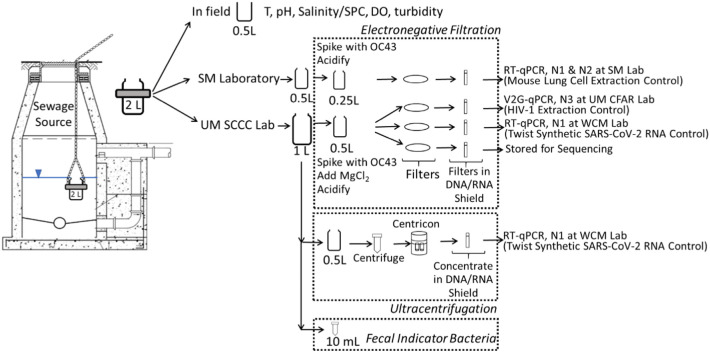
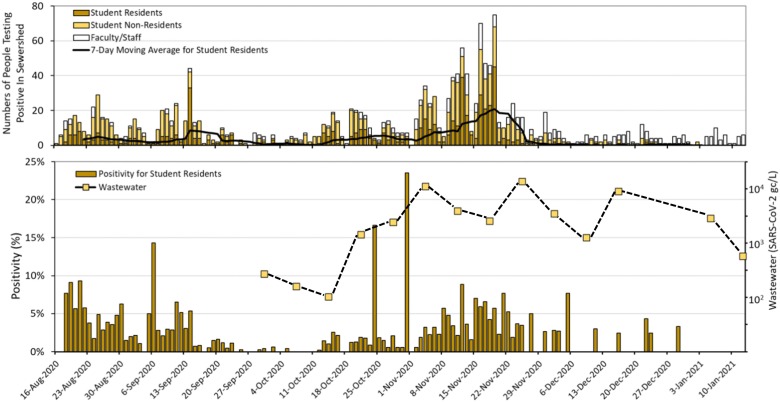
Standardized protocols for wastewater-based surveillance (WBS) for the RNA of SARS-CoV-2, the virus responsible for the current COVID-19 pandemic, are being developed and refined worldwide for early detection of disease outbreaks. We report here on lessons learned from establishing a WBS program for SARS-CoV-2 integrated with a human surveillance program for COVID-19. We have established WBS at three campuses of a university, including student residential dormitories and a hospital that treats COVID-19 patients. Lessons learned from this WBS program address the variability of water quality, new detection technologies, the range of detectable viral loads in wastewater, and the predictive value of integrating environmental and human surveillance data. Data from our WBS program indicated that water quality was statistically different between sewer sampling sites, with more variability observed in wastewater coming from individual buildings compared to clusters of buildings. A new detection technology was developed based upon the use of a novel polymerase called V2G. Detectable levels of SARS-CoV-2 in wastewater varied from 10 to 10 genomic copies (gc) per liter of raw wastewater (L). Integration of environmental and human surveillance data indicate that WBS detection of 100 gc/L of SARS-CoV-2 RNA in wastewater was associated with a positivity rate of 4% as detected by human surveillance in the wastewater catchment area, though confidence intervals were wide (β ~ 8.99 ∗ ln(100); 95% CI = 0.90-17.08; p < 0.05). Our data also suggest that early detection of COVID-19 surges based on correlations between viral load in wastewater and human disease incidence could benefit by increasing the wastewater sample collection frequency from weekly to daily. Coupling simpler and faster detection technology with more frequent sampling has the potential to improve the predictive potential of using WBS of SARS-CoV-2 for early detection of the onset of COVID-19.
正在全球范围内制定和完善用于 SARS-CoV-2(导致当前 COVID-19 大流行的病毒)废水监测(WBS)的标准化方案,以便及早发现疾病暴发。我们在此报告了将 SARS-CoV-2 的 WBS 计划与 COVID-19 的人类监测计划相结合的经验教训。我们已经在一所大学的三个校区建立了 WBS,包括学生宿舍和治疗 COVID-19 患者的医院。从这个 WBS 计划中吸取的经验教训涉及水质的可变性、新的检测技术、废水中可检测到的病毒载量范围以及整合环境和人类监测数据的预测价值。我们的 WBS 计划数据表明,污水采样点之间的水质存在统计学差异,与来自建筑物集群的废水相比,来自个别建筑物的废水的变化更大。一种新的检测技术是基于使用一种称为 V2G 的新型聚合酶开发的。废水中 SARS-CoV-2 的可检测水平从每升原始废水中的 10 到 10 基因组拷贝(gc)不等。环境和人类监测数据的整合表明,WBS 在废水中检测到 100 gc/L 的 SARS-CoV-2 RNA 与人类监测在废水集水区中的阳性率为 4%相关,尽管置信区间较宽(β~8.99 ∗ ln(100);95%CI = 0.90-17.08;p < 0.05)。我们的数据还表明,通过增加每周至每日的废水样本采集频率,基于废水中病毒载量与人类疾病发病率之间的相关性,早期检测 COVID-19 激增可以受益。将更简单、更快的检测技术与更频繁的采样相结合,有可能提高使用 SARS-CoV-2 的 WBS 进行 COVID-19 早期检测的预测潜力。