Department of Microbiology and Immunology, Faculty of Tropical Medicine, Mahidol University, Bangkok, Thailand.
Department of Clinical Tropical Medicine, Faculty of Tropical Medicine, Mahidol University, Bangkok, Thailand.
PLoS One. 2021 Aug 10;16(8):e0255796. doi: 10.1371/journal.pone.0255796. eCollection 2021.
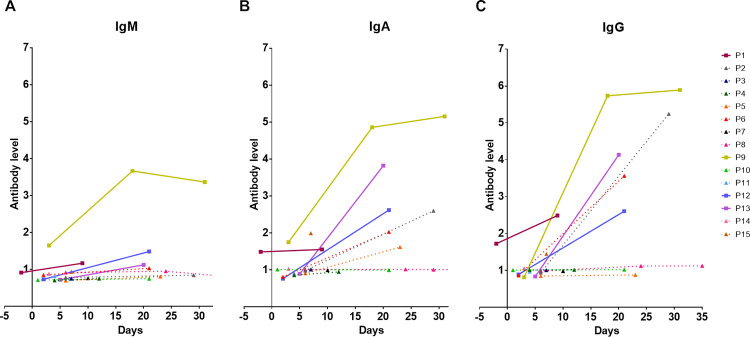
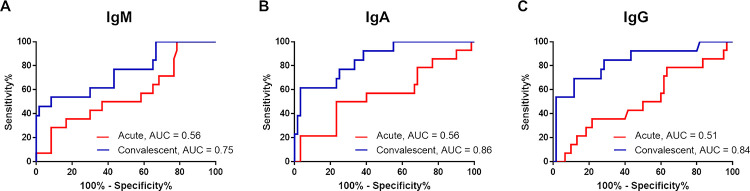
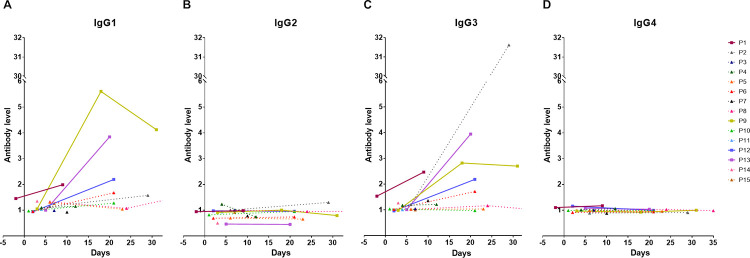
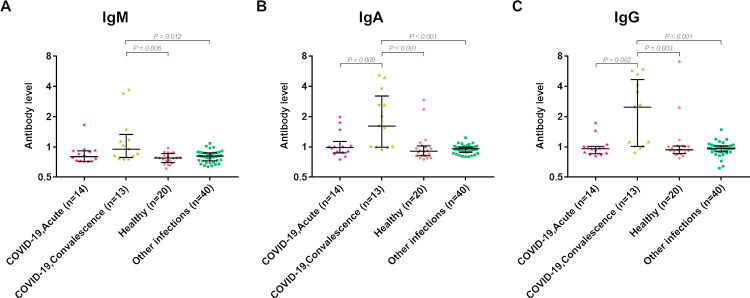
Serological assays to detect antibodies against severe acute respiratory syndrome coronavirus 2 (SARS-CoV-2) might contribute to confirming the suspected coronavirus disease 2019 (COVID-19) in patients not detected with molecular assays. Human antibodies that target the host angiotensin-converting enzyme 2-binding domain of the viral spike protein are a target for serodiagnosis and therapeutics. This study aimed to characterize the classes and subclasses of antibody responses to a recombinant receptor-binding protein (RBD) of SARS-CoV-2 in COVID-19 patients and investigated the reactivity of these antibodies in patients with other tropical infections and healthy individuals in Thailand. ELISAs for IgM, IgA, IgG and IgG subclasses based on RBD antigen were developed and tested with time series of 27 serum samples from 15 patients with COVID-19 and 60 samples from pre-COVID-19 outbreaks including acute dengue fever, murine typhus, influenza, leptospirosis and healthy individuals. Both RBD-specific IgA and IgG were detected in only 21% of the COVID-19 patients in the acute phase. The median IgA and IgG levels were significantly higher in the convalescent serum sample compared to the acute serum sample (P < 0.05). We observed the highest correlation between levels of IgG and IgA (rho = 0. 92). IgG1 and IgG3 were the major IgG subclasses detected in SARS-CoV-2 infection. Only acute IgG3 level was negatively associated with viral detection based on RT-PCR of ORF1ab gene (rho = -0.57). The median IgA and IgG levels in convalescence sera of COVID-19 patients were significantly higher than healthy individuals and convalescent sera of other febrile infectious patients. The analyses of antibody classes and subclasses provide insights into human immune responses against SARS-CoV-2 during natural infection and interpretation of antibody assays.
用于检测针对严重急性呼吸综合征冠状病毒 2(SARS-CoV-2)的抗体的血清学检测可能有助于在未通过分子检测发现的患者中确诊疑似 2019 年冠状病毒病(COVID-19)。针对病毒刺突蛋白上的宿主血管紧张素转换酶 2 结合域的人抗体是血清学诊断和治疗的靶标。本研究旨在表征 COVID-19 患者中针对 SARS-CoV-2 重组受体结合蛋白(RBD)的抗体反应类别和亚类,并研究这些抗体在泰国其他热带感染患者和健康个体中的反应性。基于 RBD 抗原的 IgM、IgA、IgG 和 IgG 亚类 ELISA 已开发并对来自 15 名 COVID-19 患者的 27 份血清样本和 60 份来自 COVID-19 前爆发的样本进行了测试,包括急性登革热、鼠型斑疹伤寒、流感、钩端螺旋体病和健康个体。在急性期,只有 21%的 COVID-19 患者检测到 RBD 特异性 IgA 和 IgG。与急性血清样本相比,恢复期血清样本的 IgA 和 IgG 中位数水平显著升高(P < 0.05)。我们观察到 IgG 和 IgA 水平之间的相关性最高(rho = 0.92)。在 SARS-CoV-2 感染中检测到的主要 IgG 亚类是 IgG1 和 IgG3。仅急性 IgG3 水平与基于 ORF1ab 基因的 RT-PCR 的病毒检测呈负相关(rho = -0.57)。COVID-19 患者恢复期血清中 IgA 和 IgG 中位数水平明显高于健康个体和其他发热性传染病患者的恢复期血清。抗体类别和亚类的分析为 SARS-CoV-2 自然感染期间人类免疫反应以及抗体检测的解释提供了见解。