Outbreak Research Team, Institute of Tropical Medicine, Antwerp, Belgium.
Virology Unit, Department of Biomedical Sciences, Institute of Tropical Medicine, Antwerp, Belgium.
J Virol Methods. 2021 Feb;288:114025. doi: 10.1016/j.jviromet.2020.114025. Epub 2020 Nov 20.
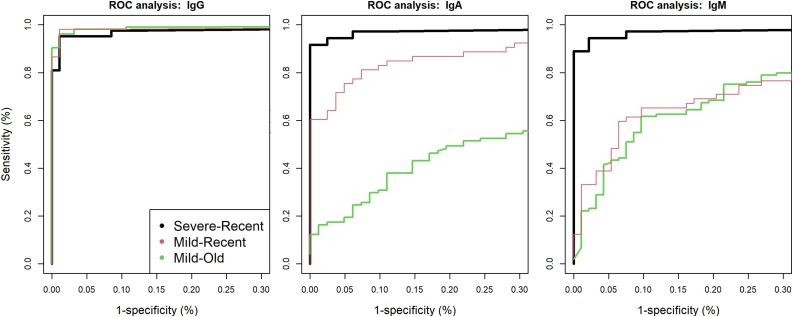
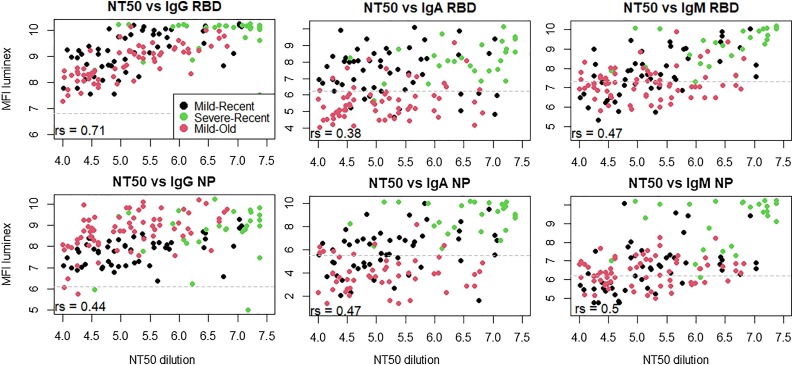
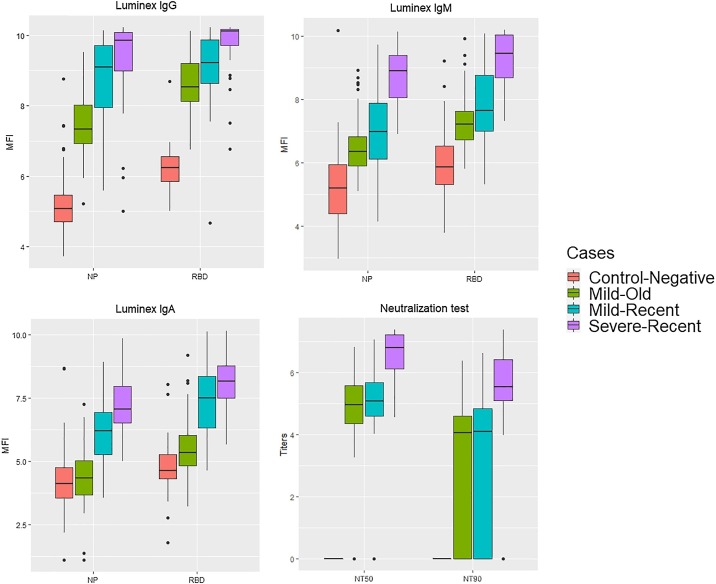
Large-scale serosurveillance of severe acute respiratory syndrome coronavirus type 2 (SARS-CoV-2) will only be possible if serological tests are sufficiently reliable, rapid and affordable. Many assays are either labour-intensive and require specialised facilities (e.g. virus neutralization assays), or are expensive with suboptimal specificity (e.g. commercial ELISAs and RDTs). Bead-based assays offer a cost-effective alternative and allow for multiplexing to test for antibodies against multiple antigens and against other pathogens. Here, we compare the performance of spike (S) and nucleocapsid (NP) antigens for the detection of SARS-CoV-2 specific IgG, IgM and IgA antibodies in a panel of sera that includes recent (up to six weeks after symptom onset, severe n = 44; and mild cases n = 52) and old infections (five months after symptom onset, mild n = 104), using a Luminex-bead based assay and comparison to a virus neutralization test. While we show that neutralizing antibody levels are significantly lower in mild than in severe cases, we demonstrate that a combination of the recombinant nucleocapsid protein (NP) and receptor-binding domain (RBD) results in highly specific (99 %) IgG antibody detection five months after infection in 96 % of cases. Although most severe Covid-19 cases developed a clear IgM and IgA response, titers fell below the detection threshold in more than 20 % of mild cases in our bead-based assay. In conclusion, our data supports the use of RBD and NP for the development of SARS-CoV-2 serological IgG bead-based assays.
大规模的严重急性呼吸综合征冠状病毒 2 型(SARS-CoV-2)血清学监测只有在血清学检测足够可靠、快速和经济实惠的情况下才有可能。许多检测方法要么劳动强度大,需要专门的设施(例如病毒中和检测),要么昂贵且特异性不理想(例如商业 ELISA 和 RDT)。基于珠粒的检测方法提供了一种具有成本效益的替代方法,并允许进行多重检测,以检测针对多种抗原和其他病原体的抗体。在这里,我们比较了刺突(S)和核衣壳(NP)抗原在包括近期(发病后最多六周,严重病例 n=44;轻症病例 n=52)和陈旧感染(发病后五个月,轻症病例 n=104)的血清样本中检测 SARS-CoV-2 特异性 IgG、IgM 和 IgA 抗体的性能,使用 Luminex 珠粒基检测方法,并与病毒中和检测进行比较。虽然我们表明中和抗体水平在轻症病例中明显低于重症病例,但我们证明,重组核衣壳蛋白(NP)和受体结合域(RBD)的组合可在感染后五个月内以 96%的病例高度特异性(99%)检测 IgG 抗体。尽管大多数严重的 Covid-19 病例产生了明确的 IgM 和 IgA 反应,但在我们的珠粒检测中,超过 20%的轻症病例的滴度低于检测阈值。总之,我们的数据支持使用 RBD 和 NP 开发 SARS-CoV-2 血清学 IgG 基于珠粒的检测方法。