Department of Anesthesiology and Pain Medicine, Maisonneuve-Rosemont Hospital - CIUSSS de L'Est de l'Ile de Montréal, Université de Montréal, Montréal, Québec, Canada.
Department of Anesthesiology and Pain Medicine, Université de Montréal, Québec, Canada.
PLoS One. 2021 Aug 10;16(8):e0255852. doi: 10.1371/journal.pone.0255852. eCollection 2021.
The number of elderly patients undergoing major surgery is rapidly increasing. They are particularly at risk of developing postoperative neurocognitive disorders (NCD). Earlier studies suggested that processed electroencephalographic (EEG) monitors may reduce the incidence of postoperative NCD. However, none of these studies controlled for intraoperative nociception levels or personalized blood pressure targets. Their results remain unclear if the reduction in the incidence of postoperative NCD relates to avoidance of any electroencephalographic pattern suggesting excessive anesthesia depth.
The objective of this trial is to investigate-in patients ≥ 70 years old undergoing major non-cardiac surgery-the effect of EEG-guided anesthesia on postoperative NCD while controlling for intraoperative nociception, personalized blood pressure targets, and using detailed information provided by the EEG monitor (including burst suppression ratio, density spectral array, and raw EEG waveform).
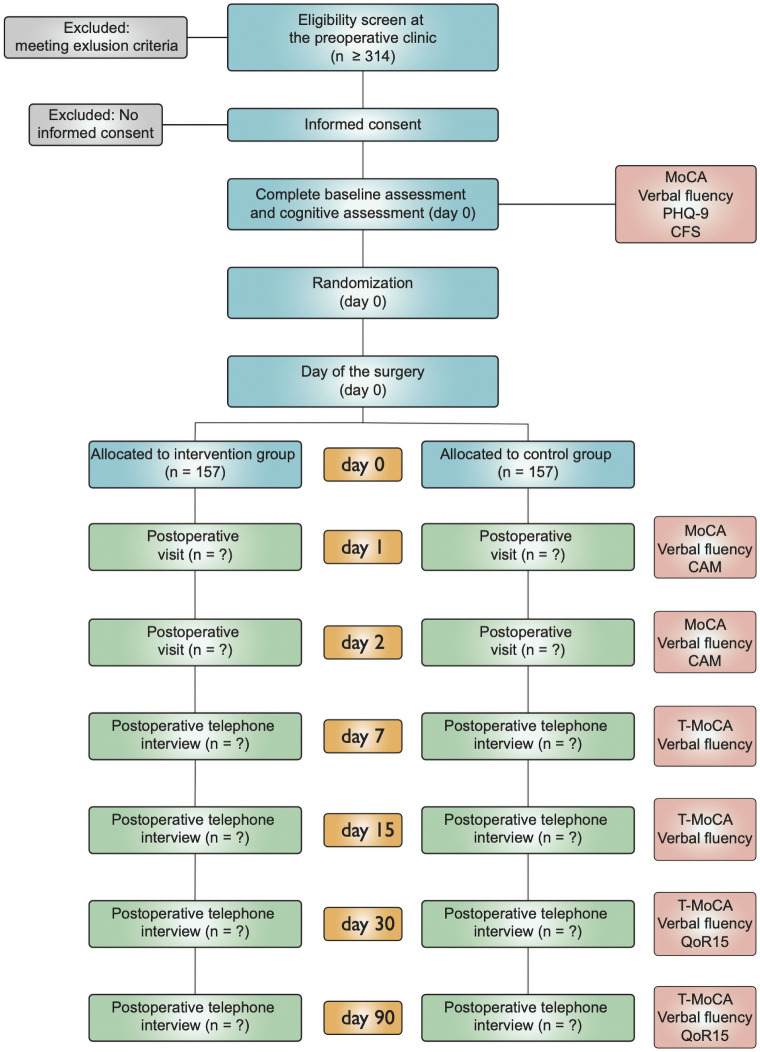
This prospective, randomized, controlled trial will be conducted in a single Canadian university hospital. Patients ≥ 70 years old undergoing elective major non-cardiac surgery will be included in the trial. The administration of sevoflurane will be adjusted to maintain a BIS index value between 40 and 60, to keep a Suppression Ratio (SR) at 0%, to keep a direct EEG display without any suppression time and a spectrogram with most of the EEG wave frequency within the alpha, theta, and delta frequencies in the EEG-guided group. In the control group, sevoflurane will be administered to achieve an age-adjusted minimum alveolar concentration of [0.8-1.2]. In both groups, a nociception monitor will guide intraoperative opioid administration, individual blood pressure targets will be used, and cerebral oximetry used to tailor intraoperative hemodynamic management. The primary endpoint will be the incidence of NCD at postoperative day 1, as evaluated by the Montreal Cognitive Assessment (MoCA). Secondary endpoints will include the incidence of postoperative NCD at different time points and the evaluation of cognitive trajectories up to 90 days after surgery among EEG-guided and control groups.
NCT04825847 on ClinicalTrials.gov.
接受大手术的老年患者人数正在迅速增加。他们特别容易发生术后神经认知障碍(NCD)。早期研究表明,经过处理的脑电图(EEG)监测仪可能会降低术后 NCD 的发生率。然而,这些研究都没有控制术中疼痛水平或个性化血压目标。如果术后 NCD 发生率的降低与避免任何提示麻醉深度过大的脑电图模式有关,那么其结果仍然不清楚。
本试验旨在调查 70 岁以上接受非心脏大手术的患者中,脑电图引导麻醉对术后 NCD 的影响,同时控制术中疼痛、个性化血压目标,并使用脑电图监测仪提供的详细信息(包括爆发抑制比、密度谱阵列和原始脑电图波形)。
这是一项前瞻性、随机、对照试验,将在加拿大的一家大学医院进行。纳入年龄≥70 岁、接受择期大非心脏手术的患者。七氟醚的给药将根据需要进行调整,以维持 BIS 值在 40 至 60 之间,保持抑制率(SR)为 0%,保持直接脑电图显示,无任何抑制时间,且脑电图的频谱图显示大多数脑电图频率处于α、θ和δ频率范围内。在对照组中,将给予七氟醚以达到年龄调整后的最低肺泡浓度[0.8-1.2]。在两组中,疼痛监测仪将指导术中阿片类药物的给药,使用个体化血压目标,并使用脑氧饱和度来调整术中血流动力学管理。主要终点是术后第 1 天用蒙特利尔认知评估(MoCA)评估的 NCD 发生率。次要终点包括不同时间点术后 NCD 的发生率,以及脑电图引导组和对照组术后 90 天内认知轨迹的评估。
ClinicalTrials.gov 上的 NCT04825847。