Intensive Care Department, Sir Charles Gairdner Hospital, Level 4 G Block, Hospital Ave, Nedlands, Perth, WA, 6009, Australia.
School of Population Health, Curtin University, Bentley, Australia.
Crit Care. 2021 Aug 10;25(1):287. doi: 10.1186/s13054-021-03712-4.
To test the hypothesis that Intensive Care Unit (ICU) doctors and nurses differ in their personal preferences for treatment from the general population, and whether doctors and nurses make different choices when thinking about themselves, as compared to when they are treating a patient.
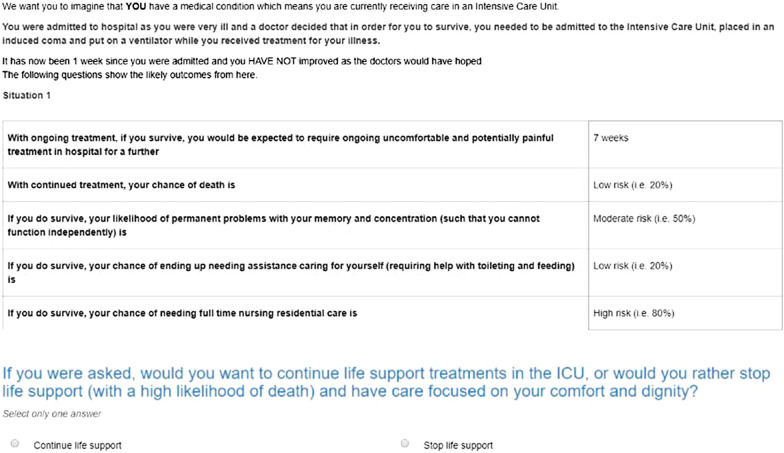
Cross sectional, observational study conducted in 13 ICUs in Australia in 2017 using a discrete choice experiment survey. Respondents completed a series of choice sets, based on hypothetical situations which varied in the severity or likelihood of: death, cognitive impairment, need for prolonged treatment, need for assistance with care or requiring residential care.
A total of 980 ICU staff (233 doctors and 747 nurses) participated in the study. ICU staff place the highest value on avoiding ending up in a dependent state. The ICU staff were more likely to choose to discontinue therapy when the prognosis was worse, compared with the general population. There was consensus between ICU staff personal views and the treatment pathway likely to be followed in 69% of the choices considered by nurses and 70% of those faced by doctors. In 27% (1614/5945 responses) of the nurses and 23% of the doctors (435/1870 responses), they felt that aggressive treatment would be continued for the hypothetical patient but they would not want that for themselves.
The likelihood of returning to independence (or not requiring care assistance) was reported as the most important factor for ICU staff (and the general population) in deciding whether to receive ongoing treatments. Goals of care discussions should focus on this, over likelihood of survival.
为了验证一个假设,即重症监护病房(ICU)的医生和护士在治疗偏好上与普通人群存在差异,以及当他们考虑自己和治疗患者时,医生和护士是否会做出不同的选择。
这是一项 2017 年在澳大利亚 13 家 ICU 进行的横断面、观察性研究,采用离散选择实验调查。受访者根据死亡、认知障碍、需要长期治疗、需要护理协助或需要长期护理的可能性和严重程度的不同,完成一系列选择集。
共有 980 名 ICU 工作人员(233 名医生和 747 名护士)参与了这项研究。ICU 工作人员最看重避免陷入依赖状态。与普通人群相比,ICU 工作人员在预后较差时更有可能选择停止治疗。在护士考虑的 69%的选择和医生考虑的 70%的选择中,ICU 工作人员的个人观点和可能采取的治疗方案之间存在共识。在 27%(1614/5945 次回应)的护士和 23%的医生(435/1870 次回应)中,他们认为会为假设患者继续进行积极治疗,但他们自己不会这样做。
对于 ICU 工作人员(和普通人群)来说,是否继续接受治疗的最重要因素是恢复独立(或不需要护理协助)的可能性。应该将重点放在这一点上,而不是生存的可能性上,进行治疗目标讨论。