Department of Epidemiology and Health Statistics, The School of Public Health of Qingdao University, Qingdao, China.
Qingdao Municipal Center for Disease Control and Prevention, Qingdao, Shandong, China.
Environ Health Prev Med. 2021 Aug 12;26(1):78. doi: 10.1186/s12199-021-01001-8.
Health literacy is a public health goal which can be used as an independent factor of health outcomes. This study aimed to assess the association between health literacy and health status, as well as the two mediating factors of behavior and self-efficacy among residents aged 15-69 years in Qingdao.
A cross-sectional survey was implemented among residents aged 15-69 years (N = 3793) in Qingdao, China. A combination of stratified cluster random and proportional probability sampling methods was used to select subjects for this study. Data were collected using "The Chinese Citizen Health Literacy Questionnaire (2019)". We proposed a hypothetical model for the relationship between sociodemographic characteristics, health literacy, self-efficacy, health behavior, and health status, and used path analysis to validate the hypothesis.
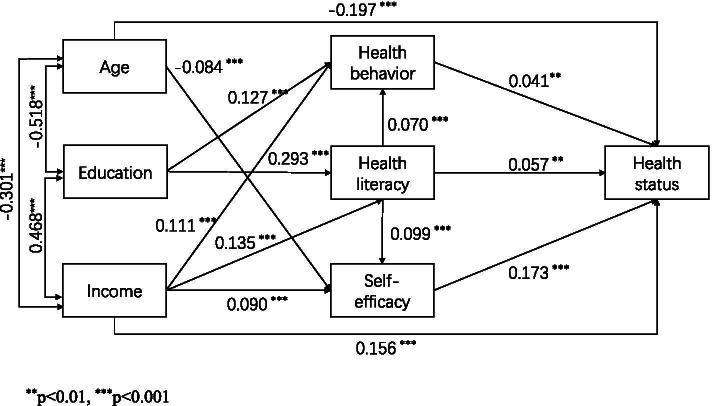
The path analysis showed that higher education (β = 0.293) and income (β = 0.135) are positively and directly associated with greater health literacy, which was positively associated with health status (β = 0.057). Health literacy is a direct influencing factor of health behavior (β = 0.070) and self-efficacy (β = 0.099). Health behavior (β = 0.041) and self-efficacy (β = 0.173) exerted a positive direct effect on health status. The model explained 14.1% of variance for health literacy, 3.8% for self-efficacy, 5.7% for health behavior, and 15.0% for health status.
Health literacy was identified to be a critical factor in health status. The results emphasized that the dissemination of health knowledge, development of healthy behavior, and cultivation of self-efficacy should be jointly promoted to reinforce the level of health status among residents in future work.
健康素养是一个公共卫生目标,可以作为健康结果的独立影响因素。本研究旨在评估健康素养与健康状况之间的关系,以及在青岛 15-69 岁居民中行为和自我效能这两个中介因素的关系。
本研究采用横断面调查的方法,对青岛市 15-69 岁居民(n=3793)进行调查。采用分层聚类随机和比例概率抽样相结合的方法选择研究对象。数据收集使用《中国公民健康素养调查问卷(2019 年版)》。我们提出了一个关于社会人口特征、健康素养、自我效能、健康行为和健康状况之间关系的假设模型,并使用路径分析来验证该假设。
路径分析显示,较高的教育水平(β=0.293)和收入(β=0.135)与更高的健康素养呈正相关,而健康素养与健康状况呈正相关(β=0.057)。健康素养是健康行为(β=0.070)和自我效能(β=0.099)的直接影响因素。健康行为(β=0.041)和自我效能(β=0.173)对健康状况有积极的直接影响。该模型解释了健康素养的 14.1%、自我效能的 3.8%、健康行为的 5.7%和健康状况的 15.0%的方差。
健康素养是健康状况的关键因素。研究结果强调,在未来的工作中,应共同促进健康知识的传播、健康行为的发展和自我效能的培养,以提高居民的健康水平。