Section of Interventional Pulmonology, Pulmonary Service, Department of Medicine, Memorial Sloan Kettering Cancer Center, New York, NY.
Thoracic Service, Department of Surgery, Memorial Sloan Kettering Cancer Center, New York, NY.
Chest. 2022 Feb;161(2):572-582. doi: 10.1016/j.chest.2021.07.2169. Epub 2021 Aug 9.
The landscape of guided bronchoscopy for the sampling of pulmonary parenchymal lesions is evolving rapidly. Shape-sensing robotic-assisted bronchoscopy (ssRAB) recently was introduced as means to allow successful sampling of traditionally challenging lesions.
What are the feasibility, diagnostic yield, determinants of diagnostic sampling, and safety of ssRAB in patients with pulmonary lesions?
Data from 131 consecutive ssRAB procedures performed at a US-based cancer center between October 2019 and July 2020 were captured prospectively and analyzed retrospectively. Definitions of diagnostic procedures were based on prior standards. Associations of procedure- and lesion-related factors with diagnostic yield were examined by univariate and multivariate generalized linear mixed models.
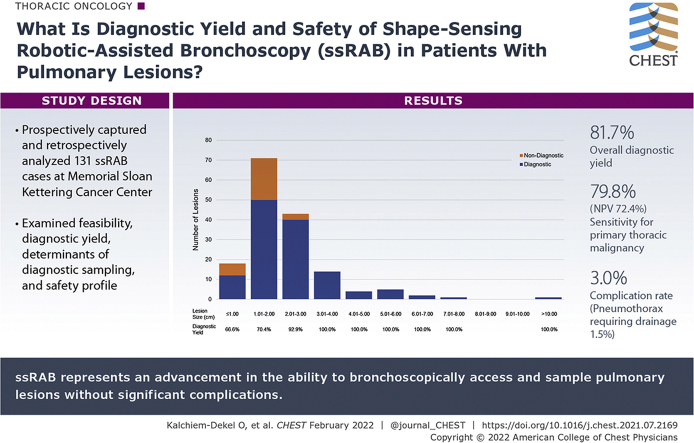
A total of 159 pulmonary lesions were targeted during 131 ssRAB procedures. The median lesion size was 1.8 cm, 59.1% of lesions were in the upper lobe, and 66.7% of lesions were beyond a sixth-generation airway. The navigational success rate was 98.7%. The overall diagnostic yield was 81.7%. Lesion size of ≥ 1.8 cm and central location were associated significantly with a diagnostic procedure in the univariate analysis. In the multivariate model, lesions of ≥ 1.8 cm were more likely to be diagnostic compared with lesions < 1.8 cm, after adjusting for lung centrality (OR, 12.22; 95% CI, 1.66-90.10). The sensitivity and negative predictive value of ssRAB for primary thoracic malignancies were 79.8% and 72.4%, respectively. The overall complication rate was 3.0%, and the pneumothorax rate was 1.5%.
This study was the first to provide comprehensive evidence regarding the usefulness and diagnostic yield of ssRAB in the sampling of pulmonary parenchymal lesions. ssRAB may represent a significant advancement in the ability to access and sample successfully traditionally challenging pulmonary lesions via the bronchoscopic approach, while maintaining a superb safety profile. Lesion size seems to remain the major predictor of a diagnostic procedure.
引导式支气管镜检查用于肺实质病变取样的技术领域正在迅速发展。形状感应机器人辅助支气管镜检查(ssRAB)最近被引入,作为成功取样传统上具有挑战性病变的手段。
在肺病变患者中,ssRAB 的可行性、诊断率、诊断性取样的决定因素和安全性如何?
2019 年 10 月至 2020 年 7 月,在美国一家癌症中心进行的 131 例连续 ssRAB 手术的数据被前瞻性捕获,并进行回顾性分析。诊断程序的定义基于先前的标准。通过单变量和多变量广义线性混合模型检查程序和病变相关因素与诊断率的关联。
在 131 例 ssRAB 手术中,共靶向 159 个肺病变。病变的中位大小为 1.8cm,59.1%的病变位于上叶,66.7%的病变位于第六代气道以外。导航成功率为 98.7%。总体诊断率为 81.7%。在单变量分析中,病变大小≥1.8cm 和中央位置与诊断性程序显著相关。在多变量模型中,与病变大小<1.8cm 相比,病变大小≥1.8cm 的病变更有可能进行诊断,调整肺中心性后(OR,12.22;95%CI,1.66-90.10)。ssRAB 对原发性胸内恶性肿瘤的敏感性和阴性预测值分别为 79.8%和 72.4%。总体并发症率为 3.0%,气胸发生率为 1.5%。
这项研究首次提供了关于 ssRAB 在肺实质病变取样中的实用性和诊断率的综合证据。ssRAB 可能代表了通过支气管镜途径成功获取和取样传统上具有挑战性的肺病变的能力的重大进展,同时保持出色的安全性。病变大小似乎仍然是诊断性程序的主要预测因素。