Department of Respiratory Medicine, The Second Hospital of Dalian Medical University, Dalian, 116023, China.
Liaoning Clinical Research Center for Lung Cancer, The Second Hospital of Dalian Medical University, Dalian, 116023, China.
Environ Health Prev Med. 2021 Aug 13;26(1):80. doi: 10.1186/s12199-021-00998-2.
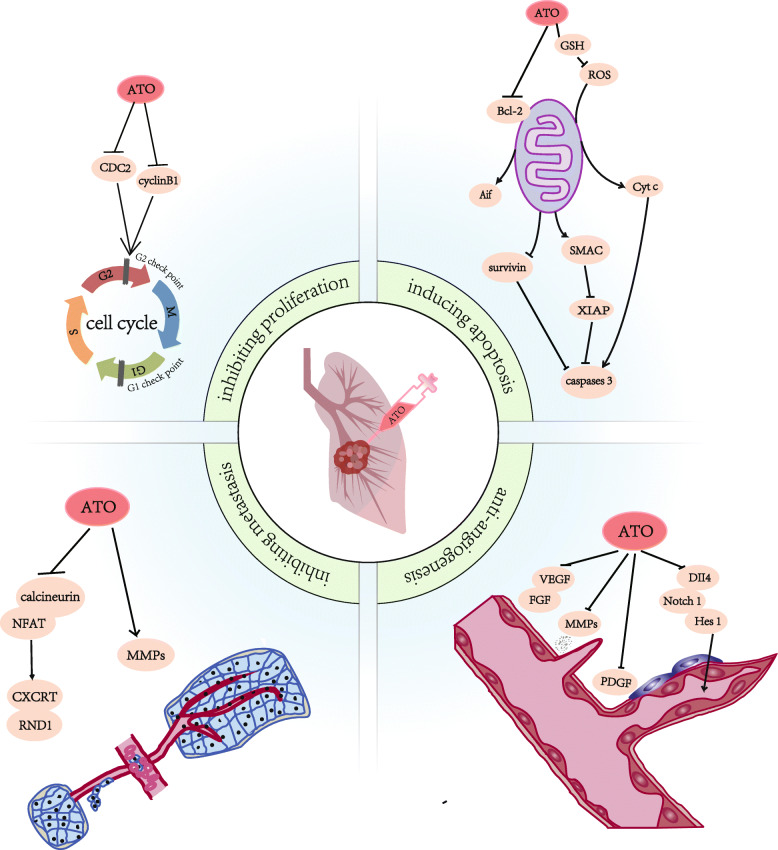
High levels (> 100 ug/L) of arsenic are known to cause lung cancer; however, whether low (≤ 10 ug/L) and medium (10 to 100 ug/L) doses of arsenic will cause lung cancer or other lung diseases, and whether arsenic has dose-dependent or threshold effects, remains unknown. Summarizing the results of previous studies, we infer that low- and medium-concentration arsenic cause lung diseases in a dose-dependent manner. Arsenic trioxide (ATO) is recognized as a chemotherapeutic drug for acute promyelocytic leukemia (APL), also having a significant effect on lung cancer. The anti-lung cancer mechanisms of ATO include inhibition of proliferation, promotion of apoptosis, anti-angiogenesis, and inhibition of tumor metastasis. In this review, we summarized the role of arsenic in lung disease from both pathogenic and therapeutic perspectives. Understanding the paradoxical effects of arsenic in the lungs may provide some ideas for further research on the occurrence and treatment of lung diseases.
已知高水平(> 100ug/L)的砷会导致肺癌;然而,低水平(≤ 10ug/L)和中等水平(10 至 100ug/L)的砷是否会导致肺癌或其他肺部疾病,以及砷是否存在剂量依赖性或阈值效应,目前尚不清楚。总结以往研究的结果,我们推断低浓度和中浓度砷会以剂量依赖的方式引起肺部疾病。三氧化二砷(ATO)被认为是治疗急性早幼粒细胞白血病(APL)的化疗药物,对肺癌也有显著疗效。ATO 的抗癌机制包括抑制增殖、促进凋亡、抗血管生成和抑制肿瘤转移。在这篇综述中,我们从发病机制和治疗两个角度总结了砷在肺部疾病中的作用。了解砷在肺部的矛盾作用可能为进一步研究肺部疾病的发生和治疗提供一些思路。