Ng Thomas S C, Gao Xin, Salari Keyan, Zlatev Dimitar V, Heidari Pedram, Kamran Sophia C
Division of Nuclear Medicine and Molecular Imaging, Department of Radiology, Massachusetts General Hospital, Harvard Medical School, Boston, MA, United States.
Division of Hematology and Oncology, Department of Medicine, Massachusetts General Hospital, Harvard Medical School, Boston, MA, United States.
Front Oncol. 2021 Jul 28;11:722277. doi: 10.3389/fonc.2021.722277. eCollection 2021.
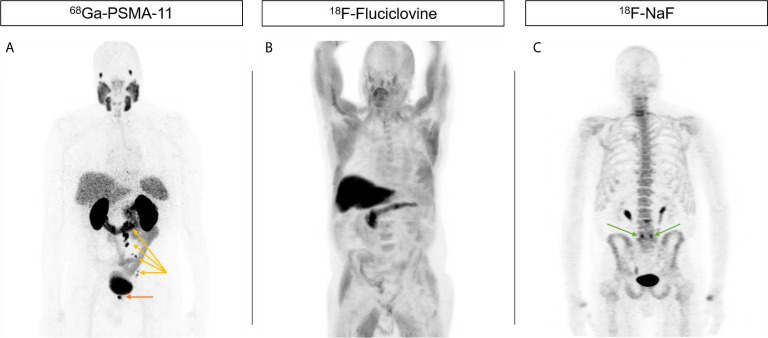
Recent developments in prostate-specific membrane antigen (PSMA) targeted diagnostic imaging and therapeutics (theranostics) promise to advance the management of primary, biochemically recurrent, and metastatic prostate cancer. In order to maximize the clinical impact of PSMA-targeted theranostics, a coordinated approach between the clinical stakeholders involved in prostate cancer management is required. Here, we present a vision for multidisciplinary use of PSMA theranostics from the viewpoints of nuclear radiology, medical oncology, urology, and radiation oncology. We review the currently available and forthcoming PSMA-based imaging and therapeutics and examine current and potential impacts on prostate cancer management from early localized disease to advanced treatment-refractory disease. Finally, we highlight the clinical and research opportunities related to PSMA-targeted theranostics and describe the importance of multidisciplinary collaboration in this space.
前列腺特异性膜抗原(PSMA)靶向诊断成像与治疗(诊疗一体化)的最新进展有望推动原发性、生化复发和转移性前列腺癌的管理。为了使PSMA靶向诊疗一体化产生最大的临床影响,参与前列腺癌管理的临床利益相关者之间需要采取协调一致的方法。在此,我们从核放射学、医学肿瘤学、泌尿外科学和放射肿瘤学的角度,提出了PSMA诊疗一体化多学科应用的设想。我们回顾了目前可用的和即将出现的基于PSMA的成像和治疗方法,并研究了从早期局限性疾病到晚期难治性疾病对前列腺癌管理的当前和潜在影响。最后,我们强调了与PSMA靶向诊疗一体化相关的临床和研究机会,并描述了该领域多学科合作的重要性。