Khazaei Monfared Yousef, Heidari Pedram, Klempner Samuel J, Mahmood Umar, Parikh Aparna R, Hong Theodore S, Strickland Matthew R, Esfahani Shadi A
Division of Nuclear Medicine and Molecular Imaging, Department of Radiology, Massachusetts General Hospital, Harvard Medical School, Boston, MA 02114, USA.
Division of Hematology-Oncology, Department of Medicine, Mass General Cancer Center, Massachusetts General Hospital, Harvard Medical School, Boston, MA 02114, USA.
Pharmaceutics. 2023 Dec 12;15(12):2761. doi: 10.3390/pharmaceutics15122761.
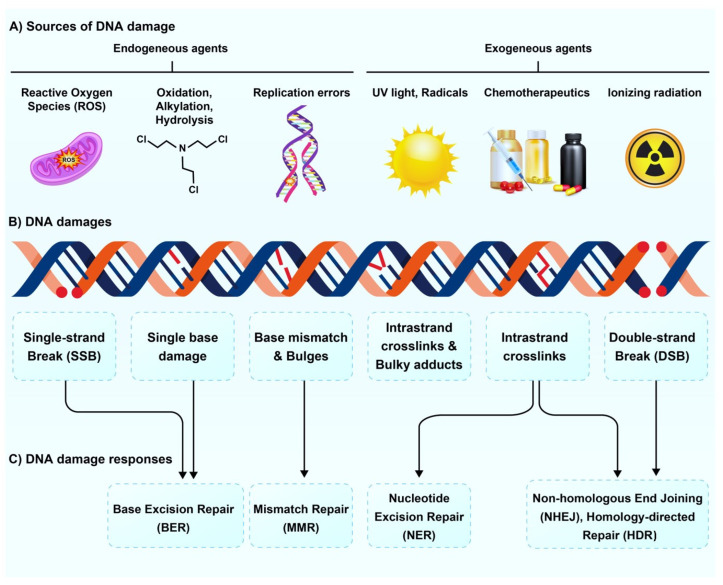
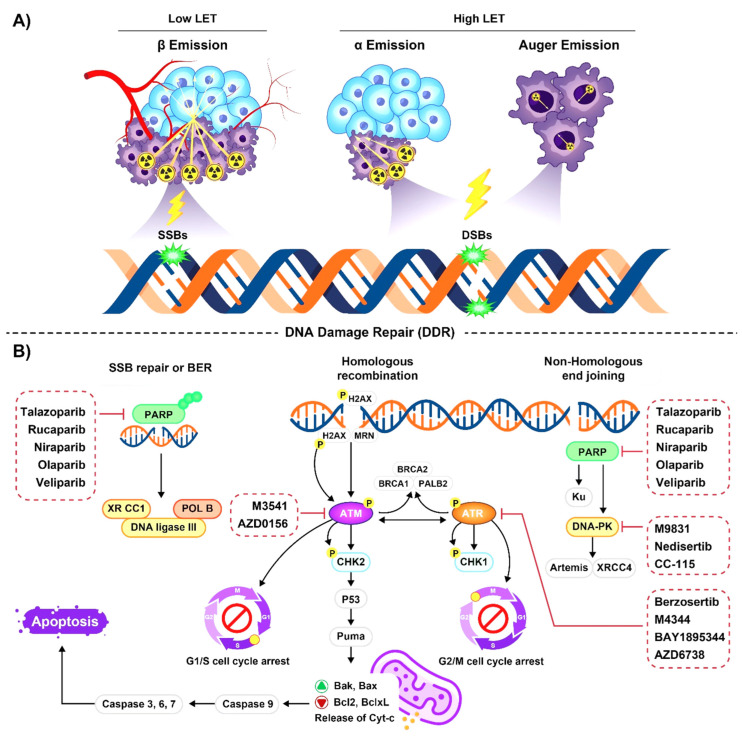
DNA is an organic molecule that is highly vulnerable to chemical alterations and breaks caused by both internal and external factors. Cells possess complex and advanced mechanisms, including DNA repair, damage tolerance, cell cycle checkpoints, and cell death pathways, which together minimize the potentially harmful effects of DNA damage. However, in cancer cells, the normal DNA damage tolerance and response processes are disrupted or deregulated. This results in increased mutagenesis and genomic instability within the cancer cells, a known driver of cancer progression and therapeutic resistance. On the other hand, the inherent instability of the genome in rapidly dividing cancer cells can be exploited as a tool to kill by imposing DNA damage with radiopharmaceuticals. As the field of targeted radiopharmaceutical therapy (RPT) is rapidly growing in oncology, it is crucial to have a deep understanding of the impact of systemic radiation delivery by radiopharmaceuticals on the DNA of tumors and healthy tissues. The distribution and activation of DNA damage and repair pathways caused by RPT can be different based on the characteristics of the radioisotope and molecular target. Here we provide a comprehensive discussion of the biological effects of RPTs, with the main focus on the role of varying radioisotopes in inducing direct and indirect DNA damage and activating DNA repair pathways.
DNA是一种有机分子,极易受到内部和外部因素导致的化学改变和断裂的影响。细胞拥有复杂而先进的机制,包括DNA修复、损伤耐受、细胞周期检查点和细胞死亡途径,这些机制共同将DNA损伤的潜在有害影响降至最低。然而,在癌细胞中,正常的DNA损伤耐受和反应过程会被破坏或失调。这导致癌细胞内的诱变增加和基因组不稳定,这是癌症进展和治疗抗性的已知驱动因素。另一方面,快速分裂的癌细胞基因组的固有不稳定性可以被用作一种工具,通过用放射性药物施加DNA损伤来杀死癌细胞。随着靶向放射性药物治疗(RPT)领域在肿瘤学中迅速发展,深入了解放射性药物全身辐射对肿瘤和健康组织DNA的影响至关重要。基于放射性同位素和分子靶点的特性,RPT引起的DNA损伤和修复途径的分布和激活可能会有所不同。在此,我们全面讨论RPT的生物学效应,主要关注不同放射性同位素在诱导直接和间接DNA损伤以及激活DNA修复途径中的作用。