Office of Cancer Prevention and Treatment, Sichuan Cancer Hospital & Institute, Sichuan Cancer Center, School of Medicine, University of Electronic Science and Technology of China, Chengdu, China.
The Brown School, Washington University in Saint Louis, Saint Louis, MO, United States of America.
PLoS One. 2021 Aug 16;16(8):e0256297. doi: 10.1371/journal.pone.0256297. eCollection 2021.
The effects of childhood adversities on cognitive function in later life are well reported. However, few studies have examined the cumulative mechanism, especially in Chinese population. This study aims to explore this cumulative effects of childhood adversities on mid to late cognitive decline in China.
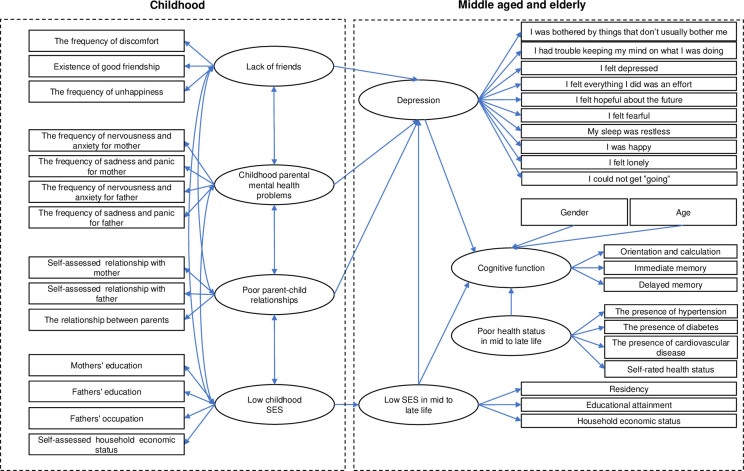
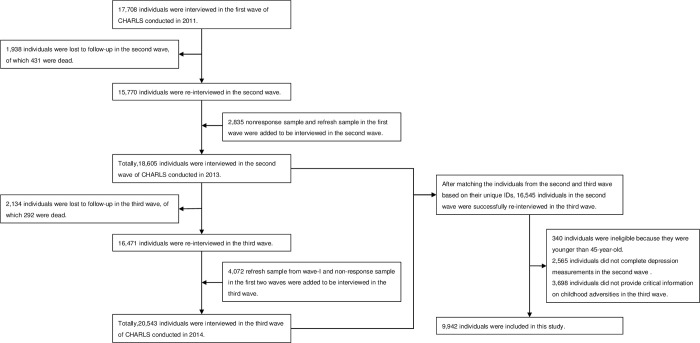
Data were drawn from the second and third wave of the China Health and Retirement Longitudinal Study (CHARLS). We included 9,942 respondents aged 45 and above and retrospectively collected information on childhood adversities. Cognitive function was measured in three dimensions: orientation and calculation, immediate memory, and delayed memory. A structural equation model was employed for analysis.
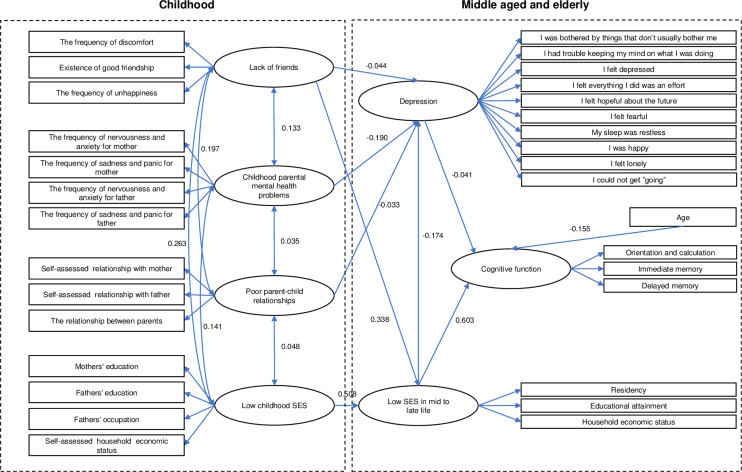
Age (β = -0.155, P<0.001) and mid to late depressive symptoms (β = -0.041, P<0.001) showed direct effects on cognitive decline. Low mid to late life socioeconomic status (SES) showed a direct effect on mid-late cognitive impairment (β = 0.603, P<0.001) and an indirect effect through depression (β = 0.007, P<0.001). Low childhood SES (β = 0.310, P<0.001), lack of friends (β = 0.208, P<0.001), parental mental health problems (β = 0.008, P<0.001), and poor relationship with parents (β = 0.001, P<0.001) had an indirect effect on cognitive impairment.
Childhood adversities had negative effects on cognitive function among middle aged and elderly population in China. The findings suggest that early counter measures on childhood adversities may lead to an effective reduction of cognitive impairment.
儿童期逆境对晚年认知功能的影响已有大量报道。然而,很少有研究探讨其累积机制,尤其是在中国人群中。本研究旨在探讨儿童期逆境对中国中老年认知衰退的累积效应。
数据来自中国健康与养老追踪调查(CHARLS)的第二和第三波调查。我们纳入了 9942 名年龄在 45 岁及以上的受访者,并回顾性收集了儿童期逆境的信息。认知功能在三个维度上进行测量:定向和计算、即刻记忆和延迟记忆。采用结构方程模型进行分析。
年龄(β=-0.155,P<0.001)和中老年期抑郁症状(β=-0.041,P<0.001)对认知衰退有直接影响。中晚期低社会经济地位(SES)对中晚期认知障碍有直接影响(β=0.603,P<0.001),并通过抑郁产生间接影响(β=0.007,P<0.001)。儿童期 SES 低(β=0.310,P<0.001)、缺乏朋友(β=0.208,P<0.001)、父母心理健康问题(β=0.008,P<0.001)和与父母关系差(β=0.001,P<0.001)对认知障碍有间接影响。
儿童期逆境对中国中老年人群的认知功能有负面影响。研究结果表明,早期采取针对儿童期逆境的干预措施可能会有效降低认知障碍的发生。