Chiao Chi, Weng Li-Jen
Insitute of Health and Welfare Policy, Research Center for Health and Welfare Policy, College of Medicine, National Yang-Ming University, Taipei, Taiwan, R.O.C.
Department of Psychology, College of Science, National Taiwan University, Taipei, Taiwan, R.O.C.
BMC Geriatr. 2016 Apr 20;16:88. doi: 10.1186/s12877-016-0257-7.
Few longitudinal studies have analyzed how socioeconomic status (SES) influences both depressive and cognitive development over an individual's life course. This study investigates the change trajectories of both depressive symptomatology and general cognitive status, as well as their associations over time, focusing on the effects of mid-life SES.
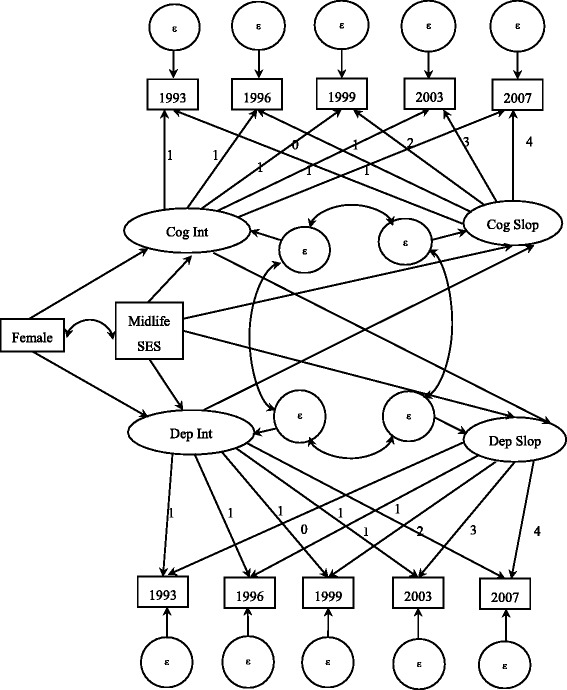
Data were obtained from the Taiwan Longitudinal Study on Aging (1993-2007), a nationally representative cohort study of older adults in Taiwan. The short form of the Center of Epidemiological Studies-Depression (CES-D) scale that measures depressive symptomatology in two domains (negative affect and lack of positive affect) was used. General cognitive status was assessed using the brief Short Portable Mental Status Questionnaire scale. Assessments of the subjects' mid-life SES included measurement of the participant's education and occupation. Analyses were conducted by the parallel latent growth curve modeling.
The participants' initial levels of depressive symptomatology and general cognitive status were significantly and negatively correlated; furthermore, any changes in these two outcomes were also correlated over time. The initial assessment of general cognitive status significantly contributed to any advancement towards more severe depressive symptomatology over time, particularly when this occurred in a negative manner. Furthermore, a mid-life SES advantage resulted in a significant reduction in late-life depressive symptomatology and also produced a slower decline in general cognitive status during later life. In contrast, lower mid-life SES exacerbated depressive symptomatology during old age, both at the initial assessment and in terms of the change over time. In addition, female gender was significantly associated with lower general cognitive status and more severe depressive symptomatology in negative affect.
These findings suggest a complex and longitudinal association between depressive symptomatology and general cognitive status in later life and this complicated relationship seems to be affected by mid-life SES over time.
很少有纵向研究分析社会经济地位(SES)如何在个体的生命历程中影响抑郁和认知发展。本研究调查了抑郁症状和一般认知状态的变化轨迹,以及它们随时间的关联,重点关注中年SES的影响。
数据来自台湾老年纵向研究(1993 - 2007年),这是一项对台湾老年人具有全国代表性的队列研究。使用流行病学研究中心抑郁量表(CES - D)简表,该量表在两个领域(消极情绪和缺乏积极情绪)测量抑郁症状。使用简短便携式精神状态问卷量表评估一般认知状态。对受试者中年SES的评估包括对参与者教育程度和职业的测量。采用平行潜在增长曲线模型进行分析。
参与者的抑郁症状初始水平与一般认知状态显著负相关;此外,这两个结果的任何变化也随时间相关。一般认知状态的初始评估对随着时间向更严重抑郁症状的任何进展有显著贡献,特别是当这种进展以消极方式发生时。此外,中年SES优势导致晚年抑郁症状显著减少,并且在晚年一般认知状态的下降也更缓慢。相比之下,中年SES较低在老年期初始评估时以及随时间变化方面都会加剧抑郁症状。此外,女性性别与较低的一般认知状态和消极情绪方面更严重的抑郁症状显著相关。
这些发现表明晚年抑郁症状和一般认知状态之间存在复杂的纵向关联,并且这种复杂关系似乎会随时间受到中年SES的影响。