Jockey Club School of Public Health and Primary Care (Guo, Yang, Bo, Zeng, Lao), the Chinese University of Hong Kong, Hong Kong SAR, China; Department of Public Health (Yu), National Cheng Kung University, Tainan, Taiwan; Institute of Sociology (Chang), Academia Sinica, Taipei, Taiwan; Division of Environment and Sustainability (Lin, Lau), the Hong Kong University of Science and Technology, Hong Kong SAR, China; Department of Civil and Environmental Engineering (Lau), the Hong Kong University of Science and Technology, Hong Kong SAR, China; Department of Nutrition and Food Hygiene (Bo), School of Public Health, Zhengzhou University, China; Department of Sociology (Tam), the Chinese University of Hong Kong, Hong Kong SAR, China; Shenzhen Research Institute of the Chinese University of Hong Kong (Lao), Shenzhen, China.
CMAJ. 2021 Aug 16;193(32):E1240-E1249. doi: 10.1503/cmaj.202729.
Exercise may exacerbate the adverse health effects of air pollution by increasing the inhalation of air pollutants. We investigated the combined effects of long-term exposure to fine particle matter (PM) and habitual exercise on deaths from natural causes in Taiwan.
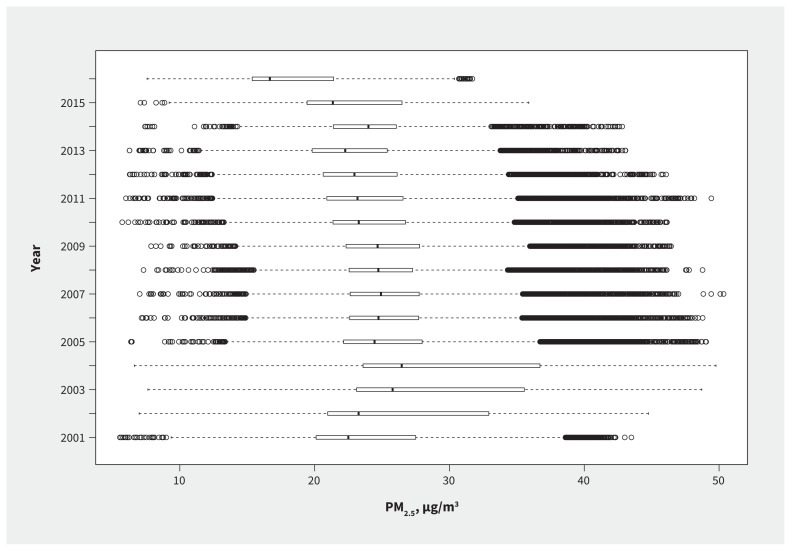
We recruited 384 130 adults (aged ≥ 18 yr) with 842 394 medical examination records between 2001 and 2016, and followed all participants until May 31, 2019. We obtained vital data from the National Death Registry of Taiwan. We estimated PM exposure using a satellite-based spatiotemporal model, and collected information on exercise habits using a standard self-administered questionnaire. We analyzed the data using a Cox regression model with time-dependent covariates.
A higher level of habitual exercise was associated with a lower risk of death from natural causes, compared with inactivity (hazard ratio [HR] 0.84, 95% confidence interval [CI] 0.80-0.88 for the moderate exercise group; HR 0.65, 95% CI 0.62-0.68 for the high exercise groups), whereas a higher PM exposure was associated with a higher risk of death from natural causes compared with lower exposure (HR 1.02, 95% CI 0.98-1.07, and HR 1.15, 95% CI 1.10-1.20, for the moderate and high PM exposure groups, respectively). Compared with inactive adults with high PM exposure, adults with high levels of habitual exercise and low PM exposure had a substantially lower risk of death from natural causes. We found a minor, but statistically significant, interaction effect between exercise and PM exposure on risk of death (HR 1.03 95% CI 1.01-1.06). Subgroup analyses, stratified by PM categories, suggested that moderate and high levels of exercise were associated with a lower risk of death in each PM stratum, compared with inactivity.
Increased levels of exercise and reduced PM exposure are associated with a lower risk of death from natural causes. Habitual exercise can reduce risk regardless of the levels of PM exposure. Our results suggest that exercise is a safe health improvement strategy, even for people residing in relatively polluted regions.
运动可能会通过增加空气污染物的吸入而加剧空气污染对健康的不利影响。我们研究了长期暴露于细颗粒物(PM)和习惯性运动对台湾自然原因死亡的综合影响。
我们招募了 384130 名成年人(年龄≥18 岁),他们在 2001 年至 2016 年间有 842394 份体检记录,并随访所有参与者直至 2019 年 5 月 31 日。我们从台湾国家死亡登记处获得了重要数据。我们使用基于卫星的时空模型来估计 PM 暴露量,并使用标准的自我管理问卷来收集运动习惯信息。我们使用具有时变协变量的 Cox 回归模型来分析数据。
与不活动相比,较高水平的习惯性运动与较低的自然原因死亡风险相关(中度运动组的危险比[HR]为 0.84,95%置信区间[CI]为 0.80-0.88;高运动组的 HR 为 0.65,95%CI 为 0.62-0.68),而较高的 PM 暴露与较高的自然原因死亡风险相关,与较低的暴露相比(中度和高 PM 暴露组的 HR 分别为 1.02,95%CI 为 0.98-1.07,和 HR 为 1.15,95%CI 为 1.10-1.20)。与高 PM 暴露的不活跃成年人相比,高水平习惯性运动和低 PM 暴露的成年人自然原因死亡风险显著降低。我们发现运动和 PM 暴露对死亡风险的交互作用较小,但具有统计学意义(HR 为 1.03,95%CI 为 1.01-1.06)。按 PM 类别进行的亚组分析表明,与不活动相比,中高强度运动与各 PM 层的死亡风险降低相关。
增加运动水平和减少 PM 暴露与自然原因死亡风险降低有关。习惯性运动无论 PM 暴露水平如何都可以降低风险。我们的研究结果表明,即使在污染相对严重的地区,运动也是一种安全的健康改善策略。