Wang Shuo, Liu Ying, Wang Linxin, Zuo Haiqi, Tian Yanfeng, Wang Yimeng, Yin Dechun, Zhang Haiyu, Tian Ye
Department of Pathophysiology and Key Laboratory of Cardiovascular Pathophysiology, Harbin Medical University, Key Laboratory of Cardiovascular Research (Harbin Medical University), Ministry of Education, Harbin 150086, PR China.
Heilongjiang Academy of Medical Sciences, Harbin, China.
Int J Cardiol Heart Vasc. 2021 Aug 2;36:100850. doi: 10.1016/j.ijcha.2021.100850. eCollection 2021 Oct.
The optimal antithrombotic strategy, especially regarding oral anticoagulants (OACs) for atrial fibrillation (AF) patients with bleeding and thrombosis risk after percutaneous coronary intervention (PCI), remains unknown. This study explored the optimal oral anticoagulants for AF patients after PCI using a -analysis.
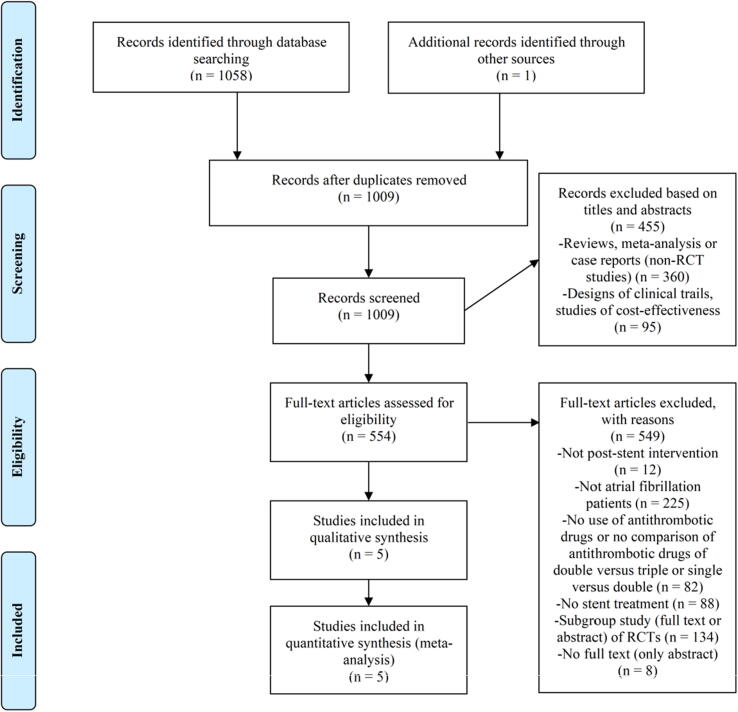
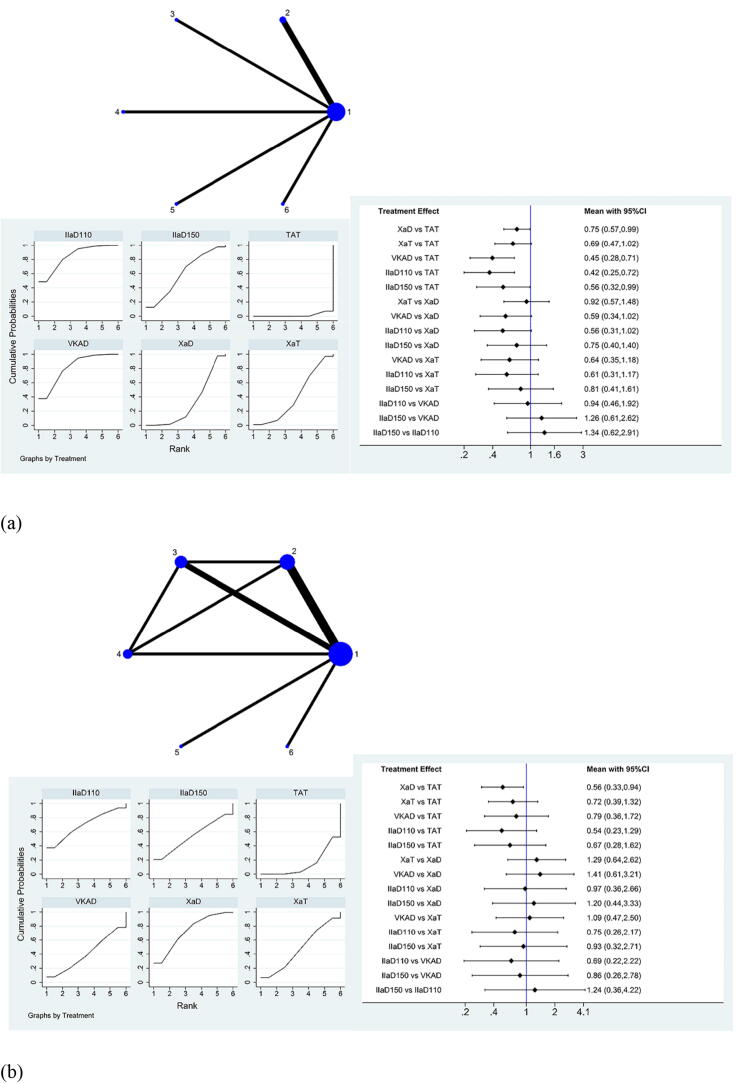
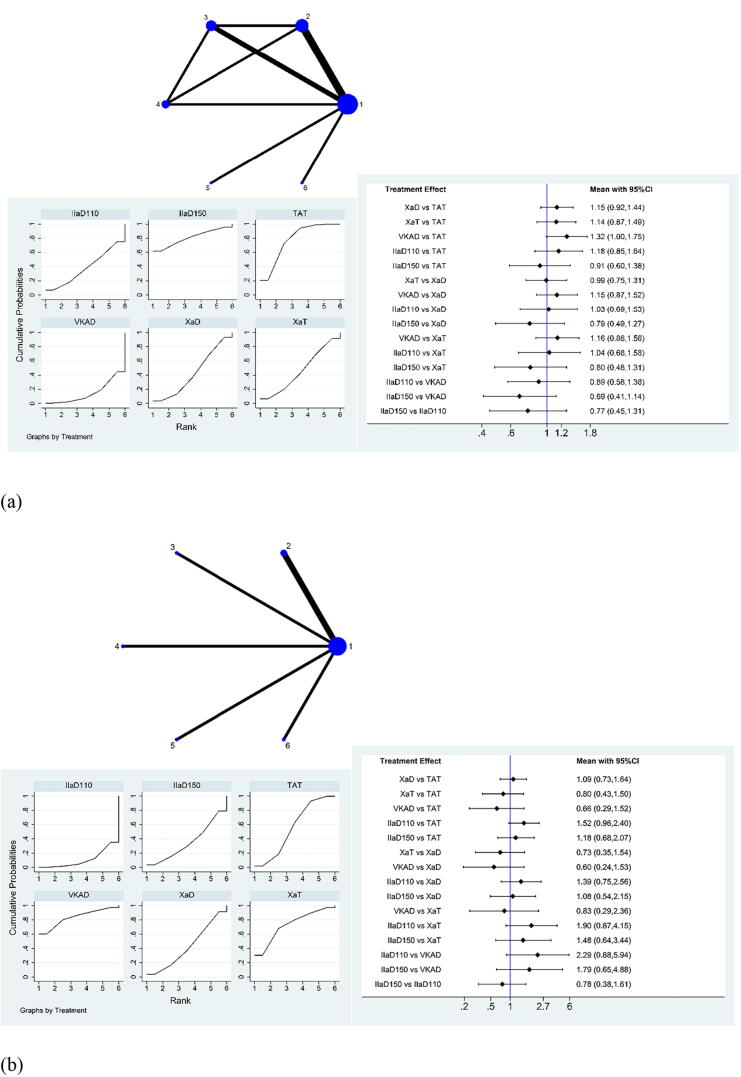
Randomised controlled trials were identified from PubMed, Embase, and the Cochrane Library through December 2020. Risk ratios, 95% confidence intervals, and random-effects models were used to compare different antithrombotic strategies through network -analysis, and the combination of antithrombotic agents was ranked according to the surface under the cumulative ranking curve and rankograms. Interval plots were drawn to observe pairwise comparisons between the different strategies.
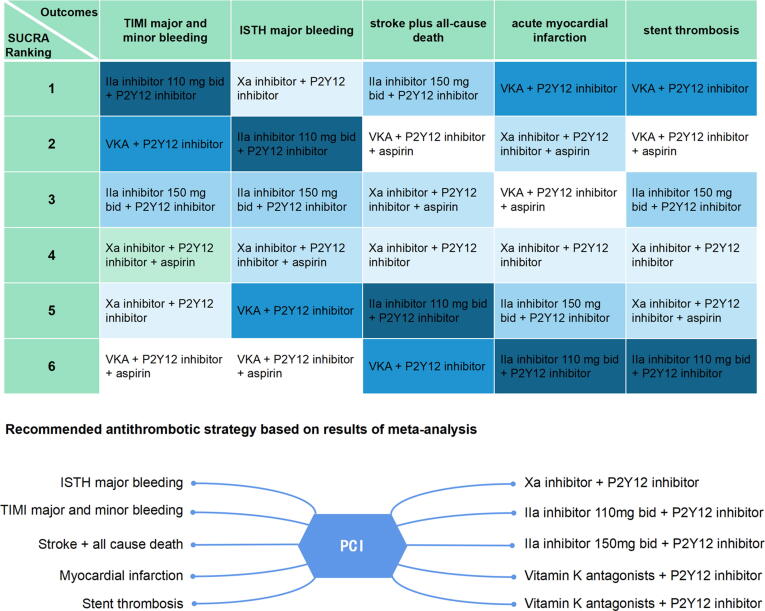
Five studies of 11,532 patients were included. Factor IIa inhibitor 110 mg bid plus a P2Y12 inhibitor had the greatest advantage for reducing Thrombolysis In Myocardial Infarction (TIMI) major or minor bleeding; Factor Xa inhibitor plus a P2Y12 inhibitor had the greatest advantage for reducing International Society on Thrombosis and Hemostasis major bleeding. For patients at risk of stroke plus all-cause death, factor IIa inhibitor 150 mg bid plus a P2Y12 inhibitor should be prioritised, and for those at risk of myocardial infarction and stent thrombosis, vitamin K antagonists plus a P2Y12 inhibitor were preferred.
Factor IIa inhibitor 110 mg, factor IIa inhibitor 150 mg, factor Xa inhibitor and vitamin K antagonists should be selected in different situations.
对于经皮冠状动脉介入治疗(PCI)后有出血和血栓形成风险的心房颤动(AF)患者,最佳抗栓策略,尤其是关于口服抗凝药(OACs)的策略,仍不明确。本研究采用网络荟萃分析探讨PCI术后AF患者的最佳口服抗凝药。
通过检索截至2020年12月的PubMed、Embase和Cochrane图书馆,确定随机对照试验。通过网络荟萃分析,使用风险比、95%置信区间和随机效应模型比较不同的抗栓策略,并根据累积排序曲线下面积和排序图对抗栓药物组合进行排序。绘制区间图以观察不同策略之间的成对比较。
纳入了5项研究,共11532例患者。凝血因子IIa抑制剂110mg bid加P2Y12抑制剂在减少心肌梗死溶栓(TIMI)大出血或小出血方面优势最大;凝血因子Xa抑制剂加P2Y12抑制剂在减少国际血栓与止血学会大出血方面优势最大。对于有中风加全因死亡风险的患者,应优先选择凝血因子IIa抑制剂150mg bid加P2Y12抑制剂;对于有心肌梗死和支架血栓形成风险的患者,维生素K拮抗剂加P2Y12抑制剂更受青睐。
应在不同情况下选择凝血因子IIa抑制剂110mg、凝血因子IIa抑制剂150mg、凝血因子Xa抑制剂和维生素K拮抗剂。