DeVore Elliana K, Gray Stacey T, Huston Molly N, Song Phillip C, Alkire Blake C, Naunheim Matthew R
Department of Otolaryngology-Head and Neck Surgery, Massachusetts Eye and Ear Infirmary Boston Massachusetts USA.
Department of Otolaryngology, Washington University in St. Louis St. Louis Missouri USA.
Laryngoscope Investig Otolaryngol. 2021 Jun 25;6(4):794-799. doi: 10.1002/lio2.604. eCollection 2021 Aug.
To determine preference patterns for topical anesthesia in patients undergoing endoscopy pre-coronavirus (2019 coronavirus disease [COVID-19]) pandemic and analyze outcomes based on preference, using a decision aid format.
A decision aid was developed with expert and patient input. New patients presenting to subspecialty clinics over a 2-month pre-COVID-19 period completed a pre-procedure survey about their priorities, then were asked to choose between topical oxymetazoline/lidocaine spray or none. A post-procedure outcome survey followed.
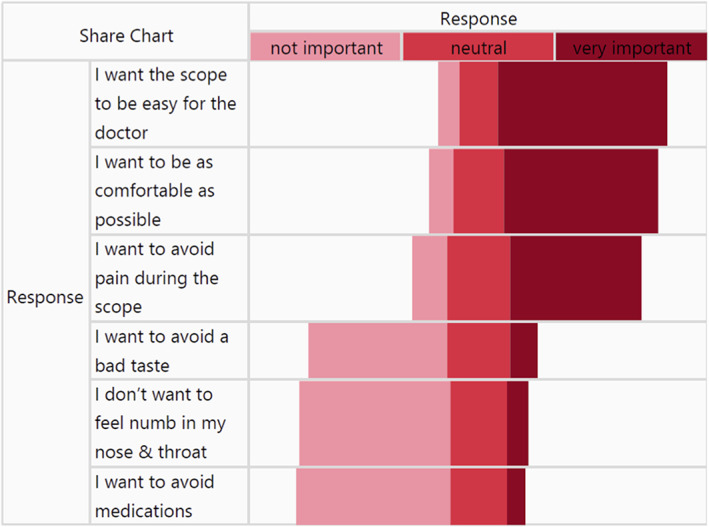
Of 151 patients, 90.1% patients elected to have topical anesthesia. Top patient priorities were "I want the scope to be easy for the doctor" and "I want to be as comfortable as possible." Patients who strongly wanted to avoid medication ( = .002) and bad taste ( = .003) were more likely to select no spray, whereas those who wanted to avoid pain received anesthetic ( = .011). According to the post-procedure assessment, 95.4% of patients were satisfied or strongly satisfied their choice, and this did not correlate with anesthetic vs none.
Patient preferences are easily elicited and correlate with treatment choices. Most patients chose to have topical anesthetic and were willing to tolerate side effects; however, both patients with and without topical anesthetic were satisfied with their choices. This decision aid can be used to optimize shared decision making in the otolaryngology clinic. Given the aerosolizing potential of both spray and no spray conditions, this insight may be consequential when devising office protocols for post-COVID-19 practice.
II.
确定在冠状病毒病(2019冠状病毒病[COVID-19])大流行之前接受内镜检查的患者对局部麻醉的偏好模式,并使用决策辅助工具根据偏好分析结果。
在专家和患者的参与下开发了一种决策辅助工具。在COVID-19大流行前的2个月内,到专科门诊就诊的新患者在术前完成了一项关于其优先事项的调查,然后被要求在使用局部用羟甲唑啉/利多卡因喷雾剂和不使用之间做出选择。术后进行了结果调查。
在151例患者中,90.1%的患者选择进行局部麻醉。患者最优先考虑的是“我希望医生操作内镜时轻松”和“我希望尽可能舒适”。强烈希望避免用药(P = 0.002)和讨厌味道(P = 0.003)的患者更有可能选择不使用喷雾剂,而那些希望避免疼痛的患者则接受麻醉(P = 0.011)。根据术后评估,95.4%的患者对自己的选择感到满意或非常满意,这与是否使用麻醉剂无关。
患者的偏好很容易被引出,并且与治疗选择相关。大多数患者选择使用局部麻醉剂并愿意忍受副作用;然而,使用和未使用局部麻醉剂的患者对自己的选择都很满意。这种决策辅助工具可用于优化耳鼻喉科诊所的共同决策。鉴于喷雾剂使用和不使用喷雾剂两种情况下都有产生气溶胶的可能性,在制定COVID-19后实践的门诊方案时,这一见解可能具有重要意义。
II级。