Centre for Endocrinology, William Harvey Research Institute, Barts and the London School of Medicine and Dentistry, Queen Mary University of London, London, UK.
Endocrinology Unit, Department of Paediatrics, Faculty of Medicine, Prince of Songkla University, Songkhla, Thailand.
Eur J Endocrinol. 2021 Oct 8;185(5):617-627. doi: 10.1530/EJE-21-0387.
Pubertal delay can be the clinical presentation of both idiopathic hypogonadotropic hypogonadism (IHH) and self-limited delayed puberty (SLDP). Distinction between these conditions is a common but important diagnostic challenge in adolescents.
To assess whether gene panel testing can assist with clinical differential diagnosis and to allow accurate and timely management of delayed puberty patients.
Retrospective study.
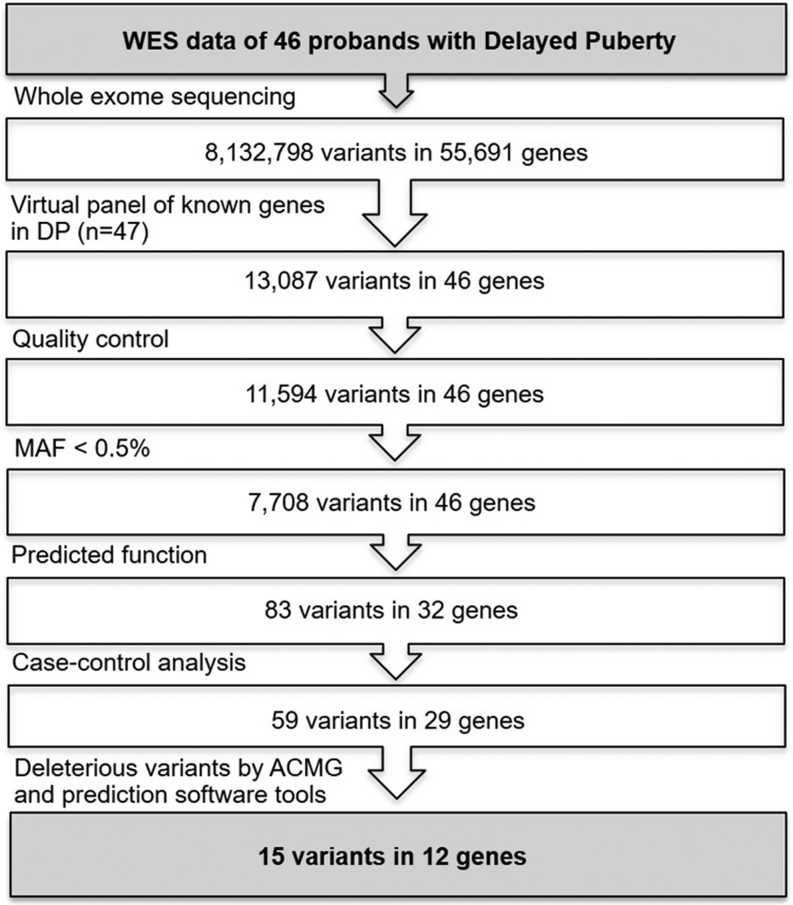
Patients presenting with delayed puberty to UK Paediatric services, followed up to final diagnosis, were included. Whole-exome sequencing was analysed using a virtual panel of genes previously reported to cause either IHH or SLDP to identify rarely predicted deleterious variants. Deleterious variants were verified by in silico prediction tools. The correlation between clinical and genotype diagnosis was analysed.
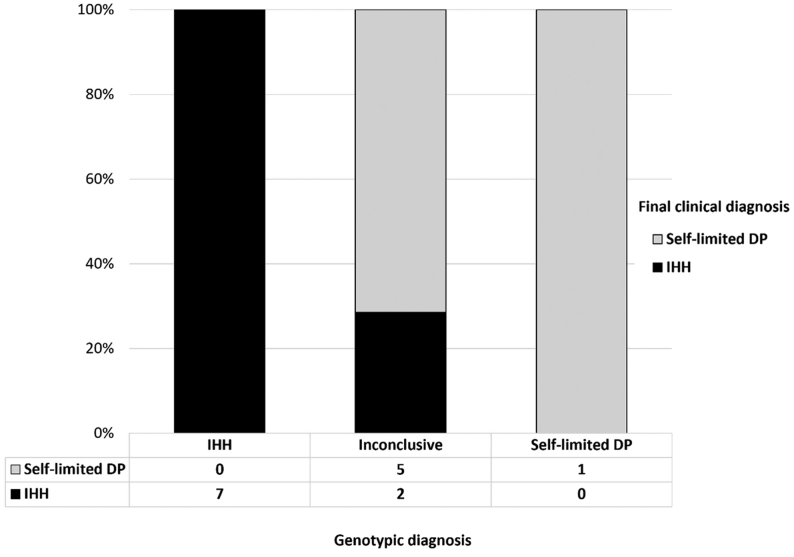
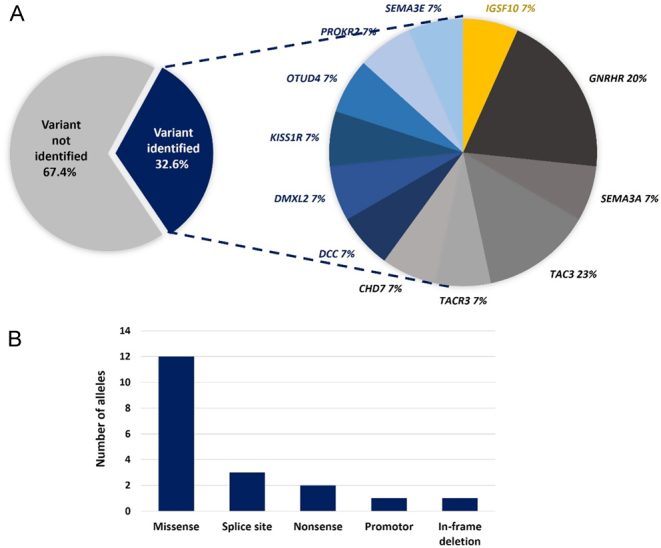
Forty-six patients were included, 54% with a final clinical diagnosis of SLDP and 46% with IHH. Red flags signs of IHH were present in only three patients. Fifteen predicted deleterious variants in 12 genes were identified in 33% of the cohort, with most inherited in a heterozygous manner. A fair correlation between final clinical diagnosis and genotypic diagnosis was found. Panel testing was able to confirm a diagnosis of IHH in patients with pubertal delay. Genetic analysis identified three patients with IHH that had been previously diagnosed as SLDP.
This study supports the use of targeted exome sequencing in the clinical setting to aid the differential diagnosis between IHH and SLDP in adolescents presenting with pubertal delay. Genetic evaluation thus facilitates earlier and more precise diagnosis, allowing clinicians to direct treatment appropriately.
青春期延迟可表现为特发性低促性腺激素性性腺功能减退症(IHH)和自限性青春延迟(SLDP)。区分这些病症是青少年中常见但具有重要诊断挑战性的问题。
评估基因面板检测是否有助于临床鉴别诊断,并能准确、及时地管理青春期延迟患者。
回顾性研究。
纳入在英国儿科就诊的以青春期延迟为表现的患者,随访至最终诊断。使用先前报道与 IHH 或 SLDP 相关的虚拟基因面板分析全外显子测序,以确定罕见预测的有害变异。通过计算机预测工具验证有害变异。分析临床和基因型诊断之间的相关性。
共纳入 46 例患者,54%最终临床诊断为 SLDP,46%为 IHH。仅有 3 例患者存在 IHH 的红色预警体征。在 33%的患者中发现了 12 个基因中的 15 个预测有害变异,多数以杂合子方式遗传。最终临床诊断和基因诊断之间存在良好的相关性。面板检测能够确认青春期延迟患者的 IHH 诊断。基因分析鉴定出 3 例先前被诊断为 SLDP 的 IHH 患者。
本研究支持在临床环境中使用靶向外显子测序,以帮助鉴别青春期延迟患者的 IHH 和 SLDP。遗传评估有助于更早、更精确的诊断,使临床医生能够进行适当的治疗。