Department of Statistics, College of Science, Engineering and Technology, University of South Africa, Florida Campus, 28 Pioneer Avenue, Roodeport, Johannesburg, 1709, South Africa.
Department of Mathematical Statistics and Actuarial Science, Faculty of Natural and Agricultural Sciences, University of the Free State, P.O. Box 339, Bloemfontein, South Africa.
BMC Public Health. 2021 Aug 17;21(1):1560. doi: 10.1186/s12889-021-11592-0.
In South Africa (SA), stroke is the second highest cause of mortality and disability. Apart from being the main killer and cause of disability, stroke is an expensive disease to live with. Stroke costs include death and medical costs. Little is known about the stroke burden, particularly the stroke direct costs in SA. Identification of stroke costs predictors using appropriate statistical methods can help formulate appropriate health programs and policies aimed at reducing the stroke burden. Analysis of stroke costs have in the main, concentrated on mean regression, yet modelling with quantile regression (QR) is more appropriate than using mean regression. This is because the QR provides flexibility to analyse the stroke costs predictors corresponding to quantiles of interest. This study aims to estimate stroke direct costs, identify and quantify its predictors through QR analysis.
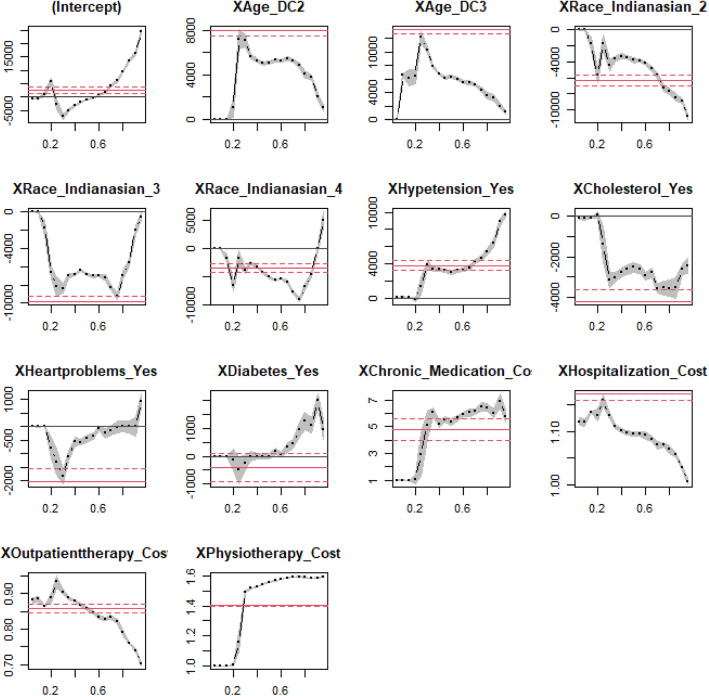
Hospital-based data from 35,730 stroke cases were retrieved from selected private and public hospitals between January 2014 and December 2018. The model used, QR provides richer information about the predictors on costs. The prevalence-based approach was used to estimate the total stroke costs. Thus, stroke direct costs were estimated by taking into account the costs of all stroke patients admitted during the study period. QR analysis was used to assess the effect of each predictor on stroke costs distribution. Quantiles of stroke direct costs, with a focus on predictors, were modelled and the impact of predictors determined. QR plots of slopes were developed to visually examine the impact of the predictors across selected quantiles.
Of the 35,730 stroke cases, 22,183 were diabetic. The estimated total direct costs over five years were R7.3 trillion, with R2.6 billion from inpatient care. The economic stroke burden was found to increase in people with hypertension, heart problems, and diabetes. The age group 55-75 years had a bigger effect on costs distribution at the lower than upper quantiles.
The identified predictors can be used to raise awareness on modifiable predictors and promote campaigns for healthy dietary choices. Modelling costs predictors using multivariate QR models could be beneficial for addressing the stroke burden in SA.
在南非(SA),中风是第二大死亡和残疾原因。中风不仅是主要的杀手和致残原因,而且是一种昂贵的疾病。中风的费用包括死亡和医疗费用。人们对中风负担知之甚少,特别是在南非,对中风直接成本知之甚少。使用适当的统计方法识别中风成本的预测因素可以帮助制定旨在减轻中风负担的适当卫生计划和政策。中风成本的分析主要集中在均值回归上,然而,使用分位数回归(QR)进行建模比使用均值回归更合适。这是因为 QR 提供了灵活性,可以分析与感兴趣分位数相对应的中风成本预测因素。本研究旨在通过 QR 分析估计中风直接成本,识别和量化其预测因素。
从 2014 年 1 月至 2018 年 12 月期间,从选定的私人和公立医院获取了 35730 例中风病例的基于医院的资料。使用的模型 QR 提供了有关成本预测因素的更丰富信息。使用基于患病率的方法来估计中风的总费用。因此,通过考虑研究期间所有中风患者的费用来估计中风的直接费用。QR 分析用于评估每个预测因素对中风成本分布的影响。针对特定的预测因素,对中风直接成本的分位数进行建模,并确定预测因素的影响。开发 QR 斜率图以直观地检查预测因素在选定分位数上的影响。
在 35730 例中风病例中,有 22183 例为糖尿病患者。在五年内,估计的直接总成本为 7.3 万亿兰特,其中 26 亿兰特来自住院治疗。研究发现,患有高血压、心脏问题和糖尿病的人的经济中风负担增加。55-75 岁年龄组在较低和较高分位数的成本分布上的影响更大。
确定的预测因素可用于提高对可改变的预测因素的认识,并促进健康饮食选择的宣传活动。使用多元 QR 模型对成本预测因素进行建模,可能有助于解决南非的中风负担问题。