Faculty of Clinical Medicine and Dentistry, Department of Surgery, Kampala International University Western Campus, Ishaka-Bushenyi, Uganda.
Faculty of Medicine, Université Catholique du Graben, Butembo, Democratic Republic of the Congo.
BMC Health Serv Res. 2021 Aug 18;21(1):831. doi: 10.1186/s12913-021-06870-x.
This study aimed to assess health facilities' readiness to provide safe surgical care during Ebola and COVID-19 era in Uganda and in the Eastern DR Congo.
A cross-sectional study was conducted in selected national, regional referral and general hospital facilities in Uganda and in the eastern part of DR Congo from 1st August 2020 to 30th October 2020. Data was analysed using Stata version 15.
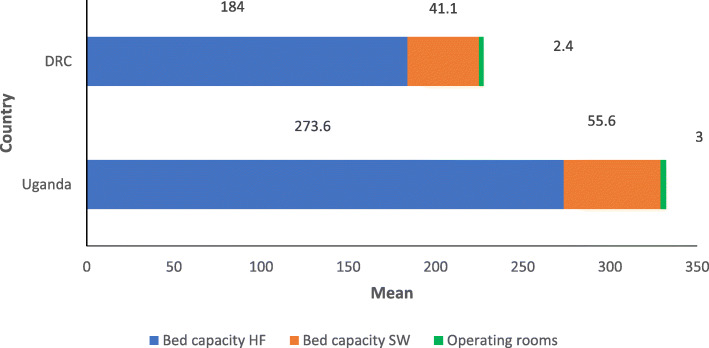
The participation rate was of 37.5 % (72/192) for both countries. None of the hospitals fulfilled the readiness criteria for safe surgical care provision in both countries. The mean bed capacity of participating health facilities (HF) was 184 in Eastern DR Congo and 274 in Uganda with an average surgical ward bed capacity of 22.3 % (41/184) and 20.4 % (56/274) respectively. The mean number of operating rooms was 2 and 3 in Eastern DR Congo and Uganda respectively. Nine hospitals (12.5 %) reported being able to test for Ebola and 25 (34.7 %) being able to test for COVID-19. Postponing of elective surgeries was reported by 10 (13.9) participating hospitals. Only 7 (9.7 %) hospitals reported having a specific operating room for suspect or confirmed cases of Ebola or COVID-19. Appropriate Personal Protection Equipment (PPE) was reported to be available in 60 (83.3 %) hospitals. Most of the staff had appropriate training on donning and doffing of PPE 40 (55.6 %). Specific teams and protocols for safe surgical care provision were reported to be present in 61 (84.7 %) and 56 (77.8 %) respectively in Uganda and Eastern DR Congo participating hospitals.
The lack of readiness to provide safe surgical care during Ebola and COVID-19 era across the participating hospitals in both countries indicate a need for strategies to enhance health facility supplies and readiness for safe surgical provision in resource-limited settings.
本研究旨在评估乌干达和刚果民主共和国东部在埃博拉和 COVID-19 时代为提供安全外科护理做好卫生机构准备的情况。
2020 年 8 月 1 日至 10 月 30 日,在乌干达和刚果民主共和国东部的选定国家、区域转诊和综合医院设施中进行了一项横断面研究。使用 Stata 版本 15 对数据进行分析。
两国参与率均为 37.5%(72/192)。两国没有一家医院符合提供安全外科护理的准备标准。参与卫生机构(HF)的平均床位容量分别为刚果民主共和国东部 184 张和乌干达 274 张,平均外科病房床位容量分别为 22.3%(41/184)和 20.4%(56/274)。平均手术室数量分别为 2 个和 3 个,分别为刚果民主共和国东部和乌干达。9 家医院(12.5%)报告能够检测埃博拉,25 家(34.7%)能够检测 COVID-19。10 家(13.9%)参与医院报告推迟了择期手术。只有 7 家(9.7%)医院报告有专门的手术室用于疑似或确诊的埃博拉或 COVID-19病例。报告 60 家(83.3%)医院有适当的个人防护设备(PPE)。大多数工作人员在穿戴和脱下 PPE 方面接受了适当的培训 40(55.6%)。报告乌干达和刚果民主共和国东部参与医院分别有 61(84.7%)和 56(77.8%)专门的团队和协议来提供安全的外科护理。
两国参与医院在埃博拉和 COVID-19 时代提供安全外科护理的准备情况不足,表明需要采取战略,加强资源有限环境下卫生机构的供应和安全外科供应准备。