Service d'Anatomie Pathologique, Hôpital Nord Franche-Comté, Trévenans, France.
Service de Chirurgie Orthopédique, Centre Hospitalo-Universitaire de Nancy, Laxou, France.
J Med Case Rep. 2021 Aug 18;15(1):428. doi: 10.1186/s13256-021-02962-8.
Gastrointestinal stromal tumors represent the most frequently encountered primary mesenchymal tumors. Whereas the liver and the peritoneum are known to be the preferential metastasis sites, no therapeutic standard has yet been established for the management of bone metastases because of their very low incidence. We report a unique example of a single humerus metastasis of a jejunal gastrointestinal stromal tumor.
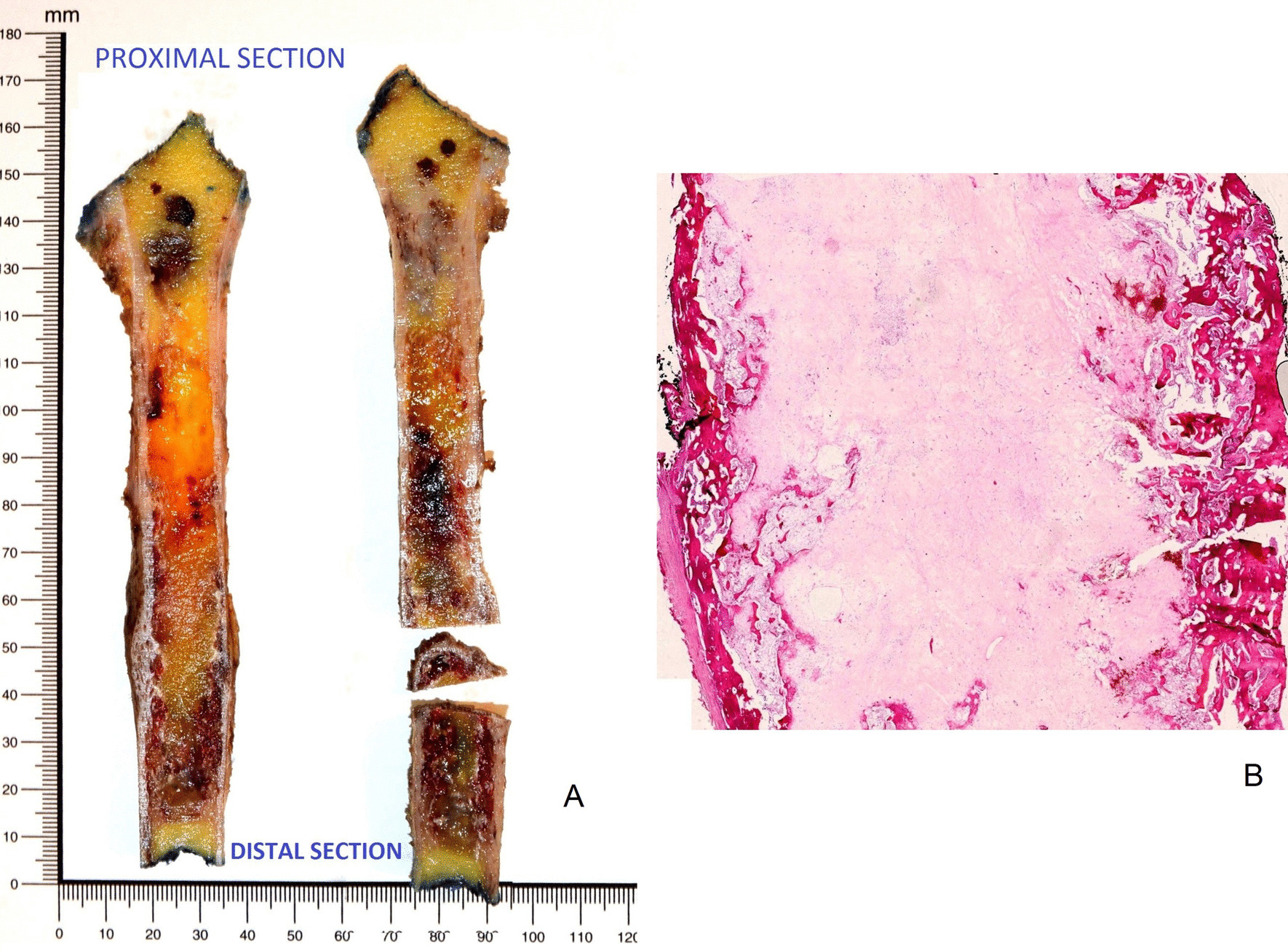
We report the case of a 72-year-old European woman whose jejunal gastrointestinal stromal tumor was resected in 2013 and treated during the following 3 years with imatinib (400 mg daily). In 2018, she developed a single humeral bone lesion that was identified as a gastrointestinal stromal tumor metastasis. After 7 months of imatinib intake, reconstructive surgery was performed. Pathologists confirmed the satisfactory histological regression and assessed the complete tumor resection. The patient is still on imatinib maintenance therapy, with no recurrence reported so far. She fully recovered the upper limb function after following an appropriate rehabilitation program.
Current literature and published case reports indicate that bones are one of the rarest locations of gastrointestinal stromal tumor metastasis (about 1%), with occurrence mainly in the spine. Patients initially diagnosed with gastrointestinal stromal tumor of the small intestine and stomach are more likely to suffer from bone metastasis, compared with other gastrointestinal stromal tumor locations. The median overall survival rate is higher for patients with isolated bone metastasis compared with those having liver metastasis. Metastasis occurs on average 4 years after the primary, but it may take up to 20 years, emphasizing the need for long-term clinical and radiological monitoring. Although specific guidelines for such cases have not yet been established, we suggest that a multimodal concerted approach involving surgery or radiotherapy associated with tyrosine kinase inhibitor intake should be considered.
Bones are one of the rarest locations of gastrointestinal stromal tumor metastasis. A multidisciplinary collaboration was set up to allow conservative surgery of our patient after several months of imatinib treatment. A year and a half later, the patient is still in complete remission. This specific case supports the concept of an intermediate stage between local and oligometastatic disease that should be managed with a curative aim, as much as possible.
胃肠道间质瘤是最常见的原发性间叶性肿瘤。肝脏和腹膜是已知的优先转移部位,但由于其发病率非常低,尚未建立治疗骨转移的标准。我们报告了一例罕见的空肠胃肠道间质瘤单一肱骨转移的病例。
我们报告了一位 72 岁的欧洲女性病例,她在 2013 年切除了空肠胃肠道间质瘤,并在接下来的 3 年中接受了伊马替尼(每天 400mg)治疗。2018 年,她出现了单一的肱骨骨病变,被确定为胃肠道间质瘤转移。伊马替尼治疗 7 个月后,进行了重建手术。病理学家证实了满意的组织学消退,并评估了完全肿瘤切除。患者仍在接受伊马替尼维持治疗,目前尚无复发报告。她在遵循适当的康复计划后完全恢复了上肢功能。
目前的文献和已发表的病例报告表明,骨骼是胃肠道间质瘤转移(约 1%)最罕见的部位之一,主要发生在脊柱。与其他胃肠道间质瘤部位相比,最初诊断为小肠和胃的胃肠道间质瘤患者更有可能发生骨转移。与肝转移患者相比,孤立性骨转移患者的总生存中位数更高。转移平均发生在原发后 4 年,但也可能需要 20 年,这强调了需要长期的临床和影像学监测。尽管尚未为这种情况制定具体指南,但我们建议考虑多模式联合治疗,包括手术或放疗联合酪氨酸激酶抑制剂的摄入。
骨骼是胃肠道间质瘤转移最罕见的部位之一。我们建立了多学科合作,以便在伊马替尼治疗数月后对我们的患者进行保守手术。一年半后,患者仍处于完全缓解状态。这一具体病例支持了中间阶段的概念,即局部和寡转移疾病之间的阶段,应尽可能以治愈为目标进行管理。