Kamdee Kornyok, Panadsako Nitirat, Mueangson Onchuma, Nuinoon Manit, Janwan Penchom, Poonsawat Wasinee, Pongpanitanont Pongphan, Kitkumthorn Nakarin, Thongsroy Jirapan, Chunglok Warangkana
School of Allied Health Sciences, Walailak University, Nakhon Si Thammarat 80160, Thailand.
Research Institute for Health Sciences, Walailak University, Nakhon Si Thammarat 80160, Thailand.
Biomed Rep. 2021 Sep;15(3):78. doi: 10.3892/br.2021.1454. Epub 2021 Jul 23.
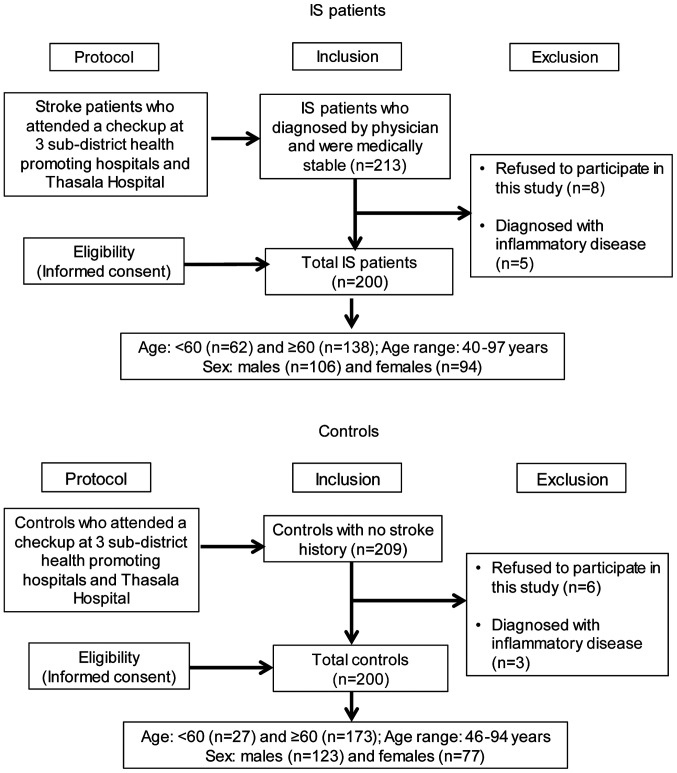
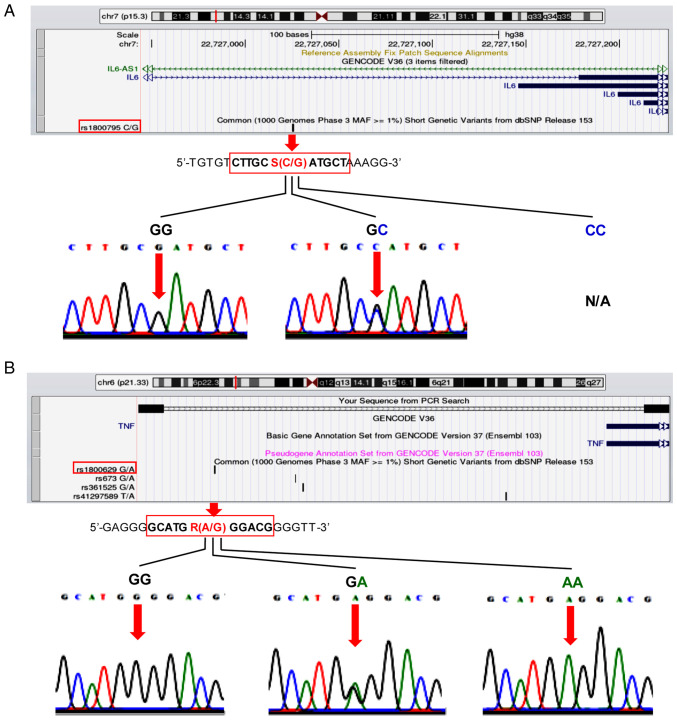
Stroke represents the leading cause of disability and mortality amongst the elderly worldwide. Multiple risk factors, including both genetic and non-genetic components, as well as their interactions, are proposed as etiological factors involved in the development of ischemic stroke (IS). Promoter polymorphisms of the -174G/C (rs1800795) and -308G/A (rs1800629) genes have been considered as predictive risk factors of IS; however, these have not yet been evaluated in a Thai population. The aims of this study were to investigate the association of -174G/C and -308G/A polymorphisms with IS. Genomic DNA from 200 patients with IS and 200 controls were genotyped for -174G/C and -308G/A polymorphisms using TaqMan™ SNP genotyping and quantitative PCR-high resolution melting analysis, respectively. It was found that the -308 A allele was significantly associated with an increased risk of IS development compared with the G allele [odds ratio (OR)=2.044; 95% CI=1.154-3.620; P=0.014]. Moreover, the IS risk was significantly higher in the presence of -308 GA or AA genotypes compared with that in the presence of GG genotypes with a dominant inheritance (OR=1.971; 95% CI=1.080-3.599; P=0.027). However, there was no association between -174G/C and the risk of IS development. The interaction study demonstrated that -174 GG and 308 GG genotypes enhanced IS susceptibility when combined with hypertension, hyperlipidemia and alcohol consumption. Hypertensive and hyperlipidemic subjects with the -308 GA and AA genotypes were more likely to develop IS compared with those who did not have these two conditions and had the GG genotype. In a matched study design (1:1), the -174 GC genotype was associated with higher IL-6 levels in the control group. Collectively, the present results highlight the utility of the -308G/A polymorphism as a predictive genetic risk factor for development of IS.
中风是全球老年人残疾和死亡的主要原因。多种风险因素,包括遗传和非遗传成分及其相互作用,被认为是缺血性中风(IS)发病的病因。-174G/C(rs1800795)和-308G/A(rs1800629)基因的启动子多态性被视为IS的预测风险因素;然而,尚未在泰国人群中进行评估。本研究的目的是调查-174G/C和-308G/A多态性与IS的关联。分别使用TaqMan™ SNP基因分型和定量PCR-高分辨率熔解分析对200例IS患者和200例对照的基因组DNA进行-174G/C和-308G/A多态性基因分型。结果发现,与G等位基因相比,-308 A等位基因与IS发病风险增加显著相关[比值比(OR)=2.044;95%可信区间(CI)=1.154-3.620;P=0.014]。此外,与GG基因型相比,-308 GA或AA基因型存在时的IS风险在显性遗传中显著更高(OR=1.971;95%CI=1.080-3.599;P=0.027)。然而,-174G/C与IS发病风险之间没有关联。相互作用研究表明,-174 GG和308 GG基因型与高血压、高脂血症和饮酒相结合时会增强IS易感性。与没有这两种情况且为GG基因型的受试者相比,具有-308 GA和AA基因型的高血压和高脂血症受试者更易发生IS。在匹配的研究设计(1:1)中,-174 GC基因型与对照组中较高的白细胞介素-6水平相关。总体而言,目前的结果突出了-308G/A多态性作为IS发病预测性遗传风险因素的作用。