Alipoor Elham, Hosseinzadeh-Attar Mohammad Javad, Salehi Shiva, Dahmardehei Mostafa, Yaseri Mehdi, Emami Mohammad Reza, Hajian Mehdi, Rezayat Seyed Mahdi, Jazayeri Shima
Department of Nutrition, School of Public Health, Iran University of Medical Sciences, Tehran, Iran.
Department of Clinical Nutrition, School of Nutritional Sciences and Dietetics, Tehran University of Medical Sciences, Tehran, Iran.
Arch Acad Emerg Med. 2021 Jul 5;9(1):e50. doi: 10.22037/aaem.v9i1.1289. eCollection 2021.
Collagen and omega-3 fatty acids (FAs) are suggested to have anti-inflammatory, anti-oxidant, and insulin-sensitizing properties. The aim of this study was to investigate the effect of collagen hydrolysate and omega-3 FAs on inflammation and insulin resistance in patients with major burns.
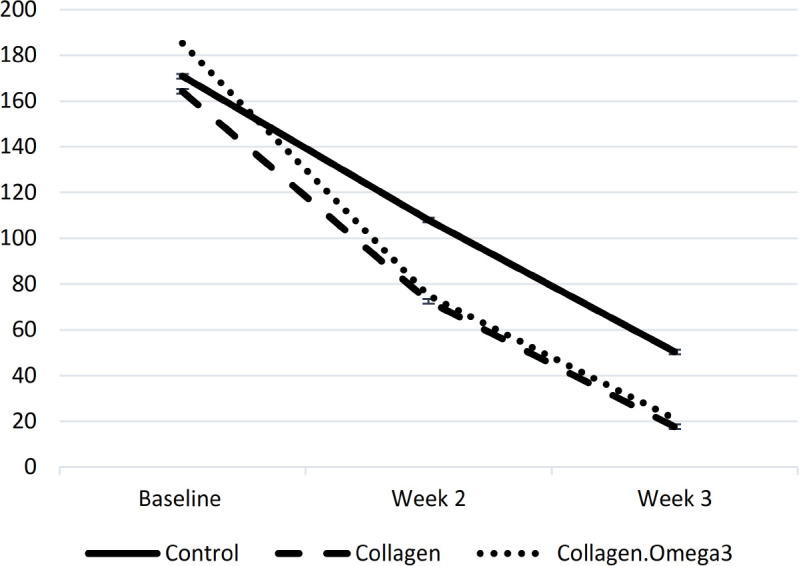
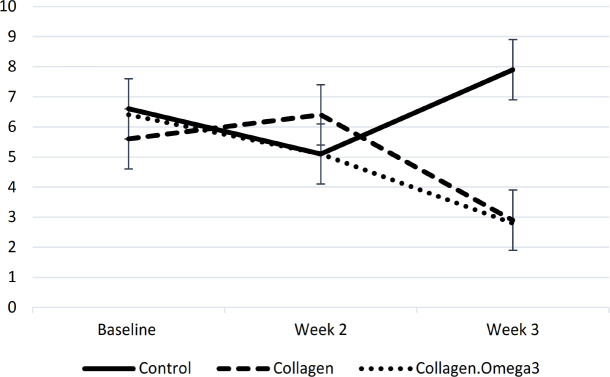
In this double-blind randomized clinical trial, 66 patients with 20-45% burns were assigned to either of the three groups of collagen (40 gr/d), collagen (40 gr/d) plus fish oil (10 ml/d), or control. High-sensitivity C-reactive protein (hs-CRP), fasting blood glucose (FBG) and insulin concentrations, and homeostatic model assessment for insulin resistance (HOMA-IR) were assessed at baseline, as well as end of weeks two and three.
Based on post-hoc analyses, hs-CRP levels were significantly lower in the collagen (p=0.026) and collagen+omega-3 (p=0.044) groups compared to the control group, at week three. However, pre- to post- (week three) changes of hs-CRP were significantly higher only in the collagen+omega-3 group compared to the control group (173.2 vs. 103.7 mg/l, p=0.024). After three weeks of the intervention, insulin (11.3 and 11.9 vs. 22.8 µIU/ml) and HOMA-IR (2.9 and 2.8 vs. 7.9) values seemed to be clinically, but not statistically, lower in both intervention groups compared to the control group. Pre- to post- (week three) values of FBG decreased significantly in the collagen (p=0.002) and collagen+omega-3 (p=0.036) groups. Insulin (p=0.008) and HOMA-IR (p=0.001) decreased significantly only in the collagen+omega-3 group at week three compared to the baseline.
Supplementation with collagen hydrolysate and omega-3 FAs can improve hs-CRP concentration and probably insulin resistance in patients with severe burns. Omega-3 FAs had additional effects on modulating inflammation. Larger clinical trials are needed to confirm the current findings especially in terms of glucose homeostasis.
胶原蛋白和ω-3脂肪酸(FAs)被认为具有抗炎、抗氧化和胰岛素增敏特性。本研究旨在探讨胶原蛋白水解物和ω-3脂肪酸对重度烧伤患者炎症和胰岛素抵抗的影响。
在这项双盲随机临床试验中,66例烧伤面积为20%-45%的患者被分为三组,分别为胶原蛋白组(40克/天)、胶原蛋白(40克/天)加鱼油组(10毫升/天)或对照组。在基线以及第2周和第3周结束时评估高敏C反应蛋白(hs-CRP)、空腹血糖(FBG)和胰岛素浓度,以及胰岛素抵抗稳态模型评估(HOMA-IR)。
根据事后分析,在第3周时,胶原蛋白组(p=0.026)和胶原蛋白+ω-3组(p=0.044)的hs-CRP水平显著低于对照组。然而,与对照组相比,仅胶原蛋白+ω-3组hs-CRP从基线到第3周的变化显著更高(173.2对103.7毫克/升,p=0.024)。干预3周后,与对照组相比,两个干预组的胰岛素(11.3和11.9对22.8微国际单位/毫升)和HOMA-IR(2.9和2.8对7.9)值在临床上似乎较低,但无统计学意义。在胶原蛋白组(p=0.002)和胶原蛋白+ω-3组(p=0.036)中,FBG从基线到第3周的值显著降低。与基线相比,仅在第3周时,胶原蛋白+ω-3组的胰岛素(p=0.008)和HOMA-IR(p=0.001)显著降低。
补充胶原蛋白水解物和ω-3脂肪酸可改善重度烧伤患者的hs-CRP浓度,并可能改善胰岛素抵抗。ω-3脂肪酸对调节炎症有额外作用。需要更大规模的临床试验来证实目前的研究结果,尤其是在葡萄糖稳态方面。