Section for Colorectal Cancer Screening, Cancer Registry of Norway, Oslo, Norway.
Department of Research, Cancer Registry of Norway, Oslo, Norway.
BMC Cancer. 2021 Aug 18;21(1):930. doi: 10.1186/s12885-021-08640-8.
Colorectal cancer (CRC) screening reduces CRC incidence and mortality. However, current screening methods are either hampered by invasiveness or suboptimal performance, limiting their effectiveness as primary screening methods. To aid in the development of a non-invasive screening test with improved sensitivity and specificity, we have initiated a prospective biomarker study (CRCbiome), nested within a large randomized CRC screening trial in Norway. We aim to develop a microbiome-based classification algorithm to identify advanced colorectal lesions in screening participants testing positive for an immunochemical fecal occult blood test (FIT). We will also examine interactions with host factors, diet, lifestyle and prescription drugs. The prospective nature of the study also enables the analysis of changes in the gut microbiome following the removal of precancerous lesions.
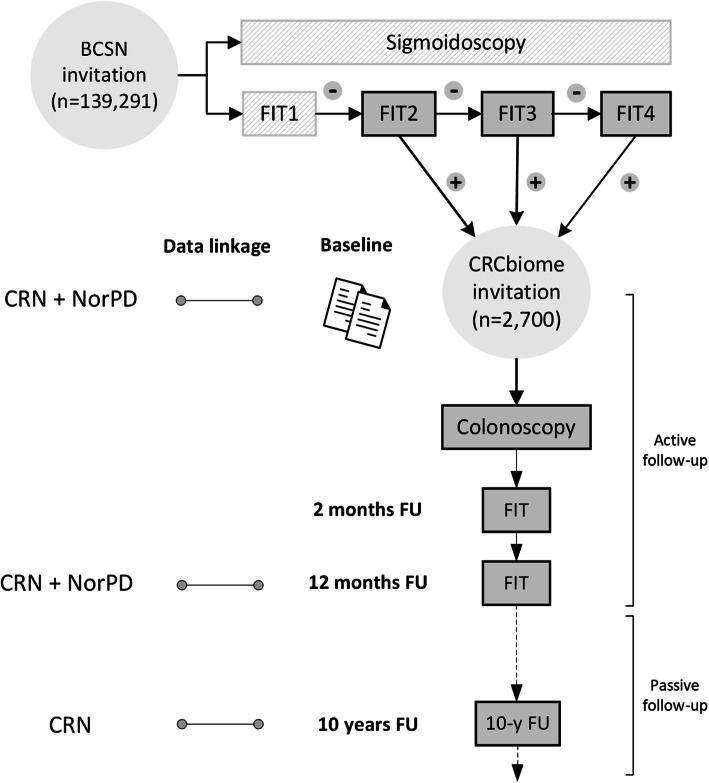
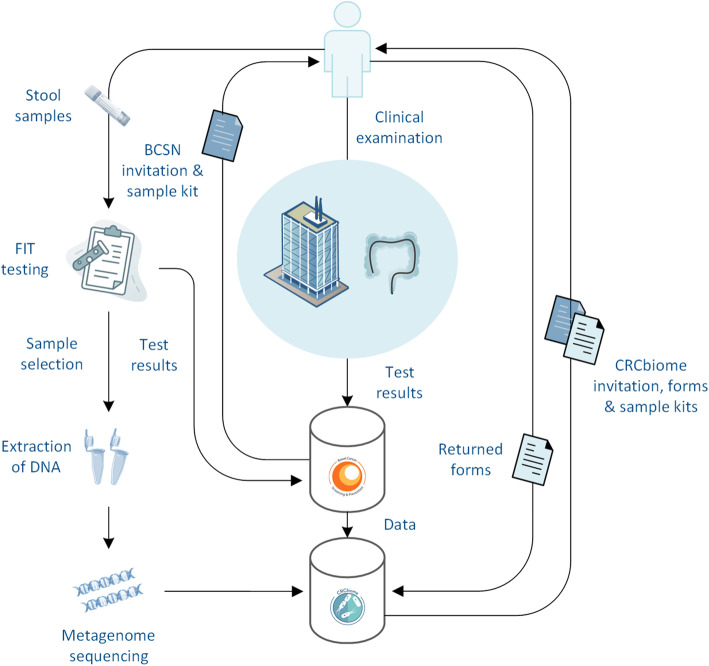
The CRCbiome study recruits participants enrolled in the Bowel Cancer Screening in Norway (BCSN) study, a randomized trial initiated in 2012 comparing once-only sigmoidoscopy to repeated biennial FIT, where women and men aged 50-74 years at study entry are invited to participate. Since 2017, participants randomized to FIT screening with a positive test result have been invited to join the CRCbiome study. Self-reported diet, lifestyle and demographic data are collected prior to colonoscopy after the positive FIT-test (baseline). Screening data, including colonoscopy findings are obtained from the BCSN database. Fecal samples for gut microbiome analyses are collected both before and 2 and 12 months after colonoscopy. Samples are analyzed using metagenome sequencing, with taxonomy profiles, and gene and pathway content as primary measures. CRCbiome data will also be linked to national registries to obtain information on prescription histories and cancer relevant outcomes occurring during the 10 year follow-up period.
The CRCbiome study will increase our understanding of how the gut microbiome, in combination with lifestyle and environmental factors, influences the early stages of colorectal carcinogenesis. This knowledge will be crucial to develop microbiome-based screening tools for CRC. By evaluating biomarker performance in a screening setting, using samples from the target population, the generalizability of the findings to future screening cohorts is likely to be high.
ClinicalTrials.gov Identifier: NCT01538550 .
结直肠癌(CRC)筛查可降低 CRC 的发病率和死亡率。然而,目前的筛查方法要么受到侵袭性的限制,要么性能不理想,限制了它们作为初级筛查方法的有效性。为了帮助开发一种具有更高敏感性和特异性的非侵入性筛查试验,我们在挪威的一项大型 CRC 筛查试验中启动了一项前瞻性生物标志物研究(CRCbiome)。我们旨在开发一种基于微生物组的分类算法,以识别免疫化学粪便潜血试验(FIT)阳性的筛查参与者中的进展性结直肠病变。我们还将研究与宿主因素、饮食、生活方式和处方药的相互作用。研究的前瞻性还使我们能够分析在去除癌前病变后肠道微生物组的变化。
CRCbiome 研究招募了参加挪威结直肠癌筛查(BCSN)研究的参与者,该研究是一项于 2012 年启动的随机试验,比较了单次乙状结肠镜检查与重复两年一次的 FIT,研究开始时年龄在 50-74 岁的女性和男性被邀请参加。自 2017 年以来,接受 FIT 筛查且检测结果阳性的参与者被邀请参加 CRCbiome 研究。在阳性 FIT 检测后(基线)进行结肠镜检查前收集自我报告的饮食、生活方式和人口统计学数据。筛查数据,包括结肠镜检查结果,从 BCSN 数据库中获得。在结肠镜检查前后以及结肠镜检查后 2 个月和 12 个月收集粪便样本进行肠道微生物组分析。使用宏基因组测序分析样本,主要测量指标为分类群谱、基因和途径含量。CRCbiome 数据还将与国家登记处链接,以获得在 10 年随访期间发生的处方史和癌症相关结局的信息。
CRCbiome 研究将增加我们对肠道微生物组如何与生活方式和环境因素一起影响结直肠癌变早期阶段的理解。这方面的知识对于开发基于微生物组的 CRC 筛查工具至关重要。通过在筛查环境中评估生物标志物的性能,使用目标人群的样本,研究结果对未来筛查队列的推广性可能很高。
ClinicalTrials.gov 标识符:NCT01538550。