• 文献检索
  • 文档翻译
  • 深度研究
  • 学术资讯
  • Suppr Zotero 插件Zotero 插件
  • 邀请有礼
  • 套餐&价格
  • 历史记录
应用&插件
Suppr Zotero 插件Zotero 插件浏览器插件Mac 客户端Windows 客户端微信小程序
定价
高级版会员购买积分包购买API积分包
服务
文献检索文档翻译深度研究API 文档MCP 服务
关于我们
关于 Suppr公司介绍联系我们用户协议隐私条款
关注我们

Suppr 超能文献

核心技术专利:CN118964589B侵权必究
粤ICP备2023148730 号-1Suppr @ 2026

文献检索

告别复杂PubMed语法,用中文像聊天一样搜索,搜遍4000万医学文献。AI智能推荐,让科研检索更轻松。

立即免费搜索

文件翻译

保留排版,准确专业,支持PDF/Word/PPT等文件格式,支持 12+语言互译。

免费翻译文档

深度研究

AI帮你快速写综述,25分钟生成高质量综述,智能提取关键信息,辅助科研写作。

立即免费体验

移动健康辅助自我监测可接受用于支持农村男性减肥:一项实用随机对照可行性试验。

Mobile health assisted self-monitoring is acceptable for supporting weight loss in rural men: a pragmatic randomized controlled feasibility trial.

机构信息

College of Nursing-Northern Division, University of Nebraska Medical Center, 801 East Benjamin Avenue, Norfolk, NE, 68701, USA.

College of Public Health, University of Nebraska Medical Center, 984355 Medical Center, Omaha, NE, 68198-4355, USA.

出版信息

BMC Public Health. 2021 Aug 18;21(1):1568. doi: 10.1186/s12889-021-11618-7.

DOI:10.1186/s12889-021-11618-7
PMID:34407782
原文链接:https://pmc.ncbi.nlm.nih.gov/articles/PMC8375071/
Abstract

BACKGROUND

Addressing overweight and obesity among men at-risk for obesity-related diseases and disability in rural communities is a public health issue. Commercial smartphone applications (apps) that promote self-monitoring for weight loss are widely available. Evidence is lacking regarding what support is required to enhance user engagement with and effectiveness of those technologies. Pragmatically comparing these apps effectiveness, including rural men's desired forms of support when using them, can lead to greater weight loss intervention impact and reach. This study assessed the feasibility and acceptability of a mobile technology application applied differently across two groups for weight loss.

METHODS

In a two-armed, pragmatic pilot feasibility study, 80 overweight and obese men aged 40-69 were randomized using a 1:1 ratio to either an enhanced Mobile Technology Plus (MT+) intervention or a basic Mobile Technology (MT) intervention. The MT+ group had an enhanced smartphone app for self-monitoring (text messaging, discussion group, Wi-Fi scale) whereas the MT group received a basic app that allowed self-monitoring logging only. Assessments were collected at baseline, 3 and 6 months. App logs were analyzed to track engagement and adherence to self-monitoring. Acceptability was assessed via focus groups. Analysis included descriptive statistics and qualitative content analysis.

RESULTS

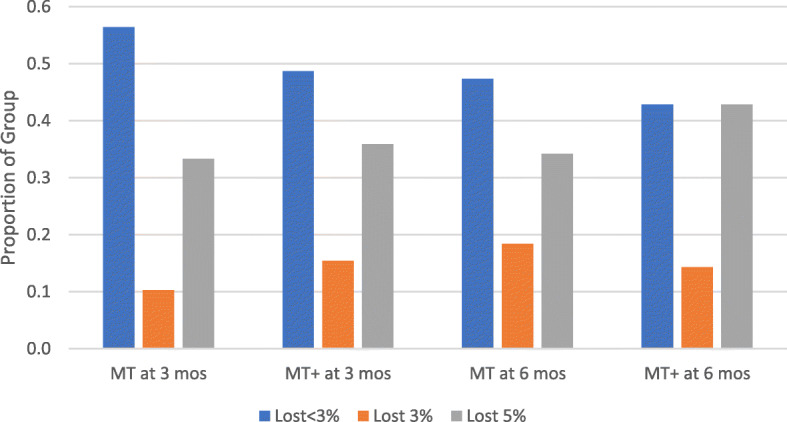
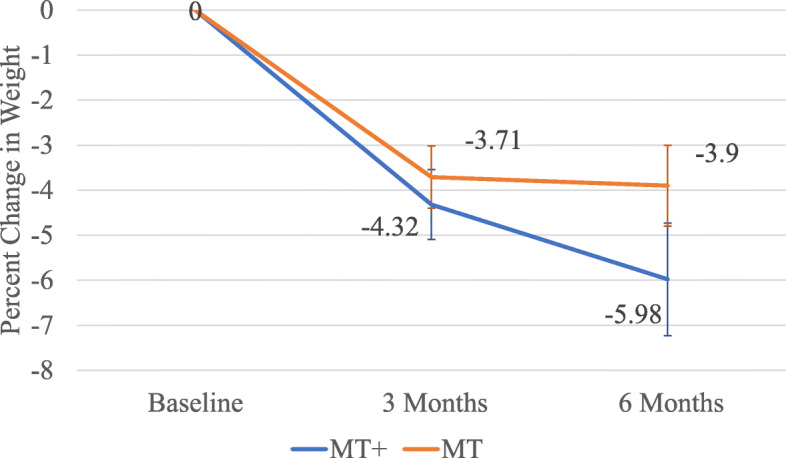
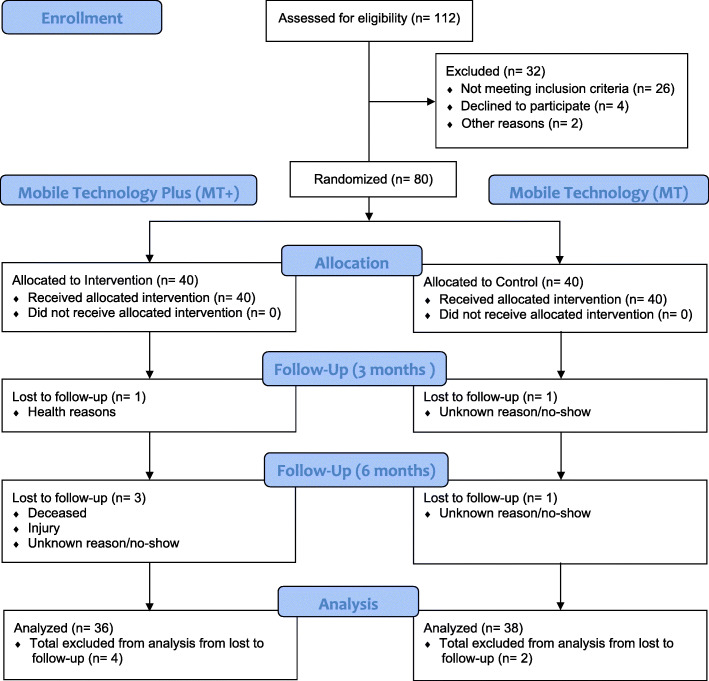
Of 80 men recruited, forty were allocated to each arm. All were included in the primary analysis. Recruitment ended after 10 months with a 97.5 and 92.5% (3 month, 6 month) retention rate. Over 90% of men reported via survey and focus groups that Lose-It app and smart scale (MT+) was an acceptable way to self-monitor weight, dietary intake and physical activity. Adherence to daily app self-monitoring of at least 800 dietary calories or more (reported respectively as MT+, MT) was positive with 73.4, 51.6% tracking at least 5 days a week. Adherence to tracking activity via recorded steps four or more days weekly was positive, 87.8, 64.6%. Men also adhered to self-weighing at least once weekly, 64, 46.3%. At 6 months, an observed mean weight loss was 7.03 kg (95% CI: 3.67, 10.39) for MT+ group and 4.14 kg (95% CI: 2.22, 6.06) for MT group, with 42.9 and 34.2% meeting ≥5% weight loss, respectively. No adverse events were reported.

CONCLUSIONS

This National Institutes of Health-funded pilot study using mobile technologies to support behavior change for weight loss was found to be feasible and acceptable among midlife and older rural men. The interventions demonstrated successful reductions in weight, noting differing adherence to lifestyle behaviors of eating, monitoring and activity between groups, with men in the MT+ having more favorable results. These findings will be used to inform the design of a larger scale, clinical trial.

TRIAL REGISTRATION

The trial was prospectively registered with ClinicalTrials NCT03329079 . 11/1/2017.

摘要

背景

解决农村社区中肥胖相关疾病和残疾高危男性的超重和肥胖问题是一个公共卫生问题。目前有许多商业智能手机应用程序(apps)可以促进减肥的自我监测,但缺乏关于增强用户参与和提高这些技术效果所需支持的证据。实际比较这些应用程序的效果,包括农村男性在使用这些应用程序时所需的支持形式,可以提高减肥干预的效果和覆盖面。本研究评估了一种移动技术应用程序在两组人群中的减肥效果。

方法

在一项两臂、实用的初步可行性研究中,将 80 名 40-69 岁超重和肥胖男性按 1:1 的比例随机分为增强型移动技术加(MT+)干预组或基本移动技术(MT)干预组。MT+组使用增强型智能手机应用程序进行自我监测(短信、讨论组、Wi-Fi 秤),而 MT 组仅使用允许自我监测记录的基本应用程序。在基线、3 个月和 6 个月时进行评估。分析应用程序日志以跟踪自我监测的参与度和依从性。通过焦点小组评估可接受性。分析包括描述性统计和定性内容分析。

结果

在招募的 80 名男性中,40 名男性被分配到每组。所有男性均被纳入主要分析。在 97.5%和 92.5%(3 个月、6 个月)的保留率下,招募于 10 个月后结束。超过 90%的男性通过调查和焦点小组报告说,Lose-It 应用程序和智能秤(MT+)是一种可以接受的自我监测体重、饮食摄入和身体活动的方式。每天至少记录 800 卡路里饮食或更多的应用程序自我监测(分别为 MT+、MT)的依从性为 73.4%,51.6%的人每周至少记录 5 天。每周至少记录 4 天的活动记录(通过记录的步骤)的依从性为 87.8%,64.6%。男性还每周至少记录一次自我称重,分别为 64%和 46.3%。在 6 个月时,MT+组的平均体重减轻了 7.03 公斤(95%CI:3.67,10.39),MT 组的平均体重减轻了 4.14 公斤(95%CI:2.22,6.06),分别有 42.9%和 34.2%的人达到了≥5%的体重减轻。没有不良事件报告。

结论

这项由美国国立卫生研究院资助的使用移动技术支持中年和老年农村男性减肥的行为改变的初步可行性研究被证明是可行和可接受的。这两种干预措施都成功地减轻了体重,注意到两组之间在饮食、监测和活动等生活方式行为上的依从性不同,MT+组的男性结果更有利。这些发现将用于为更大规模的临床试验提供信息。

试验注册

该试验前瞻性地在 ClinicalTrials.gov 上注册(NCT03329079),注册时间为 2017 年 11 月 1 日。
https://cdn.ncbi.nlm.nih.gov/pmc/blobs/9d66/8375071/b5011c718783/12889_2021_11618_Fig3_HTML.jpg
https://cdn.ncbi.nlm.nih.gov/pmc/blobs/9d66/8375071/2d093ffa658b/12889_2021_11618_Fig1_HTML.jpg
https://cdn.ncbi.nlm.nih.gov/pmc/blobs/9d66/8375071/8ee65d192734/12889_2021_11618_Fig2_HTML.jpg
https://cdn.ncbi.nlm.nih.gov/pmc/blobs/9d66/8375071/b5011c718783/12889_2021_11618_Fig3_HTML.jpg
https://cdn.ncbi.nlm.nih.gov/pmc/blobs/9d66/8375071/2d093ffa658b/12889_2021_11618_Fig1_HTML.jpg
https://cdn.ncbi.nlm.nih.gov/pmc/blobs/9d66/8375071/8ee65d192734/12889_2021_11618_Fig2_HTML.jpg
https://cdn.ncbi.nlm.nih.gov/pmc/blobs/9d66/8375071/b5011c718783/12889_2021_11618_Fig3_HTML.jpg

相似文献

1
Mobile health assisted self-monitoring is acceptable for supporting weight loss in rural men: a pragmatic randomized controlled feasibility trial.移动健康辅助自我监测可接受用于支持农村男性减肥:一项实用随机对照可行性试验。
BMC Public Health. 2021 Aug 18;21(1):1568. doi: 10.1186/s12889-021-11618-7.
2
Mobile technology intervention for weight loss in rural men: protocol for a pilot pragmatic randomised controlled trial.移动技术干预在农村男性减肥中的应用:一项基于实用随机对照试验的方案研究。
BMJ Open. 2020 Apr 14;10(4):e035089. doi: 10.1136/bmjopen-2019-035089.
3
Adherence to a smartphone application for weight loss compared to website and paper diary: pilot randomized controlled trial.与网站和纸质日记相比,使用智能手机应用程序进行减肥的依从性:试点随机对照试验。
J Med Internet Res. 2013 Apr 15;15(4):e32. doi: 10.2196/jmir.2283.
4
The Effect of a mHealth App (KENPO-app) for Specific Health Guidance on Weight Changes in Adults With Obesity and Hypertension: Pilot Randomized Controlled Trial.KENPO 应用程序(mHealth 应用程序)对特定健康指导在肥胖和高血压成年人体重变化中的影响:试点随机对照试验。
JMIR Mhealth Uhealth. 2023 Apr 12;11:e43236. doi: 10.2196/43236.
5
Comparing Self-Monitoring Strategies for Weight Loss in a Smartphone App: Randomized Controlled Trial.比较智能手机应用程序中用于减肥的自我监测策略:随机对照试验。
JMIR Mhealth Uhealth. 2019 Feb 28;7(2):e12209. doi: 10.2196/12209.
6
Mobile health (m-health) smartphone interventions for adolescents and adults with overweight or obesity.移动健康(m-health)智能手机干预措施用于超重或肥胖的青少年和成年人。
Cochrane Database Syst Rev. 2024 Feb 20;2(2):CD013591. doi: 10.1002/14651858.CD013591.pub2.
7
Effectiveness of an mHealth Intervention Combining a Smartphone App and Smart Band on Body Composition in an Overweight and Obese Population: Randomized Controlled Trial (EVIDENT 3 Study).基于智能手机应用程序和智能手环的移动医疗干预措施对超重和肥胖人群身体成分的影响:随机对照试验(EVIDENT 3 研究)
JMIR Mhealth Uhealth. 2020 Nov 26;8(11):e21771. doi: 10.2196/21771.
8
Acceptability of mHealth Technology for Self-Monitoring Eating and Activity among Rural Men.移动健康技术在农村男性自我监测饮食与活动方面的可接受性
Public Health Nurs. 2017 Mar;34(2):138-146. doi: 10.1111/phn.12297. Epub 2016 Oct 18.
9
Feasibility of a Mobile Health App for Routine Outcome Monitoring and Feedback in SMART Recovery Mutual Support Groups: Stage 1 Mixed Methods Pilot Study.适用于 SMART 康复互助组中常规结果监测和反馈的移动健康应用程序的可行性:第 1 阶段混合方法试点研究。
J Med Internet Res. 2021 Oct 6;23(10):e25217. doi: 10.2196/25217.
10
Feasibility, Usability and Acceptability of a mHealth Intervention to Reduce Cardiovascular Risk in Rural Hispanic Adults: Descriptive Study.一种移动健康干预措施降低农村西班牙裔成年人心血管风险的可行性、可用性和可接受性:描述性研究
JMIR Form Res. 2022 Dec 23;6(12):e40379. doi: 10.2196/40379.

引用本文的文献

1
Impacts of Behavioral Compliance on Weight-Loss and Metabolic Profile in a Smartphone App-Based Lifestyle Intervention or Plus Dietitian Supporting: A Randomized and Controlled Trial Among Chinese.基于智能手机应用程序的生活方式干预或加营养师支持中行为依从性对体重减轻和代谢状况的影响:一项针对中国人的随机对照试验
Phenomics. 2025 Jan 30;5(2):154-168. doi: 10.1007/s43657-024-00162-0. eCollection 2025 Apr.
2
Evaluation of the Aspects of Digital Interventions That Successfully Support Weight Loss: Systematic Review With Component Network Meta-Analysis.成功支持减肥的数字干预措施各方面评估:基于成分网络荟萃分析的系统评价
J Med Internet Res. 2025 May 22;27:e65443. doi: 10.2196/65443.
3

本文引用的文献

1
Effect of a Culturally Adapted Behavioral Intervention for Latino Adults on Weight Loss Over 2 Years: A Randomized Clinical Trial.文化适应性行为干预对拉丁裔成年人体重减轻的影响:一项随机临床试验。
JAMA Netw Open. 2020 Dec 1;3(12):e2027744. doi: 10.1001/jamanetworkopen.2020.27744.
2
Use of Technology-Based Interventions in the Treatment of Patients with Overweight and Obesity: A Systematic Review.基于技术的干预措施在超重和肥胖患者治疗中的应用:系统评价。
Nutrients. 2020 Nov 26;12(12):3634. doi: 10.3390/nu12123634.
3
Digital self-monitoring: Does adherence or association with outcomes differ by self-monitoring target?
Behavioral and Functional Adaptation to Chronic Stress in Older Adults.
老年人对慢性应激的行为和功能适应
Nurs Res. 2025;74(4):250-257. doi: 10.1097/NNR.0000000000000823. Epub 2025 Apr 2.
4
Formative Study to Inform a Physical Activity Intervention Targeted to Rural Men in the United States.一项旨在为针对美国农村男性的体育活动干预提供信息的形成性研究。
Health Sci Rep. 2025 Feb 19;8(2):e70485. doi: 10.1002/hsr2.70485. eCollection 2025 Feb.
5
Feasibility and acceptability pilot study of an online weight loss program in rural, underserved communities.农村服务不足社区在线减肥计划的可行性和可接受性试点研究。
PeerJ. 2024 Oct 3;12:e18268. doi: 10.7717/peerj.18268. eCollection 2024.
6
Acceptability of a Self-Guided Lifestyle Intervention Among Young Men: Mixed Methods Analysis of Pilot Findings.一项针对年轻男性的自我引导式生活方式干预的可接受性:试点研究结果的混合方法分析
JMIR Form Res. 2024 Apr 5;8:e53841. doi: 10.2196/53841.
7
Mobile Apps for Common Noncommunicable Disease Management: Systematic Search in App Stores and Evaluation Using the Mobile App Rating Scale.移动应用程序用于常见非传染性疾病管理:在应用商店中的系统搜索和使用移动应用程序评级量表进行评估。
JMIR Mhealth Uhealth. 2024 Mar 12;12:e49055. doi: 10.2196/49055.
8
Mobile health (m-health) smartphone interventions for adolescents and adults with overweight or obesity.移动健康(m-health)智能手机干预措施用于超重或肥胖的青少年和成年人。
Cochrane Database Syst Rev. 2024 Feb 20;2(2):CD013591. doi: 10.1002/14651858.CD013591.pub2.
9
The use of internet-based smartphone apps consistently improved consumers' healthy eating behaviors: a systematic review of randomized controlled trials.使用基于互联网的智能手机应用程序持续改善了消费者的健康饮食行为:一项随机对照试验的系统评价。
Front Digit Health. 2024 Jan 12;6:1282570. doi: 10.3389/fdgth.2024.1282570. eCollection 2024.
10
The Effectiveness of Strategies to Improve User Engagement With Digital Health Interventions Targeting Nutrition, Physical Activity, and Overweight and Obesity: Systematic Review and Meta-Analysis.策略对提高数字健康干预措施在营养、身体活动和超重肥胖方面的用户参与度的有效性:系统评价和荟萃分析。
J Med Internet Res. 2023 Dec 19;25:e47987. doi: 10.2196/47987.
数字自我监测:自我监测目标不同,其与结果的依从性或关联性是否存在差异?
Obes Sci Pract. 2019 Dec 12;6(2):126-133. doi: 10.1002/osp4.391. eCollection 2020 Apr.
4
Mobile technology intervention for weight loss in rural men: protocol for a pilot pragmatic randomised controlled trial.移动技术干预在农村男性减肥中的应用:一项基于实用随机对照试验的方案研究。
BMJ Open. 2020 Apr 14;10(4):e035089. doi: 10.1136/bmjopen-2019-035089.
5
Patterns in Weight and Physical Activity Tracking Data Preceding a Stop in Weight Monitoring: Observational Analysis.体重监测停止前体重及身体活动追踪数据的模式:观察性分析
J Med Internet Res. 2020 Mar 17;22(3):e15790. doi: 10.2196/15790.
6
Perspectives of People Who Are Overweight and Obese on Using Wearable Technology for Weight Management: Systematic Review.超重和肥胖人群对可穿戴技术用于体重管理的看法:系统评价。
JMIR Mhealth Uhealth. 2020 Jan 13;8(1):e12651. doi: 10.2196/12651.
7
Associations between self-monitoring and weight change in behavioral weight loss interventions.自我监测与行为减肥干预体重变化之间的关联。
Health Psychol. 2019 Dec;38(12):1128-1136. doi: 10.1037/hea0000800. Epub 2019 Sep 26.
8
A Focused Review of Smartphone Diet-Tracking Apps: Usability, Functionality, Coherence With Behavior Change Theory, and Comparative Validity of Nutrient Intake and Energy Estimates.智能手机饮食追踪应用程序的重点综述:可用性、功能性、与行为改变理论的一致性,以及营养素摄入和能量估计的比较有效性。
JMIR Mhealth Uhealth. 2019 May 17;7(5):e9232. doi: 10.2196/mhealth.9232.
9
Rising rural body-mass index is the main driver of the global obesity epidemic in adults.农村地区人体体重指数(BMI)的升高是导致成年人全球肥胖流行的主要驱动因素。
Nature. 2019 May;569(7755):260-264. doi: 10.1038/s41586-019-1171-x. Epub 2019 May 8.
10
Telehealth-Based Health Coaching Increases m-Health Device Adherence and Rate of Weight Loss in Obese Participants.基于远程医疗的健康指导可提高肥胖参与者对移动医疗设备的依从性和减肥率。
Telemed J E Health. 2020 Mar;26(3):365-368. doi: 10.1089/tmj.2019.0017. Epub 2019 Apr 17.