Frie Kerstin, Hartmann-Boyce Jamie, Jebb Susan, Oke Jason, Aveyard Paul
Department of Primary Care Health Sciences, University of Oxford, Oxford, United Kingdom.
J Med Internet Res. 2020 Mar 17;22(3):e15790. doi: 10.2196/15790.
Self-regulation for weight loss requires regular self-monitoring of weight, but the frequency of weight tracking commonly declines over time.
This study aimed to investigate whether it is a decline in weight loss or a drop in motivation to lose weight (using physical activity tracking as a proxy) that may be prompting a stop in weight monitoring.
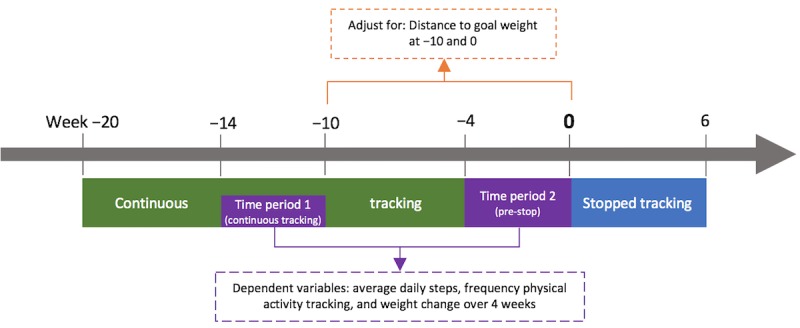
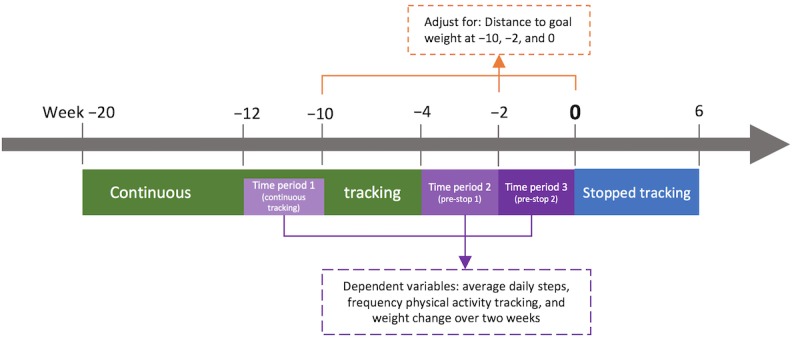
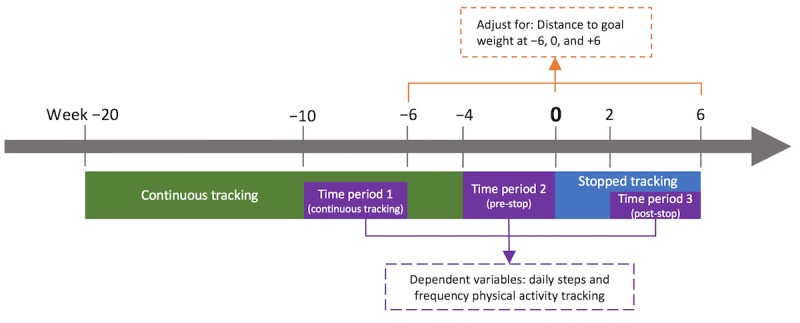
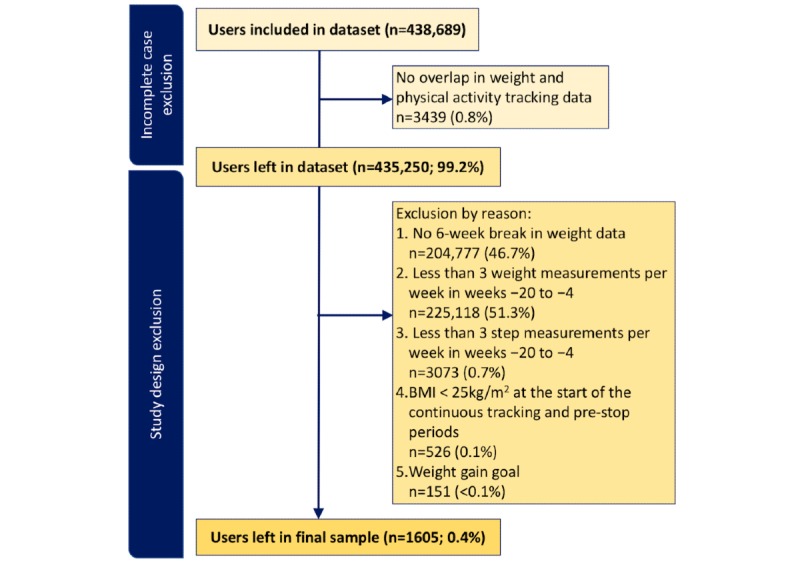
We analyzed weight and physical activity data from 1605 Withings Health Mate app users, who had set a weight loss goal and stopped tracking their weight for at least six weeks after a minimum of 16 weeks of continuous tracking. Mixed effects models compared weight change, average daily steps, and physical activity tracking frequency between a 4-week period of continuous tracking and a 4-week period preceding the stop in weight tracking. Additional mixed effects models investigated subsequent changes in physical activity data during 4 weeks of the 6-week long stop in weight tracking.
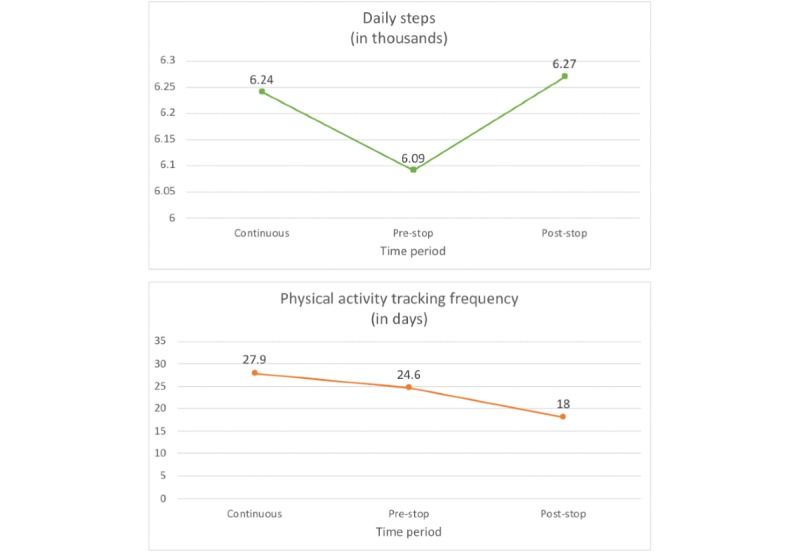
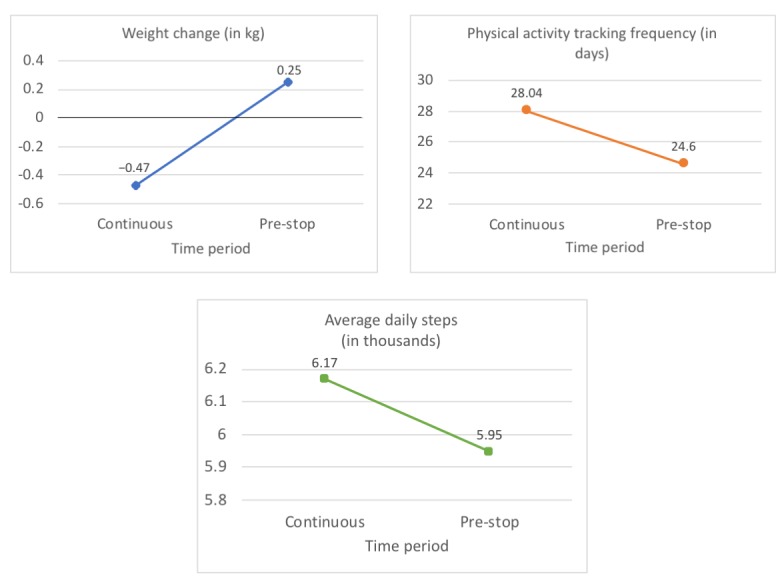
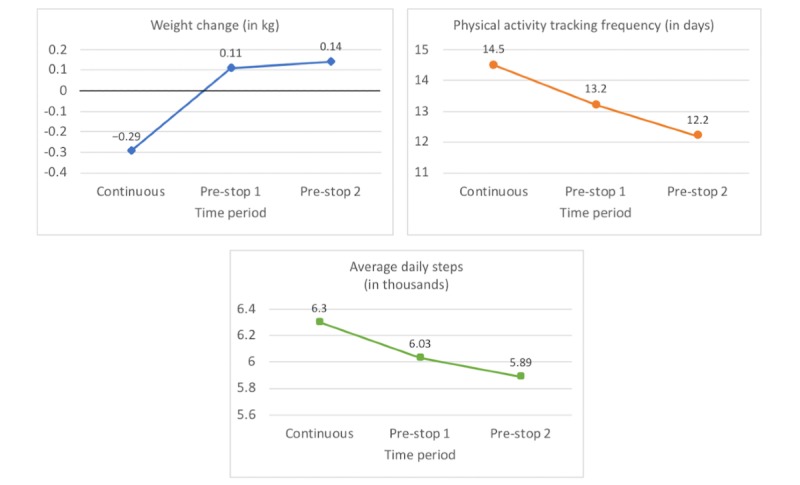
People lost weight during continuous tracking (mean -0.47 kg, SD 1.73) but gained weight preceding the stop in weight tracking (mean 0.25 kg, SD 1.62; difference 0.71 kg; 95% CI 0.60 to 0.81). Average daily steps (beta=-220 daily steps per time period; 95% CI -320 to -120) and physical activity tracking frequency (beta=-3.4 days per time period; 95% CI -3.8 to -3.1) significantly declined from the continuous tracking to the pre-stop period. From pre-stop to post-stop, physical activity tracking frequency further decreased (beta=-6.6 days per time period; 95% CI -7.12 to -6.16), whereas daily step count on the day's activity was measured increased (beta=110 daily steps per time period; 95% CI 50 to 170).
In the weeks before people stop tracking their weight, their physical activity and physical activity monitoring frequency decline. At the same time, weight increases, suggesting that declining motivation for weight control and difficulties with making use of negative weight feedback might explain why people stop tracking their weight. The increase in daily steps but decrease in physical activity tracking frequency post-stop might result from selective measurement of more active days.
体重减轻的自我调节需要定期自我监测体重,但随着时间的推移,体重追踪的频率通常会下降。
本研究旨在调查是体重减轻的下降还是减肥动机的下降(以身体活动追踪作为替代指标)可能促使体重监测停止。
我们分析了1605名Withings Health Mate应用程序用户的体重和身体活动数据,这些用户设定了减肥目标,并在至少连续追踪16周后停止追踪体重至少六周。混合效应模型比较了连续追踪的4周期间和体重追踪停止前的4周期间的体重变化、平均每日步数和身体活动追踪频率。额外的混合效应模型研究了在体重追踪停止的6周中的4周期间身体活动数据的后续变化。
人们在连续追踪期间体重减轻(平均-0.47千克,标准差1.73),但在体重追踪停止前体重增加(平均0.25千克,标准差1.62;差异0.71千克;95%置信区间0.60至0.81)。从连续追踪到停止前期间,平均每日步数(β=-220步/时间段;95%置信区间-320至-120)和身体活动追踪频率(β=-3.4天/时间段;95%置信区间-3.8至-3.1)显著下降。从停止前到停止后,身体活动追踪频率进一步降低(β=-6.6天/时间段;95%置信区间-7.12至-6.16),而在测量当天活动的每日步数增加(β=110步/时间段;95%置信区间50至170)。
在人们停止追踪体重的前几周,他们的身体活动和身体活动监测频率下降。与此同时,体重增加,这表明体重控制动机下降以及利用负体重反馈的困难可能解释了人们停止追踪体重的原因。停止后每日步数增加但身体活动追踪频率下降可能是由于对更活跃天数的选择性测量导致的。