Butryn Meghan L, Godfrey Kathryn M, Martinelli Mary K, Roberts Savannah R, Forman Evan M, Zhang Fengqing
Department of Psychology Drexel University Philadelphia PA USA.
Obes Sci Pract. 2019 Dec 12;6(2):126-133. doi: 10.1002/osp4.391. eCollection 2020 Apr.
Digital self-monitoring of eating, physical activity, and weight is increasingly prescribed in behavioural weight loss programmes. This study determined if adherence rates or associations with outcomes differed according to self-monitoring target (ie, self-monitoring of eating versus physical activity versus weight).
Participants in a 3-month, group-based weight loss programme were instructed to use an app to record food intake, wear a physical activity sensor, and use a wireless body weight scale. At post-treatment, weight loss was measured in clinic and moderate-to-vigorous physical activity (MVPA) was measured by research-grade accelerometer.
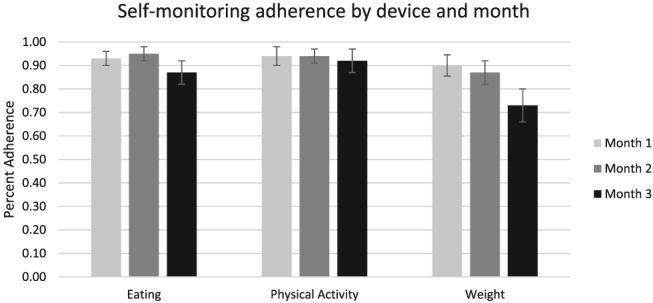
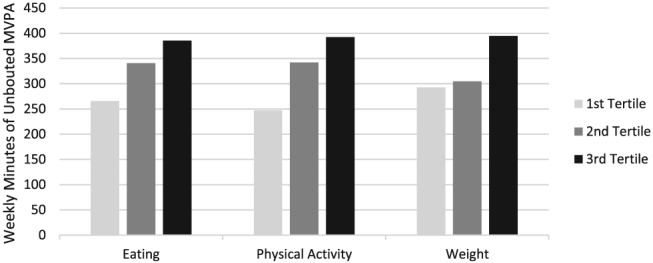
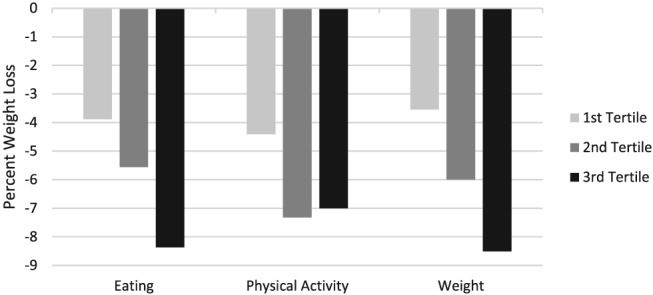
Adherence to self-monitoring decreased significantly over time for eating and weight but not physical activity. Overall, adherence to self-monitoring of weight was lower than that of eating or physical activity. Greater adherence to self-monitoring of eating, physical activity, and weight each predicted greater weight loss. Only greater adherence to self-monitoring of eating was associated with greater bouted minutes of MVPA.
Findings from this study suggest that self-monitoring should be considered a target-specific behaviour rather than a unitary construct when conceptualizing adherence and association with treatment outcomes.
在行为减肥计划中,越来越多地规定对饮食、身体活动和体重进行数字自我监测。本研究确定了依从率或与结果的关联是否因自我监测目标(即饮食自我监测与身体活动自我监测与体重自我监测)而有所不同。
参加为期3个月的基于小组的减肥计划的参与者被指示使用一款应用程序记录食物摄入量、佩戴身体活动传感器并使用无线体重秤。治疗后,在诊所测量体重减轻情况,并通过研究级加速度计测量中度至剧烈身体活动(MVPA)。
随着时间的推移,饮食和体重自我监测的依从性显著下降,但身体活动自我监测的依从性没有下降。总体而言,体重自我监测的依从性低于饮食或身体活动自我监测的依从性。对饮食、身体活动和体重自我监测的依从性越高,预测的体重减轻就越大。只有对饮食自我监测的依从性越高,与MVPA的累计分钟数越多相关。
本研究结果表明,在将依从性和与治疗结果的关联概念化时,自我监测应被视为一种特定目标的行为,而不是一个单一的概念。