Brandenburg Caitlin, Noble Christy, Wenke Rachel, Hughes Ian, Barrett Anthony, Wellwood Jeremy, Mickan Sharon
Clinical Governance, Education and Research, Gold Coast Hospital and Health Service, Southport, QLD, Australia.
Faculty of Health Sciences and Medicine, Bond University, Gold Coast, QLD, Australia.
J Multidiscip Healthc. 2021 Aug 10;14:2137-2150. doi: 10.2147/JMDH.S319191. eCollection 2021.
To describe the research capacity and culture, and research activity (publications and new projects) of medical doctors across a health service and determine if the research activity of specialty groups correlated with their self-reported "team" level research capacity and culture.
Cross-sectional, observational survey and audit of medical doctors at a tertiary health service in Queensland. The Research Capacity and Culture (RCC) validated survey was used to measure self-reported research capacity/culture at organisation, team and individual levels, and presence of barriers and facilitators to research. An audit of publications and ethically approved research projects was used to determine research activity.
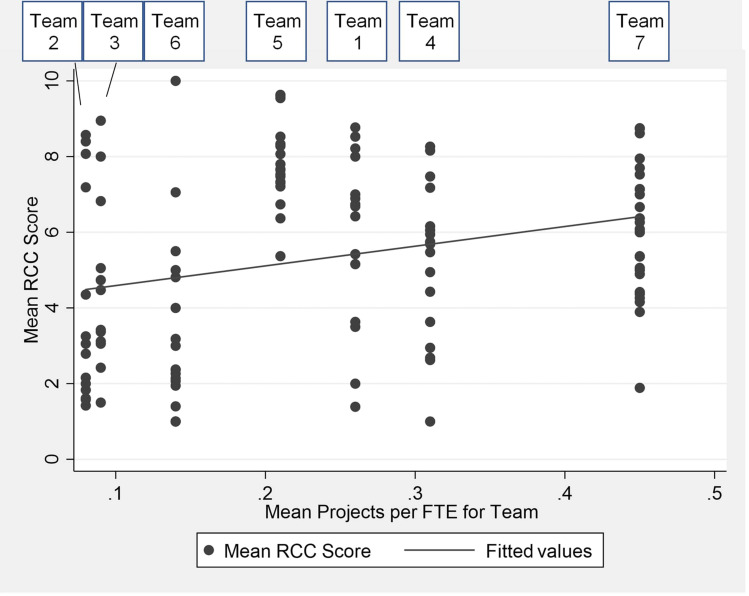
Approximately, 10% of medical doctors completed the survey (n= 124). Overall, median scores on the RCC were 5 out of 10 for organisational level, 5.5 for specialty level, and 6 for individual level capacity and culture; however, specialty-level scores varied significantly between specialty groups (range 3.1-7.8). Over 80% of participants reported lack of time and other work roles taking priority as barriers to research. One project was commenced per year for every 12.5 doctors employed in the health service, and one article was published for every 7.5. There was a positive association between a team's number of publications and projects and their self-reported research capacity and culture on the RCC. This association was stronger for publications.
Health service research capacity building interventions may need a tailored approach for different specialty teams to accommodate for varying baselines of capacity and activity. When evaluating these initiatives, a combination of research activity and subjective self-report measures may be complementary.
描述整个医疗服务体系中医师的研究能力与文化,以及研究活动(出版物和新项目),并确定专科群体的研究活动是否与其自我报告的“团队”层面研究能力和文化相关。
对昆士兰州一家三级医疗服务机构的医生进行横断面观察性调查和审核。采用经过验证的研究能力与文化(RCC)调查问卷来衡量组织、团队和个人层面自我报告的研究能力/文化,以及研究的障碍和促进因素。通过对出版物和伦理批准的研究项目进行审核来确定研究活动。
约10%的医生完成了调查(n = 124)。总体而言,RCC在组织层面的中位数得分是10分中的5分,专科层面是5.5分,个人层面的能力和文化是6分;然而,专科层面的得分在各专科群体之间差异显著(范围为3.1 - 7.8)。超过80%的参与者报告称时间不足和其他工作角色优先级更高是研究的障碍。该医疗服务机构每雇佣12.5名医生,每年启动一个项目,每7.5名医生发表一篇文章。团队的出版物和项目数量与其在RCC上自我报告的研究能力和文化之间存在正相关。这种关联在出版物方面更强。
医疗服务研究能力建设干预措施可能需要针对不同专科团队采取量身定制的方法,以适应不同的能力和活动基线。在评估这些举措时,研究活动和主观自我报告措施相结合可能具有互补性。