Wang Bin, Sun Lin, Wen Mingyun, Tan Youchun, Almalki Waleed H, Katouah Hanadi, Kazmi Imran, Afzal Obaid, Altamimi Abdulmalik Saleh Alfawaz, Al-Abbasi Fahad A, Alrobaian Majed, Alharbi Khalid S, Alenezi Sattam K, Alghaith Adel F, Beg Sarwar, Rahman Mahfoozur
Department of Oncology Minimally Invasive, The Third Affiliated Hospital of Shandong First Medical University (Affiliated Hospital of Shandong Academy of Medical Sciences), Jinan, Shandong Province 250031, China.
Department of Radiology, Binzhou People's Hospital, Binzhou, Shandong Province 256610, China.
Saudi Pharm J. 2021 Aug;29(8):843-856. doi: 10.1016/j.jsps.2021.06.006. Epub 2021 Jun 30.
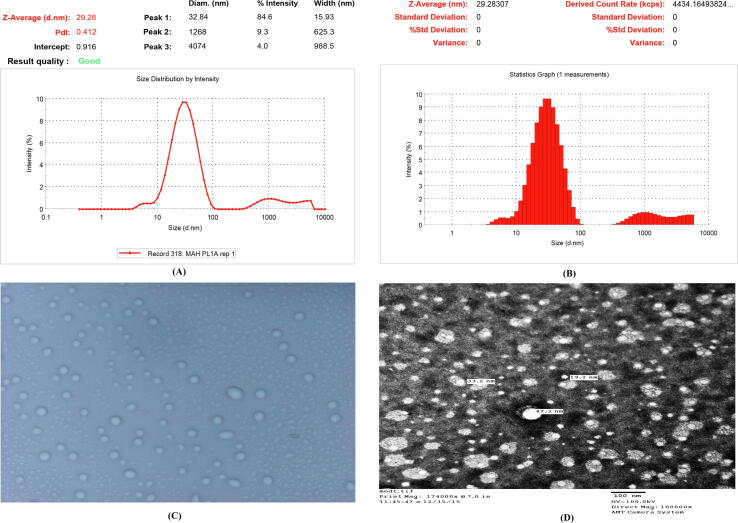
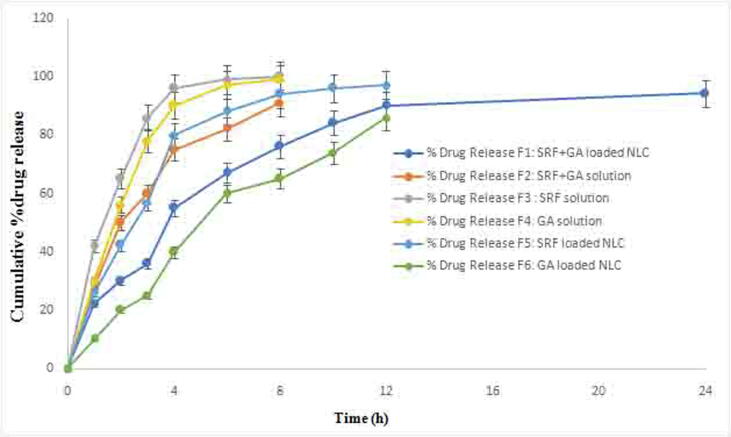
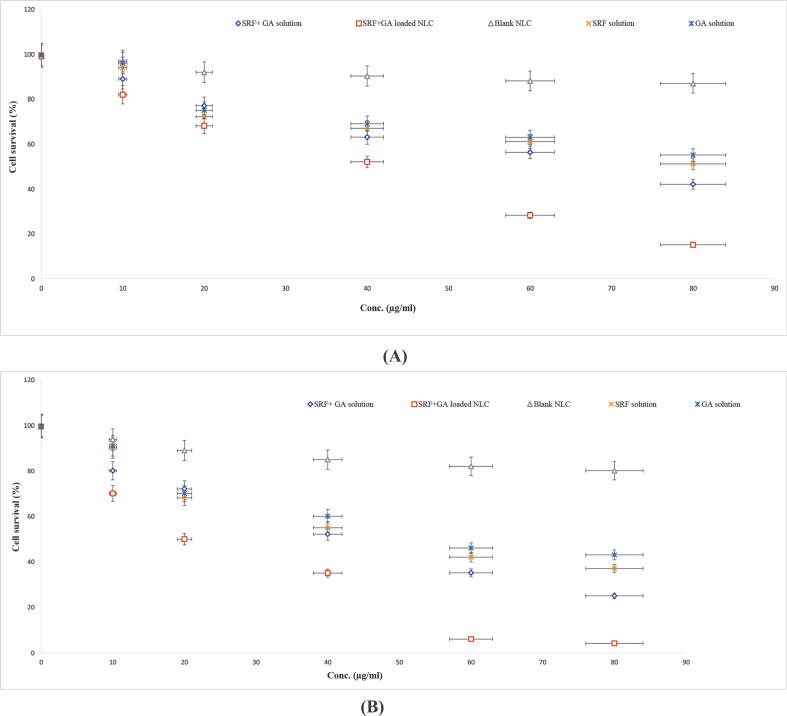
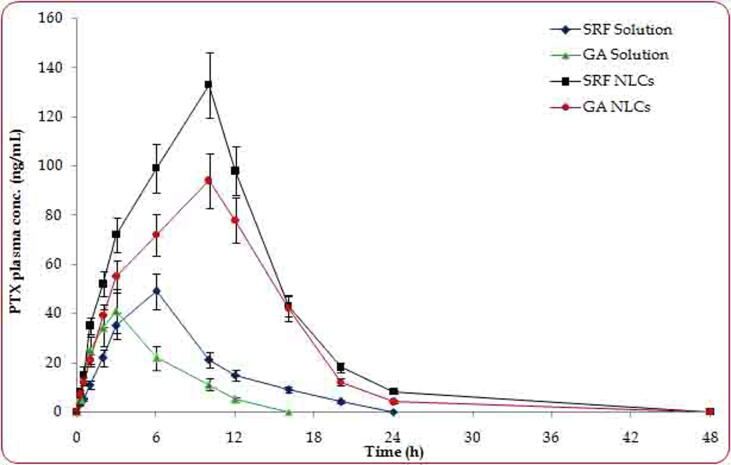
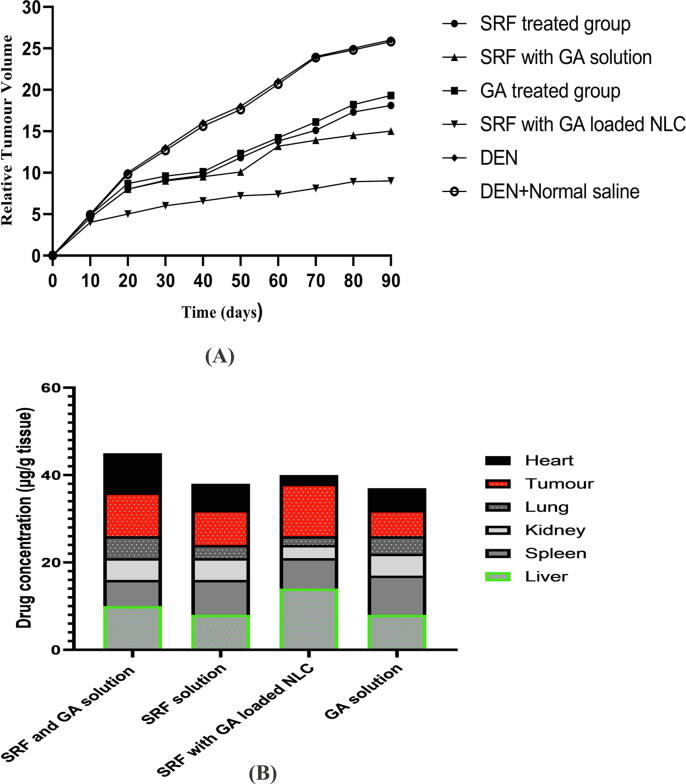
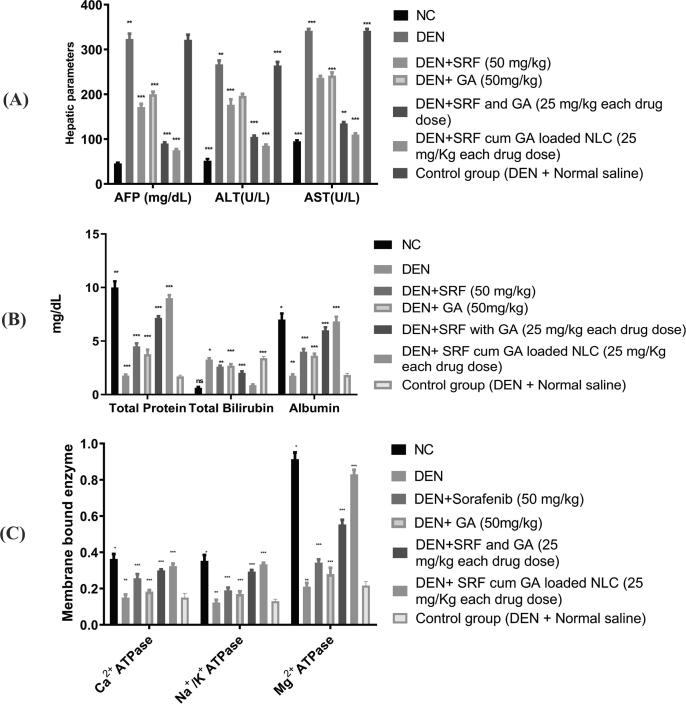
The current study focuses on the development and evaluation of nano lipidic carriers (NLCs) for codelivery of sorafenib (SRF) and ganoderic acid (GA) therapy in order to treat hepatocellular carcinoma (HCC). The dual drug-loaded NLCs were prepared by hot microemulsion technique, where SRF and GA as the drugs, Precirol ATO5, Capmul PG8 as the lipids, while Solutol HS15 and ethanol was used as surfactant and cosolvents. The optimized drug-loaded NLCs were extensively characterized through and studies. The optimized formulation had particle size 29.28 nm, entrapment efficiency 93.1%, and loading capacity 14.21%. drug release studies revealed>64% of the drug was released in the first 6 h. The enzymatic stability analysis revealed stable nature of NLCs in various gastric pH, while accelerated stability analysis at 25C/60% RH indicated the insignificant effect of studied condition on particle size, entrapment efficiency, and loading capacity of NLCs. The cytotoxicity performed on HepG2 cells indicated higher cytotoxicity of SRF and GA-loaded NLCs as compared to the free drugs (p < 0.05). Furthermore, the optimized formulation suppressed the development of hepatic nodules in the Wistar rats and significantly reduced the levels of hepatic enzymes and nonhepatic elements against DEN intoxication. The SRF and GA-loaded NLCs also showed a significant effect in suppressing the tumor growth and inflammatory cytokines in the experimental study. Further, histopathology study of rats treated SRF and GA-loaded NLCs and DEN showed absence of necrosis, apoptosis, and disorganized hepatic parenchyma, etc. over other treated groups of rats. Overall, the dual drug-loaded NLCs outperformed over the plain drugs in terms of chemoprotection, implying superior therapeutic action and most significantly eliminating the hepatic toxicity induced by DEN in Wistar rat model.
当前的研究聚焦于纳米脂质载体(NLCs)的开发与评估,以用于索拉非尼(SRF)和灵芝酸(GA)联合递送治疗肝细胞癌(HCC)。通过热微乳技术制备了载有两种药物的NLCs,其中以SRF和GA作为药物,Precirol ATO5、Capmul PG8作为脂质,而Solutol HS15和乙醇用作表面活性剂和助溶剂。通过[具体研究方法1]和[具体研究方法2]研究对优化后的载药NLCs进行了全面表征。优化后的制剂粒径为29.28 nm,包封率为93.1%,载药量为14.21%。[药物释放研究方法]表明,在最初6小时内超过64%的药物被释放。酶稳定性分析显示NLCs在不同的胃液pH值下性质稳定,而在25℃/60%相对湿度下的加速稳定性分析表明,所研究的条件对NLCs的粒径、包封率和载药量影响不显著。对HepG2细胞进行的细胞毒性试验表明,与游离药物相比,载有SRF和GA的NLCs具有更高的细胞毒性(p < 0.05)。此外,优化后的制剂抑制了Wistar大鼠肝结节的形成,并显著降低了针对二乙基亚硝胺(DEN)中毒的肝酶和非肝脏元素水平。在实验研究中,载有SRF和GA的NLCs在抑制肿瘤生长和炎性细胞因子方面也显示出显著效果。此外,对接受载有SRF和GA的NLCs及DEN治疗的大鼠进行的组织病理学研究表明,与其他治疗组大鼠相比,不存在坏死、凋亡和肝实质紊乱等情况。总体而言,在化学保护方面,载有两种药物的NLCs优于普通药物,这意味着其具有卓越的治疗作用,并且最显著地消除了Wistar大鼠模型中由DEN诱导的肝毒性。