Atkinson Charlotte, Ganeshan Balaji, Endozo Raymond, Wan Simon, Aldridge Matthew D, Groves Ashley M, Bomanji Jamshed B, Gaze Mark N
Departments of Oncology and Nuclear Medicine, University College London Hospitals NHS Foundation Trust, London, United Kingdom.
Institute of Nuclear Medicine, University College London, London, United Kingdom.
Front Oncol. 2021 Aug 2;11:686235. doi: 10.3389/fonc.2021.686235. eCollection 2021.
Neuroendocrine tumors (NET) are rare cancers with variable behavior. A better understanding of prognosis would aid individualized management. The aim of this hypothesis-generating pilot study was to investigate the prognostic potential of tumor heterogeneity and tracer avidity in NET using texture analysis (TA) of Ga-DOTATATE positron emission tomography (PET) and non-enhanced computed tomography (CT) performed at baseline in patients treated with Lu-DOTATATE. It aims to justify a larger-scale study to evaluate its clinical value.
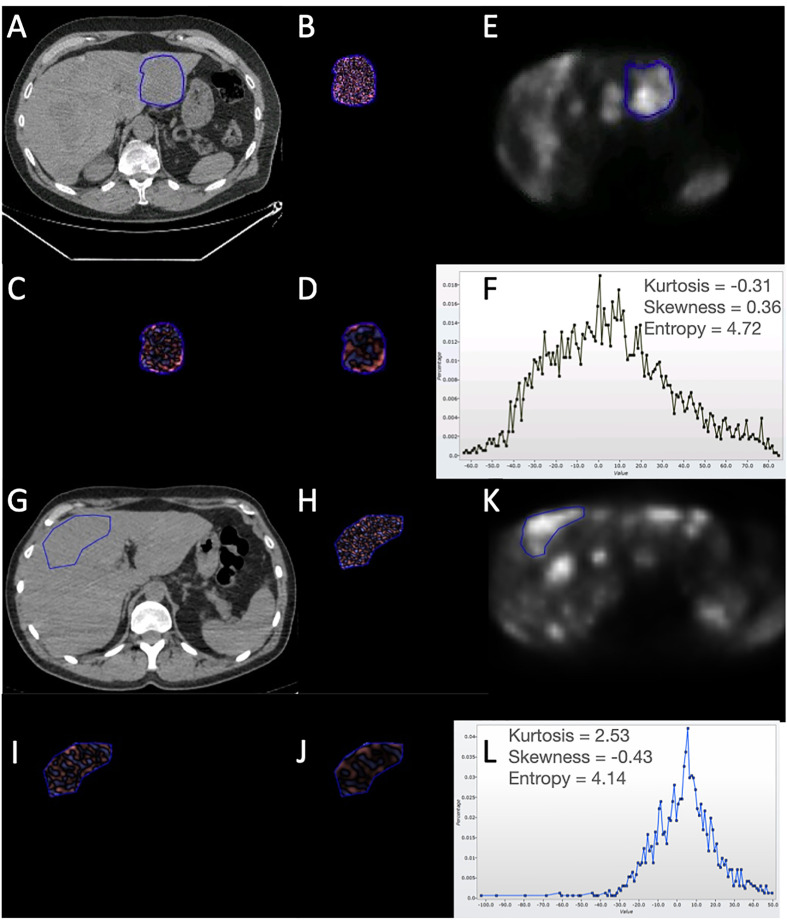
The pretherapy Ga-DOTATATE PET-CT scans of 44 patients with metastatic NET (carcinoid, pancreatic, thyroid, head and neck, catecholamine-secreting, and unknown primary NET) treated with Lu-DOTATATE were analyzed retrospectively using commercially available texture analysis research software. Image filtration extracted and enhanced objects of different sizes (fine, medium, coarse), then quantified heterogeneity by statistical and histogram-based parameters (mean intensity, standard deviation, entropy, mean of positive pixels, skewness, and kurtosis). Regions of interest were manually drawn around up to five of the most Ga-DOTATATE avid lesions for each patient. Gallium uptake on PET was quantified as SUV and SUV. Associations between imaging and clinical markers with progression-free (PFS) and overall survival (OS) were assessed using univariate Kaplan-Meier analysis. Independence of the significant univariate markers of survival was tested using multivariate Cox regression analysis.
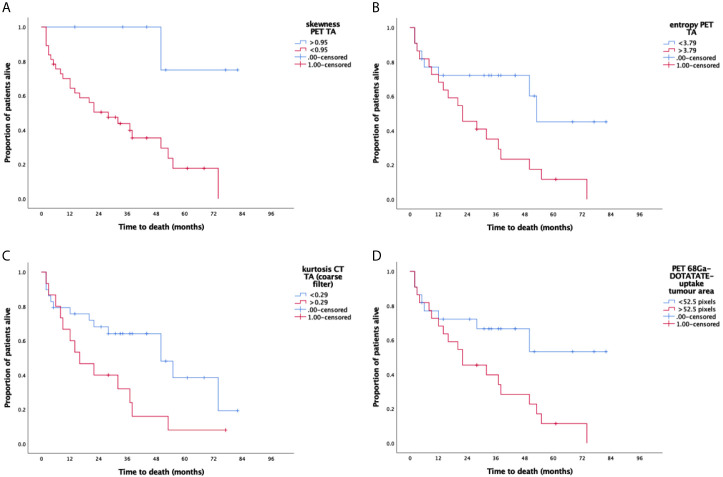
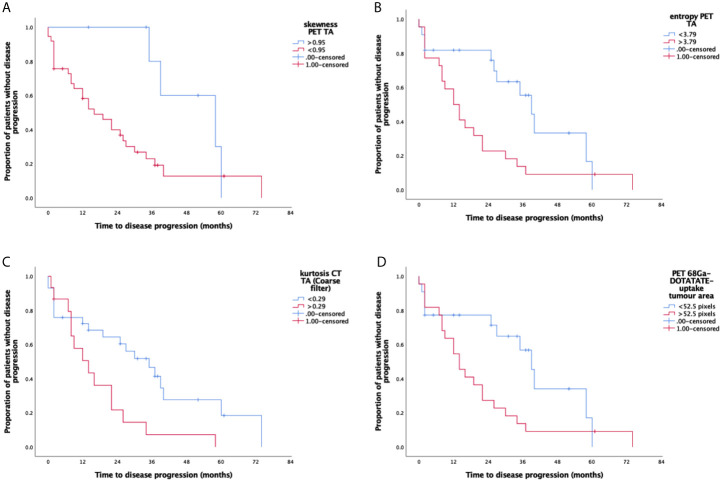
Measures of heterogeneity (higher kurtosis, higher entropy, and lower skewness) on coarse-texture scale CT and unfiltered PET images predicted shorter PFS (CT coarse kurtosis: p=0.05, PET entropy: p=0.01, PET skewness: p=0.03) and shorter OS (CT coarse kurtosis: p=0.05, PET entropy: p=0.01, PET skewness p=0.02). Conventional PET parameters such as SUV and SUV showed trends towards predicting outcome but were not statistically significant. Multivariate analysis identified that CT-TA (coarse kurtosis: HR=2.57, 95% CI=1.22-5.38, p=0.013) independently predicted PFS, and PET-TA (unfiltered skewness: HR=9.05, 95% CI=1.19-68.91, p=0.033) independently predicted OS.
These preliminary data generate a hypothesis that radiomic analysis of neuroendocrine cancer on Ga-DOTATATE PET-CT may be of prognostic value and a valuable addition to the assessment of patients.
神经内分泌肿瘤(NET)是一种行为各异的罕见癌症。更好地了解其预后将有助于个体化管理。本探索性初步研究的目的是通过对接受镥[¹⁷⁷Lu] DOTATATE治疗患者基线时进行的镓[⁶⁸Ga] DOTATATE正电子发射断层扫描(PET)和非增强计算机断层扫描(CT)进行纹理分析(TA),研究NET中肿瘤异质性和示踪剂摄取的预后潜力。其目的是为一项评估其临床价值的大规模研究提供依据。
回顾性分析44例接受镥[¹⁷⁷Lu] DOTATATE治疗的转移性NET(类癌、胰腺、甲状腺、头颈部、分泌儿茶酚胺的肿瘤以及原发灶不明的NET)患者的治疗前镓[⁶⁸Ga] DOTATATE PET-CT扫描图像,使用商用纹理分析研究软件进行分析。图像滤波提取并增强不同大小(精细、中等、粗糙)的物体,然后通过基于统计和直方图的参数(平均强度、标准差、熵、阳性像素均值、偏度和峰度)量化异质性。为每位患者在最多五个镓[⁶⁸Ga] DOTATATE摄取最高的病灶周围手动绘制感兴趣区域。PET上的镓摄取量以SUV和SUVmax进行量化。使用单变量Kaplan-Meier分析评估成像和临床标志物与无进展生存期(PFS)和总生存期(OS)之间的关联。使用多变量Cox回归分析检验生存的显著单变量标志物的独立性。
在粗糙纹理尺度CT和未滤波PET图像上的异质性测量值(较高的峰度、较高的熵和较低的偏度)预测较短的PFS(CT粗糙峰度:p=0.05,PET熵:p=0.01,PET偏度:p=0.03)和较短的OS(CT粗糙峰度:p=0.05,PET熵:p=0.01,PET偏度p=0.02)。传统PET参数如SUV和SUVmax显示出预测预后的趋势,但无统计学意义。多变量分析确定CT-TA(粗糙峰度:HR=2.57,95%CI=1.22-5.38,p=0.013)独立预测PFS,PET-TA(未滤波偏度:HR=9.05,95%CI=1.19-68.91,p=0.033)独立预测OS。
这些初步数据提出了一个假设,即对镓[⁶⁸Ga] DOTATATE PET-CT上的神经内分泌癌进行放射组学分析可能具有预后价值,是对患者评估的有价值补充。