Faculty of Medicine and University Hospital, Heidelberg Institute of Global Health, Heidelberg University, Im Neuenheimer Feld 130.3, 69120, Heidelberg, Germany.
Institute of Social Medicine, Epidemiology and Health Economics, Charité-Universitätsmedizin Berlin, corporate member of Freie Universität Berlin and Humboldt-Universität zu Berlin, Berlin, Germany.
AIDS Behav. 2022 Mar;26(3):728-738. doi: 10.1007/s10461-021-03432-4. Epub 2021 Aug 18.
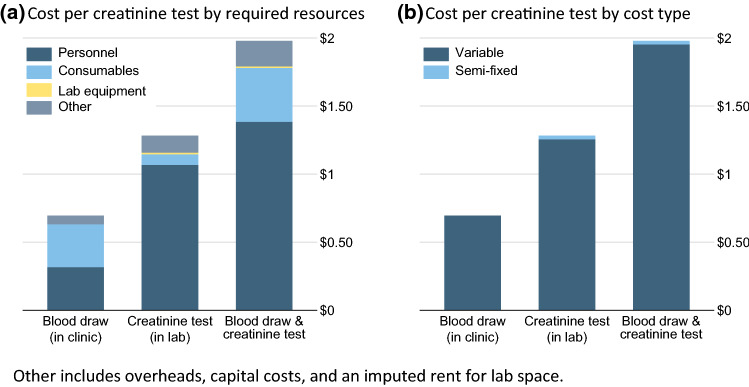
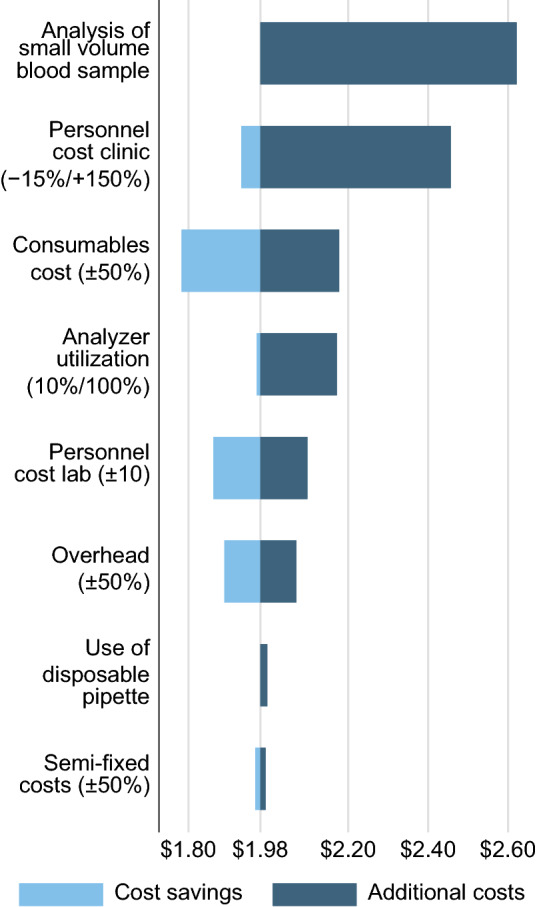
HIV treatment and prevention as well as other chronic disease care can require regular kidney function assessment based on a creatinine test. To assess the costs of creatinine testing in a public health care system, we conducted activity-based costing during a HIV pre-exposure prophylaxis (PrEP) demonstration project in the Hhohho region of Eswatini. Resource use was assessed by a laboratory technician and valued with government procurement prices, public sector salaries, and own cost estimates. Obtaining a blood sample in a clinic and performing a creatinine test in a high-throughput referral laboratory (> 660,000 blood tests, including > 120,000 creatinine tests, in 2018) were estimated to have cost, on average, $1.98 in 2018. Per test, $1.95 were variable costs ($1.38 personnel, ¢39 consumables, and ¢18 other costs) and ¢2.6 were allocated semi-fixed costs (¢1.1 laboratory equipment, ¢0.85 other, ¢0.45 consumables, and ¢1.3 personnel costs). Simulating different utilization of the laboratory indicated that semi-fixed costs of the laboratory (e.g., equipment purchase or daily calibration of the chemistry analyzer) contributed less than variable costs (e.g., per-test personnel time and test reagents) to the average creatinine test cost when certain minimum test numbers can be maintained. Our findings suggest, first, lower creatinine testing costs than previously used in cost and cost-effectiveness analyses of HIV services and, second, that investment in laboratory equipment imposed a relatively small additional cost on each performed test in the high-throughput referral laboratory.
艾滋病毒治疗和预防以及其他慢性病护理可能需要根据肌酐测试定期评估肾脏功能。为了评估公共医疗保健系统中肌酐检测的成本,我们在斯威士兰霍霍霍地区进行了艾滋病毒暴露前预防(PrEP)示范项目的基于活动的成本核算。资源利用由实验室技术员评估,并根据政府采购价格、公共部门工资和自有成本估算进行估值。在诊所获取血样并在高通量转诊实验室进行肌酐测试(2018 年进行了超过 66 万次血液测试,包括超过 12 万次肌酐测试),平均估计在 2018 年的成本为 1.98 美元。每次测试的可变成本为 1.95 美元(1.38 美元人员成本、39 美分耗材成本和 18 美分其他成本),半固定成本为 2.6 美分(1.1 美元实验室设备成本、0.85 美元其他成本、0.45 美元耗材成本和 1.3 美元人员成本)。模拟实验室的不同利用情况表明,当可以维持一定数量的最低测试时,实验室的半固定成本(例如,设备购买或化学分析仪的日常校准)对平均肌酐测试成本的贡献小于可变成本(例如,每次测试的人员时间和测试试剂)。我们的研究结果表明,首先,肌酐检测成本低于以前在艾滋病毒服务的成本和成本效益分析中使用的成本,其次,在高通量转诊实验室中,对实验室设备的投资对每次进行的测试增加的相对成本较小。