Department of Population Health Sciences, University of Bristol, Bristol, UK
National Institute for Health Research, Health Protection Research Unit (NIHR HPRU) in Behavioural Science and Evaluation, Bristol, UK.
Sex Transm Infect. 2021 Nov;97(7):507-513. doi: 10.1136/sextrans-2020-054588. Epub 2021 Aug 19.
Due to rising numbers of STI diagnosis and increasing prevalence of antimicrobial resistance, we explored trends in STI testing frequency and diagnoses, alongside sexual decision making and attitudes concerning condom use and HIV pre-exposure prophylaxis (PrEP) at a large urban UK sexual health clinic.
We examined 66 528 electronic patient records covering 40 321 attendees between 2016 and 2019, 3977 of whom were men who have sex with men or trans persons who have sex with men (MSM/TPSM). We also explored responses from MSM/TPSM attendees sent an electronic questionnaire between November 2018 and 2019 (n=1975) examining behaviours/attitudes towards PrEP. We measured trends in STI diagnoses and sexual behaviours including condomless anal intercourse (CAI), using linear and logistic regression analyses.
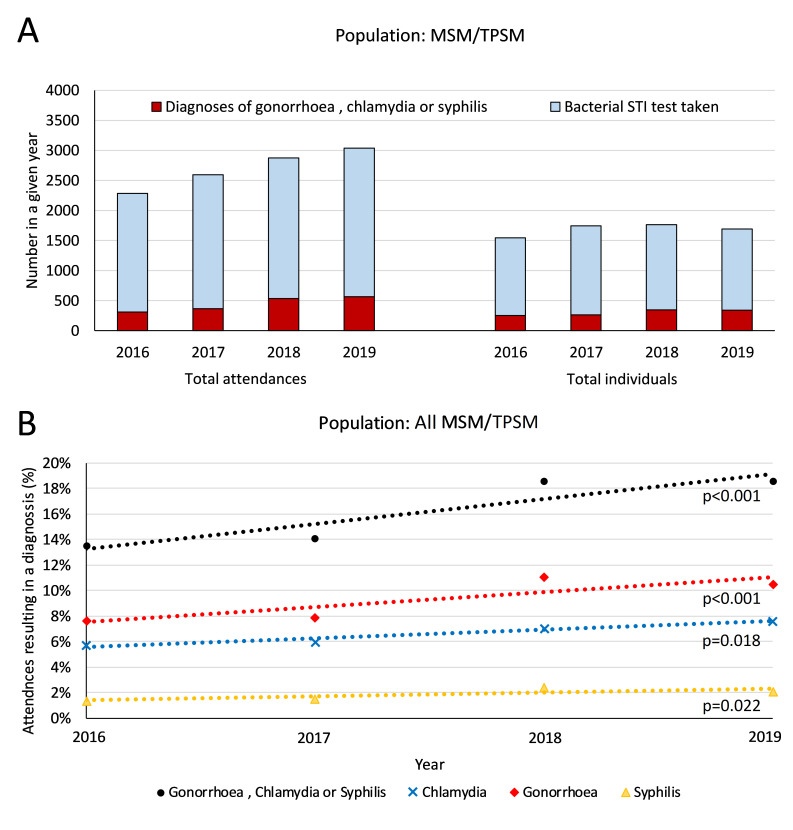
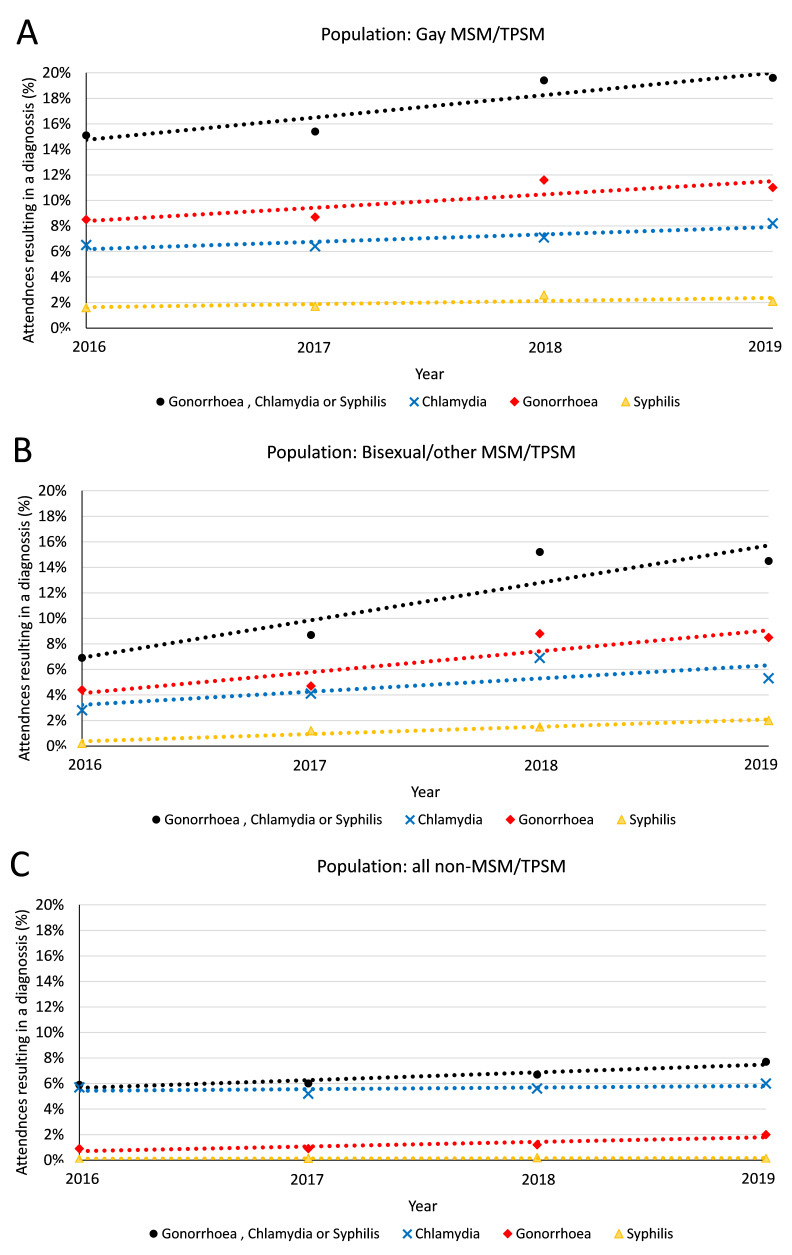
Tests resulting in gonorrhoea, chlamydia or syphilis diagnoses increased among MSM/TPSM from 13.5% to 18.5% between 2016 and 2019 (p<0.001). The average MSM/TPSM STI testing frequency increased from 1.5/person/year to 2.1/person/year (p=0.017). Gay MSM/TPSM had the highest proportions of attendances resulting in diagnoses, increasing from 15.1% to 19.6% between 2016 and 2019 (p<0.001) compared with bisexual/other MSM/TPSM increasing from 6.9% to 14.5% (p<0.001), alongside smaller but significant increases in non-MSM/TPSM from 5.9% to 7.7% (p<0.001).The proportion of MSM/TPSM clinic attendees reporting CAI in the previous 3 months prior to at least one appointment in a given year increased significantly from 40.6% to 45.5% between 2016 and 2019 (p<0.0001) and average number of partners from 3.8 to 4.5 (p=0.002). Of 617 eligible questionnaire responses, 339/578 (58.7%) HIV-negative and 29/39 (74.4%) HIV-positive MSM/TPSM indicated they would be more likely to have CAI with someone on PrEP versus not on PrEP. 358/578 (61.9%) HIV-negative respondents said that PrEP use would make them more likely to have CAI with HIV-negative partners.
Rising numbers of STI diagnoses among MSM/TPSM are not attributable to increased testing alone. Increased CAI and number of partners may be attributable to evolving sexual decision making among PrEP users and their partners. Proportionally, bisexual/other MSM/TPSM have the steepest increase in STI diagnoses.
由于性传播感染 (STI) 的诊断数量不断增加和抗生素耐药性的不断增加,我们在一家大型城市英国性健康诊所探索了 STI 检测频率和诊断的趋势,以及与避孕套使用和 HIV 暴露前预防 (PrEP) 相关的性行为决策和态度。
我们检查了 2016 年至 2019 年间覆盖 40321 名就诊者的 66528 份电子患者记录,其中 3977 名为男男性行为者或跨性别者与男性发生性行为者(MSM/TPSM)。我们还探索了 2018 年 11 月至 2019 年间向 MSM/TPSM 就诊者发送的电子问卷的回复(n=1975),调查了他们对 PrEP 的行为/态度。我们使用线性和逻辑回归分析测量了 STI 诊断和性行为的趋势,包括无保护肛交 (CAI)。
2016 年至 2019 年间,MSM/TPSM 的淋病、衣原体或梅毒诊断检测结果从 13.5%增加到 18.5%(p<0.001)。MSM/TPSM 的平均 STI 检测频率从每人每年 1.5 次增加到每人每年 2.1 次(p=0.017)。男同性恋 MSM/TPSM 的就诊者中,诊断比例最高,从 2016 年的 15.1%增加到 2019 年的 19.6%(p<0.001),相比之下,双性恋/其他 MSM/TPSM 从 6.9%增加到 14.5%(p<0.001),非 MSM/TPSM 也有显著但较小的增加,从 5.9%增加到 7.7%(p<0.001)。在给定年份中至少有一次就诊的 MSM/TPSM 就诊者中,报告在过去 3 个月内有 CAI 的比例从 2016 年的 40.6%显著增加到 2019 年的 45.5%(p<0.0001),平均伴侣数量从 3.8 增加到 4.5(p=0.002)。在 617 份符合条件的问卷回复中,339/578(58.7%)HIV 阴性和 29/39(74.4%)HIV 阳性的 MSM/TPSM 表示他们更有可能与正在接受 PrEP 的人而不是未接受 PrEP 的人发生 CAI。358/578(61.9%)HIV 阴性的受访者表示,PrEP 的使用将使他们更有可能与 HIV 阴性伴侣发生 CAI。
MSM/TPSM 中 STI 诊断数量的增加不仅仅归因于检测次数的增加。CAI 和伴侣数量的增加可能归因于 PrEP 用户及其伴侣中性行为决策的演变。相对而言,双性恋/其他 MSM/TPSM 的 STI 诊断增加比例最大。