Akkuş Koray, Peker Mehmet
Department of Psychology, Ege University, Bornova, 35030 Izmir, Turkey.
Cognit Ther Res. 2022;46(2):287-301. doi: 10.1007/s10608-021-10262-0. Epub 2021 Aug 14.
This study aimed to investigate the relationship between interpersonal emotion regulation (IER) and social anxiety symptoms and the mediating role of negative mood regulation expectancies (NMRE). We hypothesised that IER is positively associated with social anxiety symptoms, controlling for depression and intrapersonal emotion regulation strategies of suppression and reappraisal, and NMRE mediate this relationship.
Study 1 was conducted with a student sample ( = 400) and Study 2 included a community sample with 271 participants.
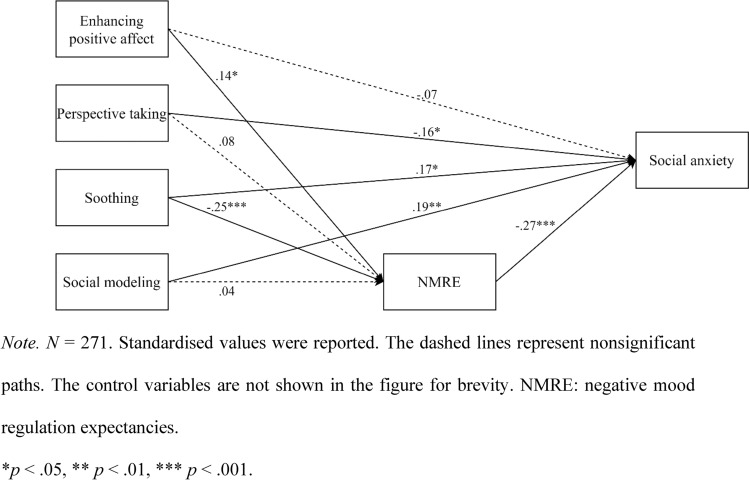
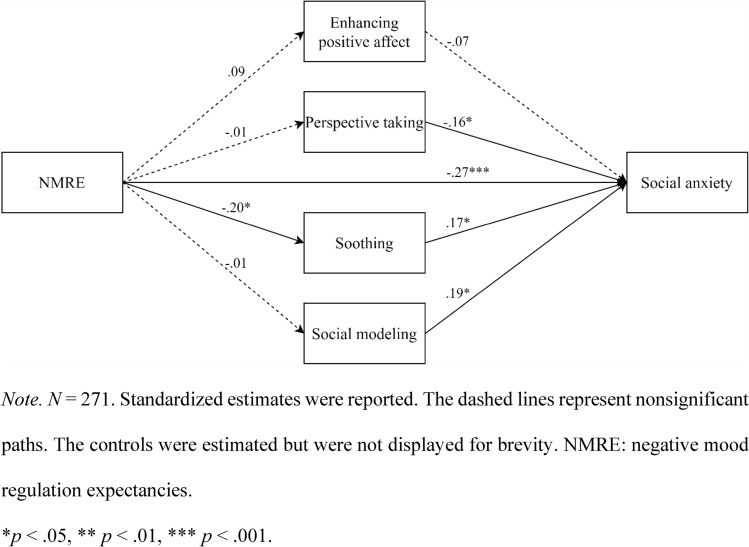
Study 1 showed that, of four IER strategies, soothing and social modeling were positively, and perspective-taking was negatively related to social anxiety symptoms controlling for depression, suppression and reappraisal. Study 2 replicated these findings and extended them by showing the mediated relationship between the two IER strategies (i.e. enhancing positive affect and soothing) and social anxiety symptoms through NMRE.
The results contribute to the limited research on IER by portraying its relationship with social anxiety symptoms and revealing the mediating role of NMRE in this relationship.
本研究旨在探讨人际情绪调节(IER)与社交焦虑症状之间的关系以及负面情绪调节预期(NMRE)的中介作用。我们假设,在控制抑郁以及抑制和重新评价等个体内情绪调节策略的情况下,IER与社交焦虑症状呈正相关,且NMRE介导这种关系。
研究1以学生样本(n = 400)进行,研究2纳入了271名参与者的社区样本。
研究1表明,在四种IER策略中,安抚和社交示范与社交焦虑症状呈正相关,而换位思考在控制抑郁、抑制和重新评价的情况下与社交焦虑症状呈负相关。研究2重复了这些发现,并通过NMRE揭示了两种IER策略(即增强积极情绪和安抚)与社交焦虑症状之间的中介关系,从而扩展了这些发现。
这些结果通过描绘IER与社交焦虑症状之间的关系,并揭示NMRE在这种关系中的中介作用,为IER方面有限的研究做出了贡献。