Clinical Research Department, Africa Health Research Institute, Somkhele, South Africa.
Institute for Global Health, University College London, London, United Kingdom.
Front Public Health. 2021 Aug 3;9:652887. doi: 10.3389/fpubh.2021.652887. eCollection 2021.
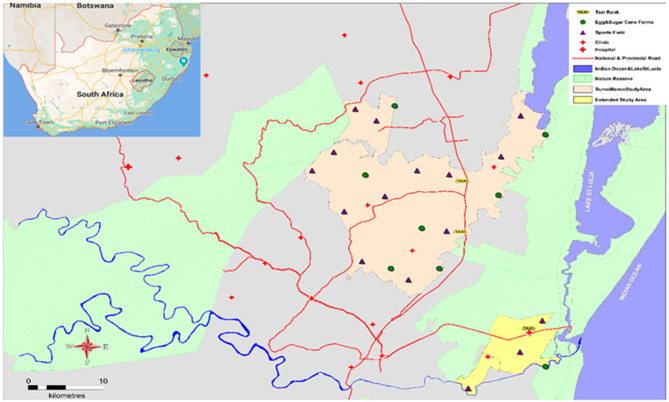
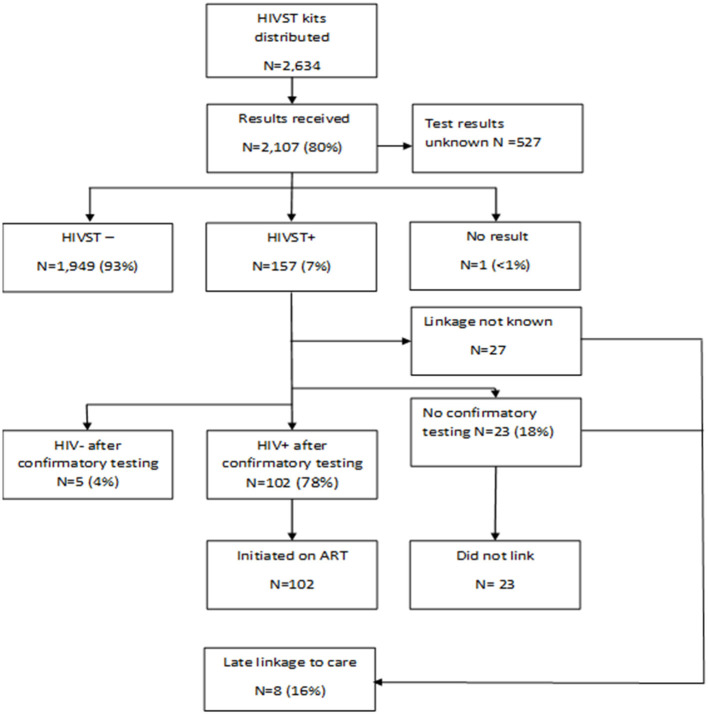
KwaZulu-Natal, South Africa has one of the highest HIV prevalence rates globally. Persons <35 years and men have lower rates of HIV testing. HIV self-testing (HIVST) may overcome many barriers of facility-based HIV testing in order to identify HIV positive young persons and men and link them to care. We investigated whether HIVST distribution was a feasible approach to reach men and assessed the proportion of participants who reported their HIVST results, tested positive and linked to care. Teams comprised of a nurse, clinic research assistant, and recruiters distributed HIVST kits in rural uMkhanyakude, KwaZulu-Natal from August-November 2018 with a focus on testing men. Workplaces (farms), social venues, taxi ranks, and homesteads were used as HIVST kit distribution points following community sensitisation through community advisory boards and community leaders. HIVST kits, demonstration of use, and small incentives to report testing outcomes were provided. The Department of Health provided confirmatory testing and HIV care at clinics. Over 11 weeks in late 2018, we distributed 2,634 HIVST kits of which 2,113 (80%) were distributed to persons aged <35 years, 2,591 (98%) to men and 356 (14%) to first time testers. Of the HIVST distributed, 2,107 (80%) reported their results to the study team, and 157 (7%) tested positive. Of persons who tested positive, 107/130 (82%) reported having a confirmatory test of which 102/107 (95%) were positive and initiated on ART. No emergencies or social harms were reported. Large scale distribution of HIVST kits targeting men in rural KwaZulu-Natal is feasible and highly effective in reaching men, including those who had not previously tested for HIV. While two-thirds of persons who tested HIV positive initiated ART, additional linkage strategies are needed for those who do not link after HIVST. HIVST should be used as a tool to reach men in order to achieve 95% coverage in the UNAIDS testing and care cascade in KwaZulu-Natal.
南非夸祖鲁-纳塔尔省的艾滋病毒感染率位居全球前列。35 岁以下人群和男性接受艾滋病毒检测的比例较低。艾滋病毒自我检测(HIVST)可以克服许多基于机构的艾滋病毒检测的障碍,以发现艾滋病毒阳性的年轻人和男性,并将他们与护理联系起来。我们调查了 HIVST 分发是否是一种可行的方法,以接触男性,并评估报告其 HIVST 结果、检测呈阳性并与护理联系的参与者的比例。
2018 年 8 月至 11 月,由一名护士、诊所研究助理和招募人员组成的团队在夸祖鲁-纳塔尔省农村的乌姆坎加库德地区分发了 HIVST 试剂盒,重点是检测男性。在通过社区咨询委员会和社区领导进行社区宣传之后,工作场所(农场)、社交场所、出租车车站和家园被用作 HIVST 试剂盒分发点。提供了 HIVST 试剂盒、使用演示以及报告检测结果的小奖励。卫生部在诊所提供确认检测和艾滋病毒护理。
在 2018 年末的 11 周内,我们分发了 2634 个 HIVST 试剂盒,其中 2113 个(80%)分发给 35 岁以下人群,2591 个(98%)分发给男性,356 个(14%)分发给首次测试者。在分发的 HIVST 中,2107 个(80%)向研究小组报告了结果,157 个(7%)检测呈阳性。在检测呈阳性的人中,有 107/130 人(82%)报告了确证检测,其中 102/107 人(95%)呈阳性并开始接受抗逆转录病毒治疗。没有报告紧急情况或社会危害。
在夸祖鲁-纳塔尔省农村地区大规模分发针对男性的 HIVST 试剂盒是可行的,并且非常有效地接触到男性,包括那些以前没有接受过艾滋病毒检测的男性。虽然三分之二的 HIV 阳性检测者开始接受抗逆转录病毒治疗,但对于那些 HIVST 后未联系的人,需要采取额外的联系策略。HIVST 应该作为一种工具,用于接触男性,以实现夸祖鲁-纳塔尔省艾滋病规划署检测和护理级联中的 95%覆盖率。